AndrA(c)s Luque-Ayala – författare
891 kr
Läs direkt efter köp
891 kr
Läs direkt efter köp
824 kr
Läs direkt efter köp
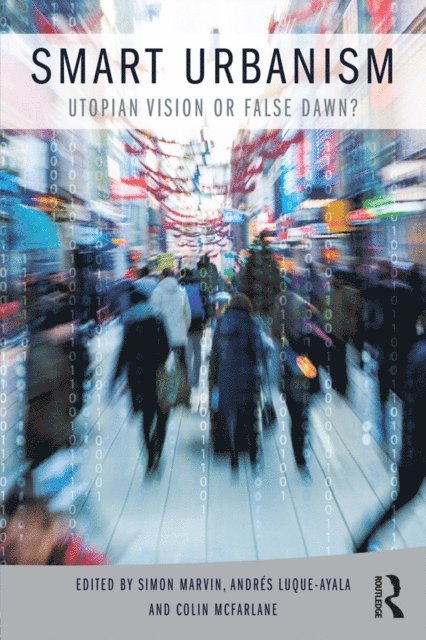
Smart Urbanism (SU) – the rebuilding of cities through the integration of digital technologies with buildings, neighbourhoods, networked infrastructures and people – is being represented as a unique emerging ‘solution’ to the majority of problems faced by cities today. SU discourses, enacted by technology companies, national governments and supranational agencies alike, claim a supremacy of urban digital technologies for managing and controlling infrastructures, achieving greater effectiveness in managing service demand and reducing carbon emissions, developing greater social interaction and community networks, providing new services around health and social care etc. Smart urbanism is being represented as the response to almost every facet of the contemporary urban question.
This book explores this common conception of the problematic of smart urbanism and critically address what new capabilities are being created by whom and with what exclusions; how these are being developed - and contested; where is this happening both within and between cities; and, with what sorts of social and material consequences. The aim of the book is to identify and convene a currently fragmented and disconnected group of researchers, commentators, developers and users from both within and outside the mainstream SU discourse, including several of those that adopt a more critical perspective, to assess ‘what’ problems of the city smartness can address.
The volume provides the first internationally comparative assessment of SU in cities of the global north and south, critically evaluates whether current visions of SU are able to achieve their potential; and then identifies alternative trajectories for SU that hold radical promise for reshaping cities.
824 kr
Läs direkt efter köp
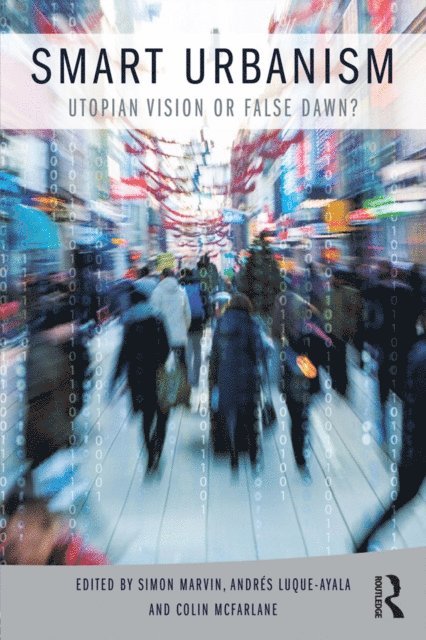
Smart Urbanism (SU) – the rebuilding of cities through the integration of digital technologies with buildings, neighbourhoods, networked infrastructures and people – is being represented as a unique emerging ‘solution’ to the majority of problems faced by cities today. SU discourses, enacted by technology companies, national governments and supranational agencies alike, claim a supremacy of urban digital technologies for managing and controlling infrastructures, achieving greater effectiveness in managing service demand and reducing carbon emissions, developing greater social interaction and community networks, providing new services around health and social care etc. Smart urbanism is being represented as the response to almost every facet of the contemporary urban question.
This book explores this common conception of the problematic of smart urbanism and critically address what new capabilities are being created by whom and with what exclusions; how these are being developed - and contested; where is this happening both within and between cities; and, with what sorts of social and material consequences. The aim of the book is to identify and convene a currently fragmented and disconnected group of researchers, commentators, developers and users from both within and outside the mainstream SU discourse, including several of those that adopt a more critical perspective, to assess ‘what’ problems of the city smartness can address.
The volume provides the first internationally comparative assessment of SU in cities of the global north and south, critically evaluates whether current visions of SU are able to achieve their potential; and then identifies alternative trajectories for SU that hold radical promise for reshaping cities.
706 kr
Läs direkt efter köp
Rethinking Urban Transitions provides critical insight for societal and policy debates about the potential and limits of low carbon urbanism. It draws on over a decade of international research, undertaken by scholars across multiple disciplines concerned with analysing and shaping urban sustainability transitions. It seeks to open up the possibility of a new generation of urban low carbon transition research, which foregrounds the importance of political, geographical and developmental context in shaping the possibilities for a low carbon urban future.
The book’s contributions propose an interpretation of urban low carbon transitions as primarily social, political and developmental processes. Rather than being primarily technical efforts aimed at measuring and mitigating greenhouse gases, the low carbon transition requires a shift in the mode and politics of urban development. The book argues that moving towards this model requires rethinking what it means to design, practise and mobilize low carbon in the city, while also acknowledging the presence of multiple and contested developmental pathways. Key to this shift is thinking about transitions, not solely as technical, infrastructural or systemic shifts, but also as a way of thinking about collective futures, societal development and governing modes – a recognition of the political and contested nature of low carbon urbanism. The various contributions provide novel conceptual frameworks as well as empirically rich cases through which we can begin to interrogate the relevance of socio-economic, political and developmental dimensions in the making or unmaking of low carbon in the city. The book draws on a diverse range of examples (including ‘world cities’ and ‘ordinary cities’) from North America, South America, Europe, Australia, Africa, India and China, to provide evidence that expectations, aspirations and plans to undertake purposive socio-technical transitions are both emerging and encountering resistance in different urban contexts.
Rethinking Urban Transitions is an essential text for courses concerned with cities, climate change and environmental issues in sociology, politics, urban studies, planning, environmental studies, geography and the built environment.
706 kr
Läs direkt efter köp
Rethinking Urban Transitions provides critical insight for societal and policy debates about the potential and limits of low carbon urbanism. It draws on over a decade of international research, undertaken by scholars across multiple disciplines concerned with analysing and shaping urban sustainability transitions. It seeks to open up the possibility of a new generation of urban low carbon transition research, which foregrounds the importance of political, geographical and developmental context in shaping the possibilities for a low carbon urban future.
The book’s contributions propose an interpretation of urban low carbon transitions as primarily social, political and developmental processes. Rather than being primarily technical efforts aimed at measuring and mitigating greenhouse gases, the low carbon transition requires a shift in the mode and politics of urban development. The book argues that moving towards this model requires rethinking what it means to design, practise and mobilize low carbon in the city, while also acknowledging the presence of multiple and contested developmental pathways. Key to this shift is thinking about transitions, not solely as technical, infrastructural or systemic shifts, but also as a way of thinking about collective futures, societal development and governing modes – a recognition of the political and contested nature of low carbon urbanism. The various contributions provide novel conceptual frameworks as well as empirically rich cases through which we can begin to interrogate the relevance of socio-economic, political and developmental dimensions in the making or unmaking of low carbon in the city. The book draws on a diverse range of examples (including ‘world cities’ and ‘ordinary cities’) from North America, South America, Europe, Australia, Africa, India and China, to provide evidence that expectations, aspirations and plans to undertake purposive socio-technical transitions are both emerging and encountering resistance in different urban contexts.
Rethinking Urban Transitions is an essential text for courses concerned with cities, climate change and environmental issues in sociology, politics, urban studies, planning, environmental studies, geography and the built environment.