
Andreas NA¶lke – författare
763 kr
Läs direkt efter köp
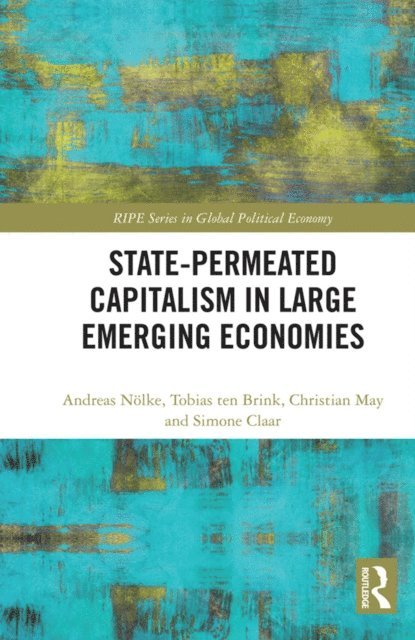
This book systematically analyzes the economic dynamics of large emerging economies from an extended Comparative Capitalisms perspective. Coining the phrase ‘state-permeated capitalism’, the authors shift the focus of research from economic policy alone, towards the real world of corporate and state behaviour.
On the basis of four empirical case studies (Brazil, India, China, South Africa), the main drivers for robust economic growth in these countries from the 2000s until the 2010s are revealed. These are found, in particular, in mutual institutional compatibilities of ‘state-permeated capitalism’, in their large domestic markets, and beneficial global economic constellations. Differences in their institutional arrangements are explored to explain why China and India have been more economically successful than Brazil and South Africa. The authors highlight substantial challenges for the stability of state-permeated capitalism and assess the potential future growth, sustainability and likely pitfalls for these large emerging economies.
Opening further avenues for empirical and theoretical research, this book raises questions for the future of the global economic order and should appeal to academics, graduate students and advanced undergraduates in politics, economics, economic sociology and development studies. It should also prove a worthwhile and provocative read for development practitioners and policy-makers.
790 kr
Läs direkt efter köp
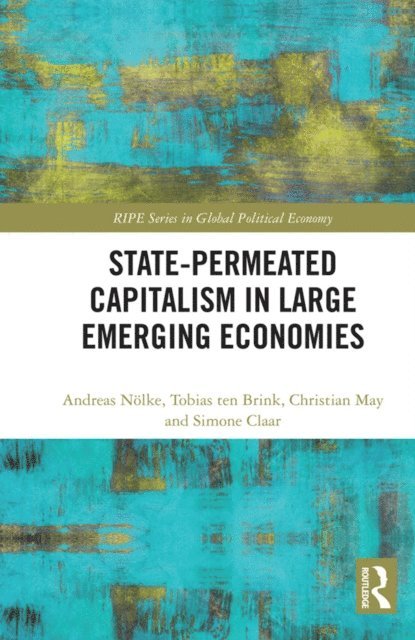
This book systematically analyzes the economic dynamics of large emerging economies from an extended Comparative Capitalisms perspective. Coining the phrase ‘state-permeated capitalism’, the authors shift the focus of research from economic policy alone, towards the real world of corporate and state behaviour.
On the basis of four empirical case studies (Brazil, India, China, South Africa), the main drivers for robust economic growth in these countries from the 2000s until the 2010s are revealed. These are found, in particular, in mutual institutional compatibilities of ‘state-permeated capitalism’, in their large domestic markets, and beneficial global economic constellations. Differences in their institutional arrangements are explored to explain why China and India have been more economically successful than Brazil and South Africa. The authors highlight substantial challenges for the stability of state-permeated capitalism and assess the potential future growth, sustainability and likely pitfalls for these large emerging economies.
Opening further avenues for empirical and theoretical research, this book raises questions for the future of the global economic order and should appeal to academics, graduate students and advanced undergraduates in politics, economics, economic sociology and development studies. It should also prove a worthwhile and provocative read for development practitioners and policy-makers.

505 kr
Läs direkt efter köp
This ambitious volume explores the politics of recent changes in corporate governance regulation and the transnational forces driving the process.
Corporate governance has in the 1990s become a catchphrase of the global business community. The Enron collapse and other recent corporate scandals, as well as growing worries in Europe about the rise of Anglo-Saxon finance, have made issues of corporate governance the subject of political controversies and of public debate.
The contributors argue that the regulation of corporate governance is an inherently political affair. Given the context of the deepening globalization of the corporate world, it is also increasingly a transnational phenomenon. In terms of the content of regulation the book shows an increasing reliance on the application of market mechanisms and a tendency for corporations themselves to become commodities. The emerging new mode of regulation is characterized by increasing informalization and by forms of private regulation. These changes in content and mode are driven by transnational actors, first of all the owners of internationally mobile financial capital and their functionaries such as coordination service firms, as well as by key public international agencies such as the European Commission.
The Transnational Politics of Corporate Governance Regulation will be of interest to students and researchers of international political economy, politics, economics and corporate governance.
505 kr
Läs direkt efter köp
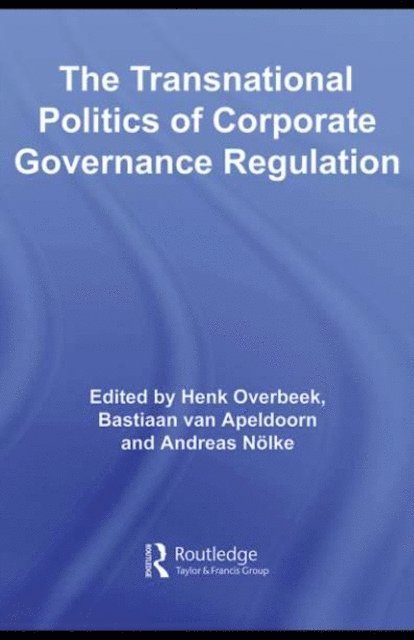
This ambitious volume explores the politics of recent changes in corporate governance regulation and the transnational forces driving the process.
Corporate governance has in the 1990s become a catchphrase of the global business community. The Enron collapse and other recent corporate scandals, as well as growing worries in Europe about the rise of Anglo-Saxon finance, have made issues of corporate governance the subject of political controversies and of public debate.
The contributors argue that the regulation of corporate governance is an inherently political affair. Given the context of the deepening globalization of the corporate world, it is also increasingly a transnational phenomenon. In terms of the content of regulation the book shows an increasing reliance on the application of market mechanisms and a tendency for corporations themselves to become commodities. The emerging new mode of regulation is characterized by increasing informalization and by forms of private regulation. These changes in content and mode are driven by transnational actors, first of all the owners of internationally mobile financial capital and their functionaries such as coordination service firms, as well as by key public international agencies such as the European Commission.
The Transnational Politics of Corporate Governance Regulation will be of interest to students and researchers of international political economy, politics, economics and corporate governance.
824 kr
Läs direkt efter köp
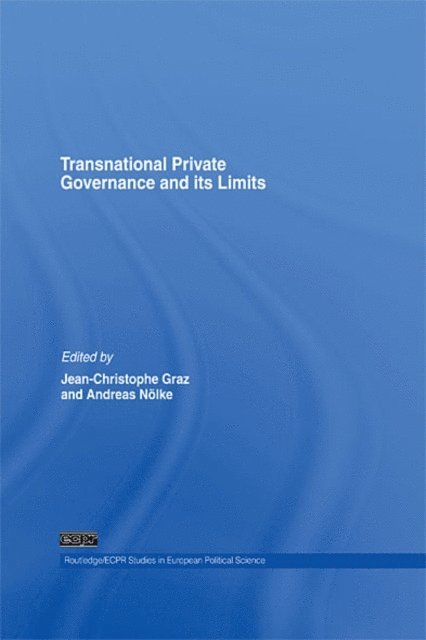
This volume explores a variety of forms of transnational private governance where non-state actors cooperate across borders to establish rules and standards accepted as legitimate by other agents.
Transnational private governance is a core feature of the devolution of power that we observe in the global realm and that is bringing about new forms of authority. Transnational Private Governance provides theoretically and empirically informed insights into the interactions between states and non-state actors including domains beyond intergovernmental organizations, conventional non-governmental organizations, and multinational enterprises, covering a wide range of arrangements, from highly formal devolutions of power to lax and informal platforms of interaction between private actors. Contributing to the latest generation of globalization studies, the authors consider the relationship between states and markets as closely integrated and seek to broaden the scope of enquiry by including new patterns and agents of change on a transnational basis.
This book will be of great interest to researchers and students of political science, international political economy, economics, business studies, globalisation and law.

824 kr
Läs direkt efter köp
This volume explores a variety of forms of transnational private governance where non-state actors cooperate across borders to establish rules and standards accepted as legitimate by other agents.
Transnational private governance is a core feature of the devolution of power that we observe in the global realm and that is bringing about new forms of authority. Transnational Private Governance provides theoretically and empirically informed insights into the interactions between states and non-state actors including domains beyond intergovernmental organizations, conventional non-governmental organizations, and multinational enterprises, covering a wide range of arrangements, from highly formal devolutions of power to lax and informal platforms of interaction between private actors. Contributing to the latest generation of globalization studies, the authors consider the relationship between states and markets as closely integrated and seek to broaden the scope of enquiry by including new patterns and agents of change on a transnational basis.
This book will be of great interest to researchers and students of political science, international political economy, economics, business studies, globalisation and law.