Andreas Nölke – författare
Visar alla böcker från författaren Andreas Nölke. Handla med fri frakt och snabb leverans.
4 produkter
4 produkter
239 kr
Skickas inom 7-10 vardagar
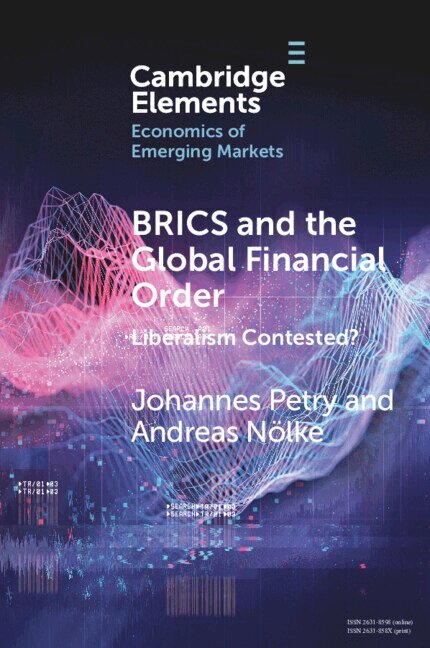
The global financial system is the economic bedrock of the contemporary liberal economic order. Contrary to other global-economy areas, finance is rarely analyzed in discussions on contestations of economic liberalism. However, a quite comprehensive process of external contestation of the global financial order (GFO) is underway. This contestation occurs through the rising share of emerging market economies within global finance in recent years, especially the rise of the BRICS economies. This Element investigates whether and how the BRICS contest the contemporary GFO by conducting a systematic empirical analysis across seven countries, eleven issues areas and three dimensions. This contestation occurs across issue areas but is mostly concentrated on the domestic and transnational dimension, not the international level on which much research focuses. Rather than the entire BRICS, it is especially China, Russia and India that contest liberal finance. This title is also available as Open Access on Cambridge Core.
771 kr
Skickas inom 7-10 vardagar
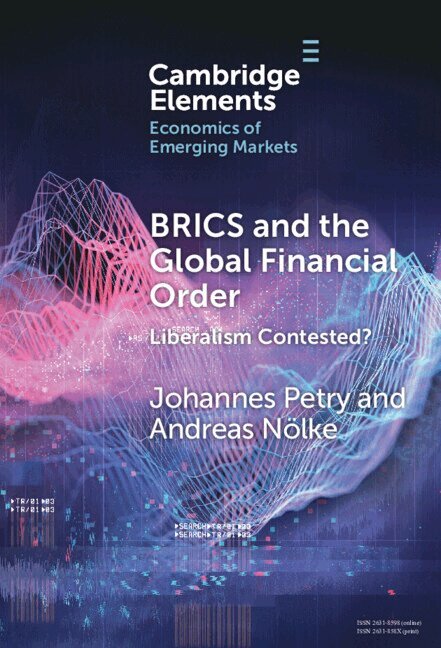
The global financial system is the economic bedrock of the contemporary liberal economic order. Contrary to other global-economy areas, finance is rarely analyzed in discussions on contestations of economic liberalism. However, a quite comprehensive process of external contestation of the global financial order (GFO) is underway. This contestation occurs through the rising share of emerging market economies within global finance in recent years, especially the rise of the BRICS economies. This Element investigates whether and how the BRICS contest the contemporary GFO by conducting a systematic empirical analysis across seven countries, eleven issues areas and three dimensions. This contestation occurs across issue areas but is mostly concentrated on the domestic and transnational dimension, not the international level on which much research focuses. Rather than the entire BRICS, it is especially China, Russia and India that contest liberal finance. This title is also available as Open Access on Cambridge Core.
Varieties of Peripheral Growth Models
Towards a New Comparative Political Economy of Development
Inbunden, Engelska, 2026
771 kr
Skickas inom 7-10 vardagar
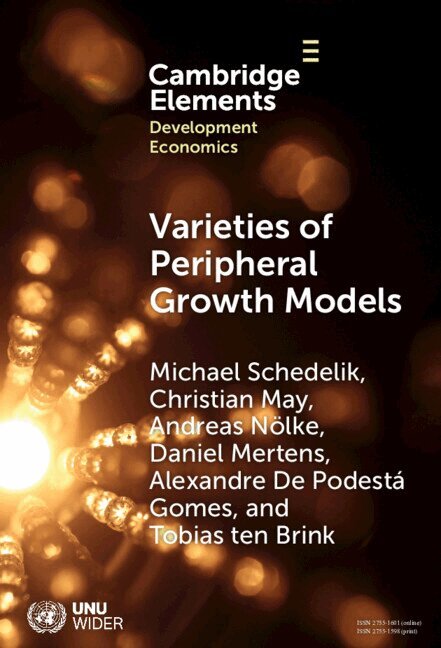
This Element seeks to develop an empirical research agenda that explores the applicability of the growth model perspective in comparative political economy to emerging capitalist economies (ECEs). Such an approach emphasizes the variety of possible growth models and their implications for development, providing an alternative to universalizing economic models as prevalent in mainstream development discourse. Using national accounts data for several large ECEs in the period from 2001 to 2022, the authors first propose a typology of peripheral growth models with varying degrees of economic vulnerability. Most notably, they add an investment-led model to the prevalent juxtaposition of consumption-led and export-led growth models. Subsequently, they employ several case vignettes from Brazil, Indonesia, South Africa, Turkey, Thailand and Vietnam to unpack the effects of volatile international interdependencies, such as commodity cycles, and diverse political underpinnings on peripheral growth models. This title is also available as open access on Cambridge Core.
Varieties of Peripheral Growth Models
Towards a New Comparative Political Economy of Development
Häftad, Engelska, 2026
241 kr
Skickas inom 7-10 vardagar
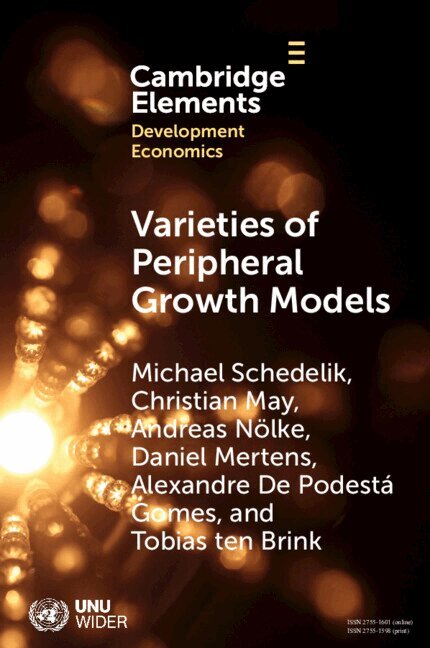
This Element seeks to develop an empirical research agenda that explores the applicability of the growth model perspective in comparative political economy to emerging capitalist economies (ECEs). Such an approach emphasizes the variety of possible growth models and their implications for development, providing an alternative to universalizing economic models as prevalent in mainstream development discourse. Using national accounts data for several large ECEs in the period from 2001 to 2022, the authors first propose a typology of peripheral growth models with varying degrees of economic vulnerability. Most notably, they add an investment-led model to the prevalent juxtaposition of consumption-led and export-led growth models. Subsequently, they employ several case vignettes from Brazil, Indonesia, South Africa, Turkey, Thailand and Vietnam to unpack the effects of volatile international interdependencies, such as commodity cycles, and diverse political underpinnings on peripheral growth models. This title is also available as open access on Cambridge Core.