Andreas Rahmatian - Böcker
Visar alla böcker från författaren Andreas Rahmatian. Handla med fri frakt och snabb leverans.
7 produkter
7 produkter
1 944 kr
Skickas inom 10-15 vardagar
Money is a legal institution with principal economic and sociological consequences. Money is a debt, because that is how it is conceptualised and comes into existence: as circulating credit – if viewed from the creditor’s perspective – or, from the debtor’s viewpoint, as debt. This book presents a legal theory of money, based on the concept of dematerialised property. It describes the money creation or money supply process for cash and for bank money, and looks at modern forms of money, such as cryptocurrencies. It also shows why mainstream economics presupposes, but avoids an analysis of, money by effectively eliminating money from the microeconomic market model and declaring it as merely a neutral medium of exchange and unit of account. The book explains that money rather brings about and influences substantially the exchange or transaction it is supposed to facilitate only as a neutral medium. As the most liquid of all assets, money enables financialisation, monetisation and commodification in the economy. The central role of the banks in the money creation process and in the economy, and their strengthened position after the bank rescue measures in the wake of the financial crisis 2008-9 are also discussed. Providing a rigorous analysis of the most salient legal issues regarding money, this book will appeal to legal theorists, economists and anyone working in commercial or banking law.
1 454 kr
Skickas inom 7-10 vardagar
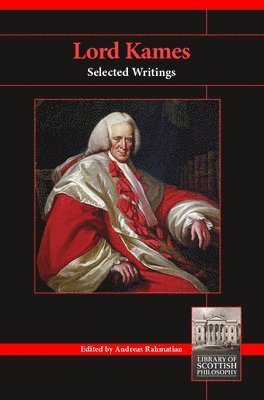
The Scottish jurist, judge, legal historian and philosopher Henry Home (1696–1782) took the title Lord Kames when he was elevated to the bench of the Scottish Court of Session in 1752. In the 18th century, his books were influential and widely read; the educated classes and representatives of the Enlightenment in England, France and in the German states were all familiar with his aesthetic and philosophical writings. Andreas Rahmatian explains Kames’ conceptions of legal philosophy, including black-letter law, legal science, legal theory, legal sociology and anthropology in its early stages, setting them in the context of the Scottish Enlightenment. He looks at how Kames came to be one of the forefathers of comparative law, sociology of law, legal psychology and ‘legal science’ in its proper meaning, as opposed to ‘law’.From the APF:Portmahomack today is a serene fishing village on the Dornoch Firth, north east Scotland where archaeological excavations have written a new history of the origins of Scotland. This book brings alive the expedition and its discoveries, most famously a monastery of the eighth century in the land of the Picts.Starting from chance finds of Pictish carved stone in St Colman’s churchyard, the archaeologists unearthed four settlements one on top of the other. An elite farm was succeeded by the Pictish monastery, which, following a Viking raid in AD800, became a trading place and then a medieval village. Scientific analysis shows at each stage where the people came from, their life-style and what they ate. Together it creates a story of the heroic adaptation of a European nation to new politics between the sixth and sixteenth century.The Picts were the outstanding sculptors of their day, producing carved stone monuments equal to anything being made in contemporary Europe. They were Britons, who resisted the Romans invaders and created their own warrior nation in the north east of the island. Coming under pressure from the Scots and the Norse, they disappeared from history in the ninth century AD. Now archaeology is finding them again.
569 kr
Skickas inom 10-15 vardagar
Money is a legal institution with principal economic and sociological consequences. Money is a debt, because that is how it is conceptualised and comes into existence: as circulating credit – if viewed from the creditor’s perspective – or, from the debtor’s viewpoint, as debt. This book presents a legal theory of money, based on the concept of dematerialised property. It describes the money creation or money supply process for cash and for bank money, and looks at modern forms of money, such as cryptocurrencies. It also shows why mainstream economics presupposes, but avoids an analysis of, money by effectively eliminating money from the microeconomic market model and declaring it as merely a neutral medium of exchange and unit of account. The book explains that money rather brings about and influences substantially the exchange or transaction it is supposed to facilitate only as a neutral medium. As the most liquid of all assets, money enables financialisation, monetisation and commodification in the economy. The central role of the banks in the money creation process and in the economy, and their strengthened position after the bank rescue measures in the wake of the financial crisis 2008-9 are also discussed. Providing a rigorous analysis of the most salient legal issues regarding money, this book will appeal to legal theorists, economists and anyone working in commercial or banking law.
297 kr
Kommande
The Scottish jurist, judge, legal historian and philosopher Henry Home (1696–1782) took the title Lord Kames when he was elevated to the bench of the Scottish Court of Session in 1752. In the 18th century, his books were influential and widely read; the educated classes and representatives of the Enlightenment in England, France and in the German states were all familiar with his aesthetic and philosophical writings. Andreas Rahmatian explains Kames’ conceptions of legal philosophy, including black-letter law, legal science, legal theory, legal sociology and anthropology in its early stages, setting them in the context of the Scottish Enlightenment. He looks at how Kames came to be one of the forefathers of comparative law, sociology of law, legal psychology and ‘legal science’ in its proper meaning, as opposed to ‘law’.From the APF:Portmahomack today is a serene fishing village on the Dornoch Firth, north east Scotland where archaeological excavations have written a new history of the origins of Scotland. This book brings alive the expedition and its discoveries, most famously a monastery of the eighth century in the land of the Picts.Starting from chance finds of Pictish carved stone in St Colman’s churchyard, the archaeologists unearthed four settlements one on top of the other. An elite farm was succeeded by the Pictish monastery, which, following a Viking raid in AD800, became a trading place and then a medieval village. Scientific analysis shows at each stage where the people came from, their life-style and what they ate. Together it creates a story of the heroic adaptation of a European nation to new politics between the sixth and sixteenth century.The Picts were the outstanding sculptors of their day, producing carved stone monuments equal to anything being made in contemporary Europe. They were Britons, who resisted the Romans invaders and created their own warrior nation in the north east of the island. Coming under pressure from the Scots and the Norse, they disappeared from history in the ninth century AD. Now archaeology is finding them again.
Concepts of Music and Copyright
How Music Perceives Itself and How Copyright Perceives Music
Inbunden, Engelska, 2015
1 663 kr
Skickas inom 7-10 vardagar
Copyright specialists have often focused on the exploitation of copyright of music and on infringement, but not on the question of how copyright conceptualises music. This highly topical volume brings together specialists in music, musicology and copyright law, providing a genuinely interdisciplinary research approach. It compares and contrasts the concepts of copyright law with those of music and musical performance. Several tensions emerge between the ideas of music as a living art and of the musical work as a basis for copyright protection.The expert contributors discuss the notions of the musical work, performance, originality, authorship in music and in copyright, and co-ownership from the disciplinary perspectives of music, musicology and copyright law. The book also examines the role of the Musicians' Union in the evolution of performers' rights in UK copyright law, and, in an empirical study, the transaction costs theory for notice-and-takedown regimes in relation to songs uploaded on YouTube.This unique study offers an interdisciplinary perspective for academics, policymakers and legal practitioners seeking a state-of-the-art understanding of music and copyright law.Contributors: J. Butt, M. Parker Dixon, A. Firth, P.J. Heald, B. Heile, A. Rahmatian, C. Waelde, J. Williamson
430 kr
Skickas inom 3-6 vardagar
1 842 kr
Skickas inom 7-10 vardagar
Copyright and Creativity discusses the making of property out of creative works through the legal mechanism of copyright. It shows the manner in which the law translates a great variety of expressions of the human mind into its normative system and transforms them into the property right of copyright or droit d auteur. This timely book examines the proprietary features of copyright, the inherent limitations of its powers, and its justification and relationship to the non-proprietary realm of the public domain. The latter part of the book deals with the 'propertisation/commodification' of human authors themselves through their works as alienable objects of property, the well-known 'Romantic author' critique as a sophisticated justification of that commodification, and at an international level, neo-feudal and neo-colonial developments as a result of this process. This detailed study will appeal to undergraduate and postgraduate students, legal sociologists, and specialists in copyright, property theory, or legal theory and political philosophy with particular interest in property theory. Practitioners within bodies involved in legal policy, organizations concerned with law reform, European institutions, and international organizations will also find much to interest them in this book.Contents: Preface; 1. Copyright as Property; 2. Copyright-Property and the Public Domain:Explanations and Justifications; 3. The Limitations to the Powers of Copyright Ownership; 4. The Attribution and Allocation of Copyright-Property: Authorship, Creativity and Ownership; 5. The Effects of Copyright-Property I: The Problem of Alienation; 6. The Effects of Copyright-Property II: Neo-Feudal and Neo-Colonial Features of International Copyright Protection; Conclusions; Index