Andrew D. Gordon - Böcker
Visar alla böcker från författaren Andrew D. Gordon. Handla med fri frakt och snabb leverans.
3 produkter
3 produkter
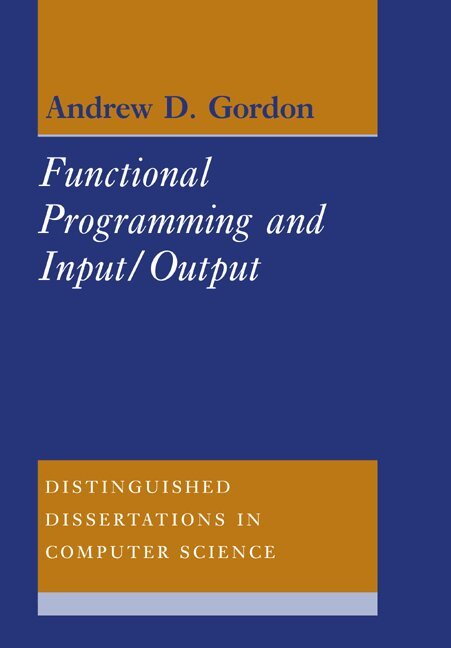
Del 8 - Distinguished Dissertations in Computer Science
Functional Programming and Input/Output
Häftad, Engelska, 2008
523 kr
Skickas inom 7-10 vardagar
A common attraction to functional programming is the ease with which proofs can be given of program properties. A common disappointment with functional programming is the difficulty of expressing input/output (I/O), while at the same time being able to verify programs. Here, the author shows how a theory of functional programming can be smoothly extended to admit both an operational semantics for functional I/O and verification of programs engaged in I/O. He obtains operational semantics for the three most widely implemented I/O mechanisms for lazy languages, and proves that the three are equivalent in expressive power. He develops semantics for a form of monadic I/O and verifies a simple programming example. These theories of functional I/O are based on an entirely operational theory of functional programming, developed using Abramsky's 'applicative bisimulation'.
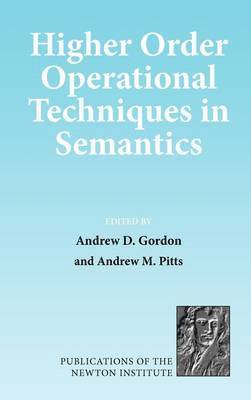
Del 12 - Publications of the Newton Institute
Higher Order Operational Techniques in Semantics
Inbunden, Engelska, 1998
1 227 kr
Skickas inom 7-10 vardagar
Most object-oriented or functional languages are higher order languages, i.e. ones in which the means of manipulation (e.g. object or function) can itself be manipulated. This 1998 book contains a collection of original articles about recent developments in operational semantics for higher order programming languages by some of the leading researchers in the field. Operational techniques are important because they are closer to implementations and language definitions than more abstract mathematical techniques such as denotational semantics. One of the exciting developments reflected by the book is that mathematical structures and techniques used in denotational semantics (such as fixpoint induction) may be recovered from a purely operational starting point. The book surveys and introduces techniques such as contextual equivalence, applicative bisimulation, logical relations, improvement relations, explicit models of memory management, and labelling techniques for confluence properties. It treats a variety of higher order languages, based on functions, processes and objects, with and without side effects, typed and untyped.
551 kr
Skickas inom 10-15 vardagar
The present volume contains the proceedings of the international conference Foundations of Software Science and Computation Structures(FOSSACS)2003, held in Warsaw, Poland, April 7-9, 2003. FOSSACS is an event of the Joint European Conferences on Theory and Practice of Software (ETAPS). The pre- ous ?ve FOSSACS conferences took place in Lisbon (1998), Amsterdam (1999), Berlin (2000), Genoa (2001), and Grenoble (2002). FOSSACS presents original papers on foundational researchwith a clear s- ni?cancetosoftwarescience.TheProgramCommitteeinvitedpapersontheories and methodsto supportthe analysis,integration,synthesis,transformation,and veri?cation of programs and software systems. We identi?ed the following t- ics, in particular: algebraic models; automata and language theory; behavioural equivalences; categorical models; computation processes over discrete and c- tinuous data; computation structures; logics of programs; modal, spatial, and temporallogics;modelsof concurrent,reactive,distributed, and mobile systems; processalgebrasandcalculi;semanticsofprogramminglanguages;softwaresp- i?cation and re?nement; transition systems; and type systems and type theory.We received 96 submissions, of which 2 were withdrawn. This proceedings consists of 27 papers. The ?rst-A Game Semantics for Generic Polymorphism-accompanies the invited lecture by Samson Abramsky, University of Oxford. The remaining 26 were selected for publication by the Program Committee during a week-long electronic discussion. I sincerely thank all the authors of papers submitted to FOSSACS 2003; the number and the quality of papers were exceptionally high this year. Moreover, I would like to thank all the members of the ProgramCommittee for the excellent job they did during a rather demanding selection process, and to thank all our subreferees for their invaluable contributions to this process.