Andrew Michael Flescher - Böcker
Visar alla böcker från författaren Andrew Michael Flescher. Handla med fri frakt och snabb leverans.
5 produkter
5 produkter
758 kr
Skickas inom 5-8 vardagar
Most of us are content to see ourselves as ordinary people - unique in ways, talented in others, but still among the ranks of ordinary mortals. Andrew Flescher probes our contented state by asking important questions: How should "ordinary" people respond when others need our help, whether the situation is a crisis, or something less? Do we have a responsibility, an obligation, to go that extra mile, to act above and beyond the call of duty? Or should we leave the braver responses to those who are somehow different than we are: better somehow, "heroes," or "saints?" Traditional approaches to ethics have suggested there is a sharp distinction between ordinary people and those called heroes and saints; between duties and acts of supererogation (going beyond the expected). Flescher seeks to undo these standard dichotomies by looking at the lives and actions of certain historical figures - Holocaust rescuers, Martin Luther King, Jr., Dorothy Day, among others - who appear to be extraordinary but were, in fact, ordinary people."Heroes, Saints, and Ordinary Morality" shifts the way we regard ourselves in relationship to those we admire from afar - it asks us not only to admire, but to emulate as well - further, it challenges us to actively seek the acquisition of virtue as seen in the lives of heroes and saints, to learn from them, a dynamic aspect of ethical behavior that goes beyond the mere avoidance of wrongdoing. Andrew Flescher sets a stage where we need to think and act, calling us to lead lives of self-examination - even if that should sometimes provoke discomfort. He asks that we strive to emulate those we admire and therefore allow ourselves to grow morally, and spiritually. It is then that the individual develops a deeper altruistic sense of self - a state that allows us to respond as the heroes of our own lives, and therefore in the lives of others, when times and circumstance demand that of us.

Altruistic Species
Scientific, Philosophical, and Religious Perspectives of Human Benevolence
Häftad, Engelska, 2007
400 kr
Skickas inom 11-20 vardagar
What motivates altruism? How essential is the phenomenon of altruism to the human experience? Is altruism readily accessible to the ordinary person? In The Altruistic Species, Andrew Michael Flescher and Daniel L. Worthen explore these questions through the lenses of four disciplinary perspectives-biology, psychology, philosophy, and religion. In their investigation, they make an extended argument for the existence of altruism against competing theories that construe all ostensible cases of benevolence as self-interest in disguise. The authors consider theories of egoism; the role of genetics and evolutionary biology; the psychological that induce altruistic behavior; philosophical theories of altruism in normative ethics such as Kantian, utilitarian, and Aristotelian models of moral action; and accounts of love of the neighbor in Christianity and Buddhism. Additionally, they offer a new, comprehensive definition of altruism that includes the insights of each of these perspectives. The Altruistic Species reinvigorates the debate over the prevalence of selfless motivation in human behavior-whether it is a rare or ubiquitous phenomenon-something considered exceptional or a capacity that members of any community could potentially develop. This noteworthy interdisciplinary examination of altruism balances science, virtue theory, and theology. It is ideal for ethics, human behavior, and evolutionary biology courses as an educational resource for other multidisciplinary studies and interested lay readers.
360 kr
Skickas inom 7-10 vardagar
The idea of moral evil has always held a special place in philosophy and theology because the existence of evil has implications for the dignity of the human and the limits of human action. Andrew Michael Flescher proposes four interpretations of evil, drawing on philosophical and theological sources and using them to trace through history the moral traditions that are associated with them. The first model, evil as the presence of badness, offers a traditional dualistic model represented by Manicheanism. The second, evil leading to goodness through suffering, presents a theological interpretation known as theodicy. Absence of badness -- that is, evil as a social construction -- is the third model. The fourth, evil as the absence of goodness, describes when evil exists in lieu of the good -- the "privation" thesis staked out nearly two millennia ago by Christian theologian St. Augustine. Flescher extends this fourth model -- evil as privation -- into a fifth, which incorporates a virtue ethic.Drawing original connections between Augustine and Aristotle, Flescher's fifth model emphasizes the formation of altruistic habits that can lead us to better moral choices throughout our lives. Flescher eschews the temptation to think of human agents who commit evil as outside the norm of human experience. Instead, through the honing of moral skills and the practice of attending to the needs of others to a greater degree than we currently do, Flescher offers a plausible and hopeful approach to the reality of moral evil.
1 355 kr
Skickas inom 5-8 vardagar
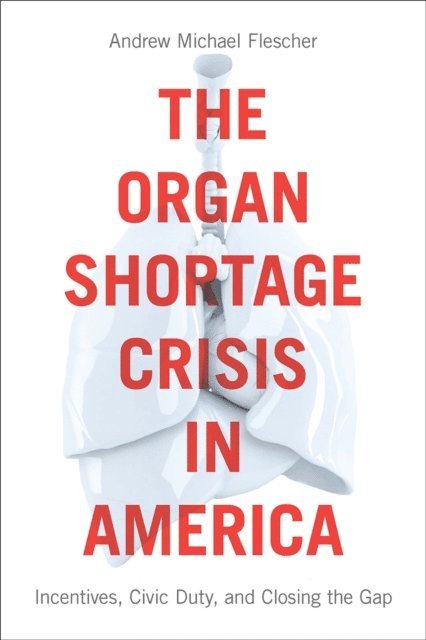
Nearly 120,000 people are in need of healthy organs in the United States. Every ten minutes a new name is added to the list, while on average twenty people die each day waiting for an organ to become available. Worse, our traditional reliance on cadaveric organ donation is becoming increasingly insufficient, and in recent years there has been a decline in the number of living donors as well as in the percentage of living donors relative to overall kidney donors. Some transplant surgeons and policy advocates have responded to this shortage by arguing for the legalization of the sale of organs among living donors. Andrew Flescher objects to this approach by going beyond concerns traditionally cited about social justice, commodification, and patient safety, and moving squarely onto the terrain of discussing what motivates major and costly acts of human selflessness. What is the most efficacious means of attracting prospective living kidney donors? Flescher, drawing on literature in the fields of moral psychology and economics, as well as on scores of interviews with living donors, suggests that inculcating a sense of altruism and civic duty is a more effective means of increasing donor participation than the resort to financial incentives. He encourages individuals to spend time with patients on dialysis in order to become acquainted with their plight and, as an alternative to lump-sum payments, consider innovative solutions that positively impact living donor participation that do not undermine the spirit of the National Organ Transplant Act of 1984. This book not only re-examines the important debate over whether to allow the sale of organs; it is also the first volume in the field to take a close look at alternative solutions to the organ shortage crisis.
462 kr
Skickas inom 5-8 vardagar
Nearly 120,000 people are in need of healthy organs in the United States. Every ten minutes a new name is added to the list, while on average twenty people die each day waiting for an organ to become available. Worse, our traditional reliance on cadaveric organ donation is becoming increasingly insufficient, and in recent years there has been a decline in the number of living donors as well as in the percentage of living donors relative to overall kidney donors. Some transplant surgeons and policy advocates have responded to this shortage by arguing for the legalization of the sale of organs among living donors. Andrew Flescher objects to this approach by going beyond concerns traditionally cited about social justice, commodification, and patient safety, and moving squarely onto the terrain of discussing what motivates major and costly acts of human selflessness. What is the most efficacious means of attracting prospective living kidney donors? Flescher, drawing on literature in the fields of moral psychology and economics, as well as on scores of interviews with living donors, suggests that inculcating a sense of altruism and civic duty is a more effective means of increasing donor participation than the resort to financial incentives. He encourages individuals to spend time with patients on dialysis in order to become acquainted with their plight and, as an alternative to lump-sum payments, consider innovative solutions that positively impact living donor participation that do not undermine the spirit of the National Organ Transplant Act of 1984. This book not only re-examines the important debate over whether to allow the sale of organs; it is also the first volume in the field to take a close look at alternative solutions to the organ shortage crisis.