Andrew Zago – författare
Visar alla böcker från författaren Andrew Zago. Handla med fri frakt och snabb leverans.
2 produkter
2 produkter
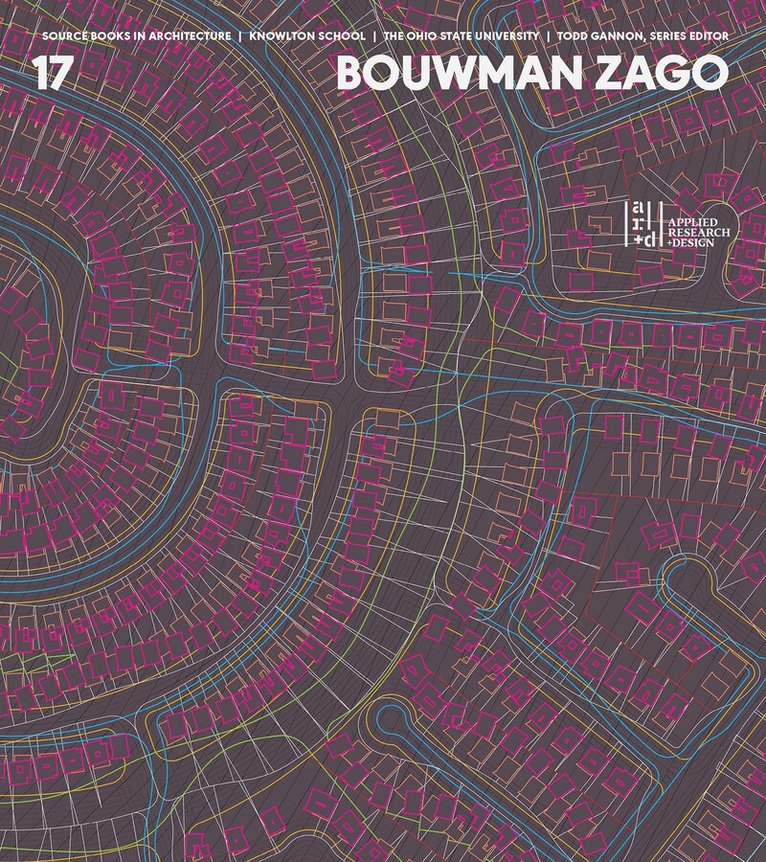
Del 17 - Source Books in Architecture
Bouwman Zago
Source Books in Architecture 17
Häftad, Engelska, 2026
381 kr
Kommande
Led by partners Laura Bouwman and Andrew Zago, Bouwman Zago brings open-ended, creative inquiry to disciplinary concerns in architecture. Noted for its prescient articulation of emerging sensibilities, the practice weds quasi-autonomous aesthetic studies to the art of making buildings and cities. In doing so, Bouwman Zago reaffirms the substantial and productive link amongst art, architecture and urbanism. The firm has completed projects in the United States, Mexico, Iran, and Korea including the Museum of Contemporary Art Detroit, Arup Downtown Los Angeles, the Fine Venture office tower in Seoul, Cornell Synthesis Studio for Cornell University’s Sibley School of Mechanical and Aerospace Engineering, and the Casa Autoproyectar in Nanacamilpa, Mexico. Current projects include “Blossom,” a multi-paneled digital billboard on the Sunset Strip in West Hollywood, California. This volume features detailed presentations of Bouwman Zago’s designs for the University of Illinois Chicago’s Visual and Performing Arts Center; “A New Federal Project for Detroit,” commissioned for the US Pavilion at the 2015 Venice Architecture Biennale; Michigan; and “Property with Properties,” the firm’s contribution to the exhibition, Foreclosed: Rehousing the American Dream, at the Museum of Modern Art in New York. Alongside, Bouwman and Zago present the theoretical underpinnings of their approach to architectural form, urban space, colour, and other topics. Critical essays by Jeffrey Kipnis, Anna Niemark, and R.E. Somol further elucidate the significance of the firm’s work and speculate on its disciplinary stakes and implications.Source Books in Architecture is a product of the Herbert Baumer seminars, a series of interactions between students and seminal practitioners at the Knowlton School of Architecture at The Ohio State University. Following a significant amount of research, students lead discussions that encourage the architects to reveal their architectural motivations and techniques.
320 kr
Tillfälligt slut
n fields, such as architecture, that produce carefully authored compositions, the chance arrangements of material grain, patinas, or other traces of matter’s resistance to orderly control are sometimes allowed an expression in the final work. In these instances they are viewed as desirable features—even moral ones when touted as evidence of a work’s architectonic authenticity. Beyond this limited embellishment nature provides to otherwise determined technological assemblies, there are larger scale also embraced instances of matter’s random nature acting against, and in part undoing, such assemblies. The effects of weathering and the slouch or deformation of structures over time are often seen as endearing informal enhancements to the rigidity of precise compositions. A more extreme but equally well understood example is the classical ruin. In it, a technological assembly (a building) is undermined to a degree that the total final effect is coproduced by the original composition and its material disassembly. Since at least Romanticism such ruins—almost always in stone—have garnered a level of appreciation that can be considered connoisseurship. In all of these instances there is happenstance; the appearance of a complex, stochastic logic of matter—both its crystalline or organic growth and its complex degradation in its environment—that is outside of and contrary to our instrumental control, unraveling our intended arrangements. We may dress a rock in geometric form and name it ‘column,’ but eventually—if centuries later—it will return to its feral state and, if still functioning, may even cause a structure to collapse. This interplay of happenstance and control extends well beyond these familiar occasions and their attendant sensibilities. They are all accidents, and as such they represent only a small, historically aestheticized, subset of an interplay that (potentially) exists in every technological assembly.