Ann Thorpe – författare
Visar alla böcker från författaren Ann Thorpe. Handla med fri frakt och snabb leverans.
4 produkter
4 produkter
610 kr
Skickas inom 11-20 vardagar
Designing for sustainability is an innovation shaping both the design industry and design education today. Yet architects, product designers, and other key professionals in this new field have so far lacked a resource that addresses their sensibilities and concerns. "The Designer's Atlas of Sustainability" now explores the basic principles, concepts, and practice of sustainable design in a visually sophisticated and engaging style. The book tackles not only the ecological aspects of sustainable design - designers' choice of materials and manufacturing processes have a tremendous impact on the natural world - but also the economic and cultural elements involved. The Atlas is neither a how-to manual, nor collection of recipes for sustainable design, but a compendium of fresh approaches to sustainability that designers can incorporate into daily thinking and practice. Illuminating many facets of this exciting field, the book offers ideas on how to harmonize human and natural systems, and then explores practical options for making the business of design more supportive of long-term sustainability.An examination of the ethical dimensions of sustainable development in our public and private lives is the theme present throughout. Like other kinds of atlases, "The Designer's Atlas of Sustainability" illustrates its subject, but it goes far beyond its visual appeal, stimulating design solutions for "development that cultivates environmental and social conditions that will support human well-being indefinitely."
Architecture & Design versus Consumerism
How Design Activism Confronts Growth
Inbunden, Engelska, 2012
1 855 kr
Tillfälligt slut
The mentality that consumerism and economic growth are cure-alls is one of the biggest obstacles to real sustainability, but any change seems impossible, unthinkable. Our contemporary paradox finds us relying for our well being on consumer-driven economic growth that we actually can’t afford — not in environmental, economic or social terms. Although architecture and design have long been seen as engines for consumerism and growth, increasing numbers of designers are concerned about the problems resulting from growth. But designers face a paradox of their own; in scenarios of sustainable consumption, where people consume or build significantly less, what will be left for designers to do? This book, informed by recent research into the viability of a "steady state" economy, sets an agenda for addressing the designer’s paradox of sustainable consumption. The agenda includes ways that architecture and design can help transition us towards a new kind of economy that prioritizes real wellbeing rather than economic growth. Packed with examples and illustrations, the book argues that taking action, or activism, is an important but so far underexplored way for architects and designers to confront consumerism.The first chapters explore how economic growth and consumerism shape and are shaped by the professions of architecture, product, and landscape design and how we can understand the problem of consumerism as four main challenges that designers are already addressing. The book maps out the main issues surrounding the development of metrics that designers and others can use to measure wellbeing, instead of simply measuring economic growth. The second half of the book looks at how design activism works and its connection to growth and consumerist issues. These chapters examine how activist practices are financed, highlight five specific methods that designers use in working for social change, and investigate the power of these methods. The book concludes with a consideration of what design’s role might be in a "post-growth" society.
680 kr
Skickas inom 10-15 vardagar
The mentality that consumerism and economic growth are cure-alls is one of the biggest obstacles to real sustainability, but any change seems impossible, unthinkable. Our contemporary paradox finds us relying for our well being on consumer-driven economic growth that we actually can’t afford — not in environmental, economic or social terms. Although architecture and design have long been seen as engines for consumerism and growth, increasing numbers of designers are concerned about the problems resulting from growth. But designers face a paradox of their own; in scenarios of sustainable consumption, where people consume or build significantly less, what will be left for designers to do? This book, informed by recent research into the viability of a "steady state" economy, sets an agenda for addressing the designer’s paradox of sustainable consumption. The agenda includes ways that architecture and design can help transition us towards a new kind of economy that prioritizes real wellbeing rather than economic growth. Packed with examples and illustrations, the book argues that taking action, or activism, is an important but so far underexplored way for architects and designers to confront consumerism.The first chapters explore how economic growth and consumerism shape and are shaped by the professions of architecture, product, and landscape design and how we can understand the problem of consumerism as four main challenges that designers are already addressing. The book maps out the main issues surrounding the development of metrics that designers and others can use to measure wellbeing, instead of simply measuring economic growth. The second half of the book looks at how design activism works and its connection to growth and consumerist issues. These chapters examine how activist practices are financed, highlight five specific methods that designers use in working for social change, and investigate the power of these methods. The book concludes with a consideration of what design’s role might be in a "post-growth" society.
208 kr
Tillfälligt slut
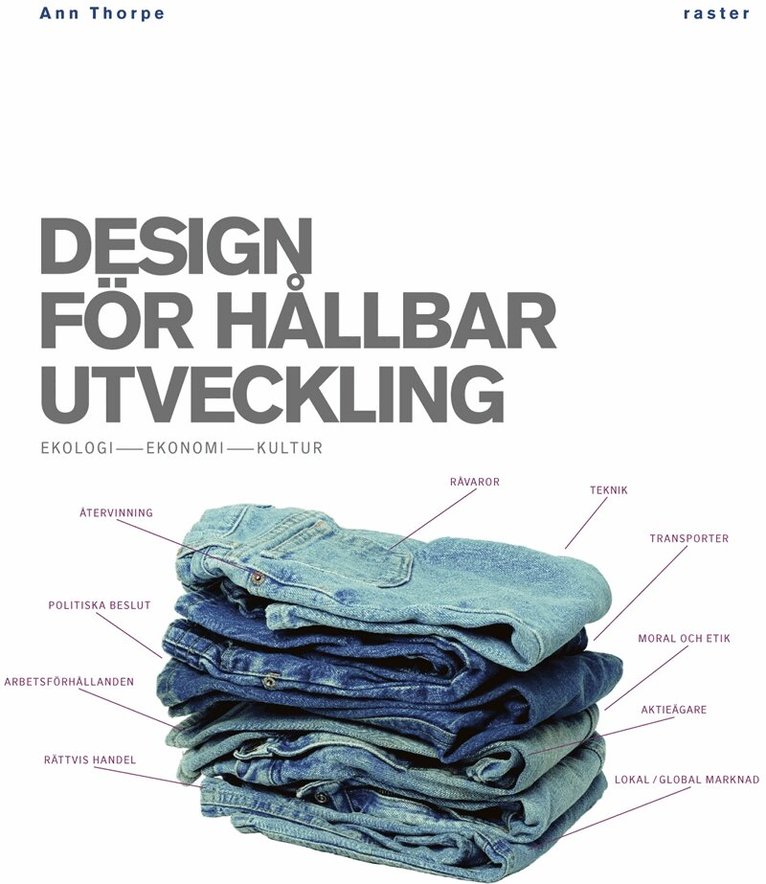
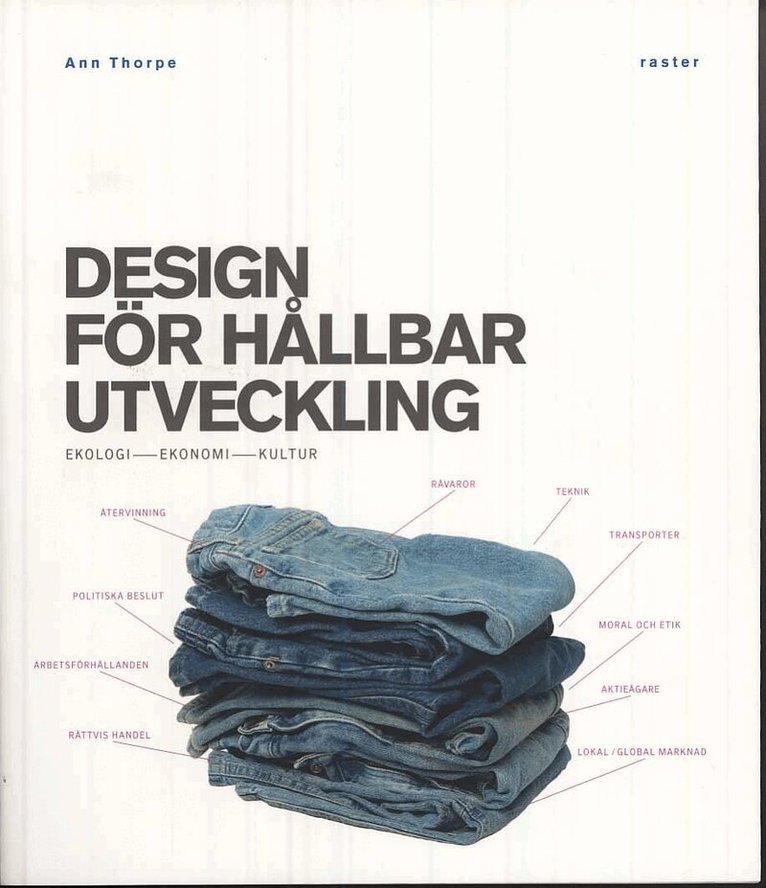
Boken är nr 6 i Rasters serie med introduktioner till estetiska ämnen. »Design för hållbar utveckling« behandlar inte bara de ekologiska aspekterna på design för hållbar utveckling, t.ex. beträffande material och produktionsprocesser, utan också ekonomiska och kulturella beröringspunkter. Den vänder sig inte bara till designer utan också till företag och en engagerad allmänhet. Bokens introduktion är skriven av Mathilda Tham, som är professor vid Beckmans högskola. Ur innehållet: Ekologi Design och ekosfären Tempo, storlek och plats Vad som tillåts, vad som föredras Se mig! »down-cycle«, »up-cycle« nytänkande om råvaror Mimikry, en sida från naturens bok Ekostrukturer och funktioner Återhämtningsförmåga Summering av design i ekologins landskap Ekonomi Ekonomins tre sektorer Pengar är målet Pris på miljön Oändligt värde Att låna från framtiden Den fria marknaden Finansiering Det är vi som väljer Design skapar värde Företag Företaget utan ansvar Design för att gott ändamål Globalisering Rättvis handel Digitala marknader Summering av design i ekonomins landskap Kultur Lyckliga människor Tillgodose mina behov Vidareutveckling i stället för återvändo En visuell tidsålder Ägande och materialism Handel och kommersialism Designerns roll Design, engagemang och relationer Användarengagemang, »open design« Begreppet tid Snabbt Långsamt Ett långt tidsperspektiv Att utveckla artefakter Att införliva tid Naturens kulturella dimension Summering av design inom kulturens landskap Gränsområden Relationen mellan designens tre landskap Tre förändringssystem Att knäcka koden Design i nytt ljus Design för förändring En lärarhandledning (på engelska) som dateras upp tre gånger/år finns för nedladdning på: http://www.designers-atlas.net/teachguide.html Ann Thorpe är lärare i design vid Surrey Institute of Art and Design. Utgivna titlar i introduktionsserien: Design - en introduktion av John Heskett. Design för hållbar utveckling - en introduktion av Ann Thorpe. Design och postmodernitet - en introduktion av Penny Sparke. Designhistoria - en introduktion av Susann Vihma. Film och andra rörliga bilder - en introduktion, red. Anu Koivunen. Fotografi - en introduktion av Steve Edwards. Konstteori - en introduktion av Cynthia Freeland. Konstvetenskap - en introduktion av Dana Arnold. Mode - en introduktion. En tvärvetenskaplig betraktelse, red. Dirk Gindt & Louise Wallenberg. Svensk designhistoria av Lasse Brunnström. Kommande introduktionsböcker 2011: Swedish Design History av Lasse Brunnström.