Anna-Maria Mayerhofer – författare
Visar alla böcker från författaren Anna-Maria Mayerhofer. Handla med fri frakt och snabb leverans.
2 produkter
2 produkter
245 kr
Tillfälligt slut
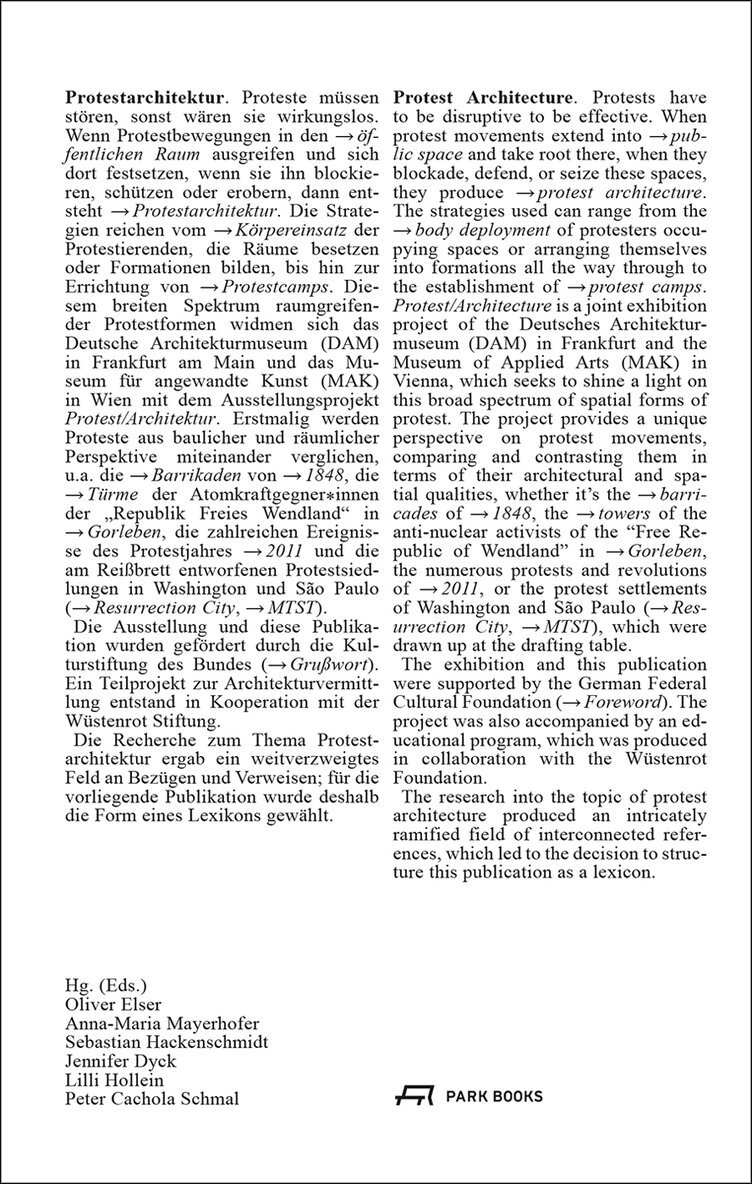
"How did UK activists outfox 700 police? Why was Hong Kong traffic stopped by ‘mini Stonehenges’? And could an octagonal treehouse and a crow’s nest really have saved a German forest? Our writer enjoys a 200-year history of resistance architecture." — The GuardianProtest movements shape public space not only through their messages, but in many cases also through their - mostly temporary - buildings. Frankfurt’s Deutsches Architekturmuseum DAM and Vienna’s MAK - Museum of Applied Arts are exploring this thesis in a joint exhibition project. The exhibition and the book coinciding with it explore the topic based on examples spanning from 1830 to 2022.Protest Architecture is the first-ever international survey of the architecture of protest and presents it in all its manifold forms and, in some cases, ambivalence. It is conceived as an encyclopedia with around 170 entries, supplemented by 14 more expansive case studies. A preceding chronology portrays some 80 protest movements and their architectural manifestations through concise texts and one image each, including examples from all over the world, such as the 1830 July Revolution in Paris, the 1848 March Revolution in Berlin, the 1911 Sugar Workers Strike in Queensland (Australia), the 1936-37 General Motors Sit-down Strike in Flint, MI (USA), the 1969-98 Troubles in Northern Ireland, Freetown Christiania in Copenhagen since 1971, the 1986 People Power Revolution in Manila, the 1999 WTO Protests in Seattle, WA (USA), the 2011 Arab Spring revolutions on Cairo’s Tahrir Square and Manama’s Pearl Roundabout, the 2013–14 Euromaidan uprisings in Kyiv, the 2015–16 #FeesMustFall student protests in Pretoria, the 2019 Acampamento Terra Livre in Brasilia, the 2020–21 Indian Farmers Protests, and the 2022 Freedom Convoy in Ottawa.Text in English and German.
423 kr
Kommande
The second volume of the Fundamente Ökologisches Bauen series offers insights into around 50 historical and current anti- demolition campaigns in Germany and Europe. For the first time, the editors systematically structure strategies for building preservation, ranging from knowledge production and conversion concepts to media attention, political influence, artistic actions, and legal means—as well as unconventional forms of resistance such as squatting or the protection of endangered species. The book reveals a wide range of options for stakeholders with diverse motivations and backgrounds. Häuser retten adopts the perspective of activism and civil society, highlights a previously neglected aspect of architectural and urban history, and raises the question of how participation in planning and spatial production is possible today.Systematic strategies against the demolition of buildingsOverview of anti-demolition campaigns in Germany and EuropeImportant contribution to the preservation of existing buildings from a civil society perspective