Annamaria Contini - Böcker
Visar alla böcker från författaren Annamaria Contini. Handla med fri frakt och snabb leverans.
2 produkter
2 produkter
Del 13 - Transcultural Studies – Interdisciplinary Literature and Humanities for Sustainable Societies
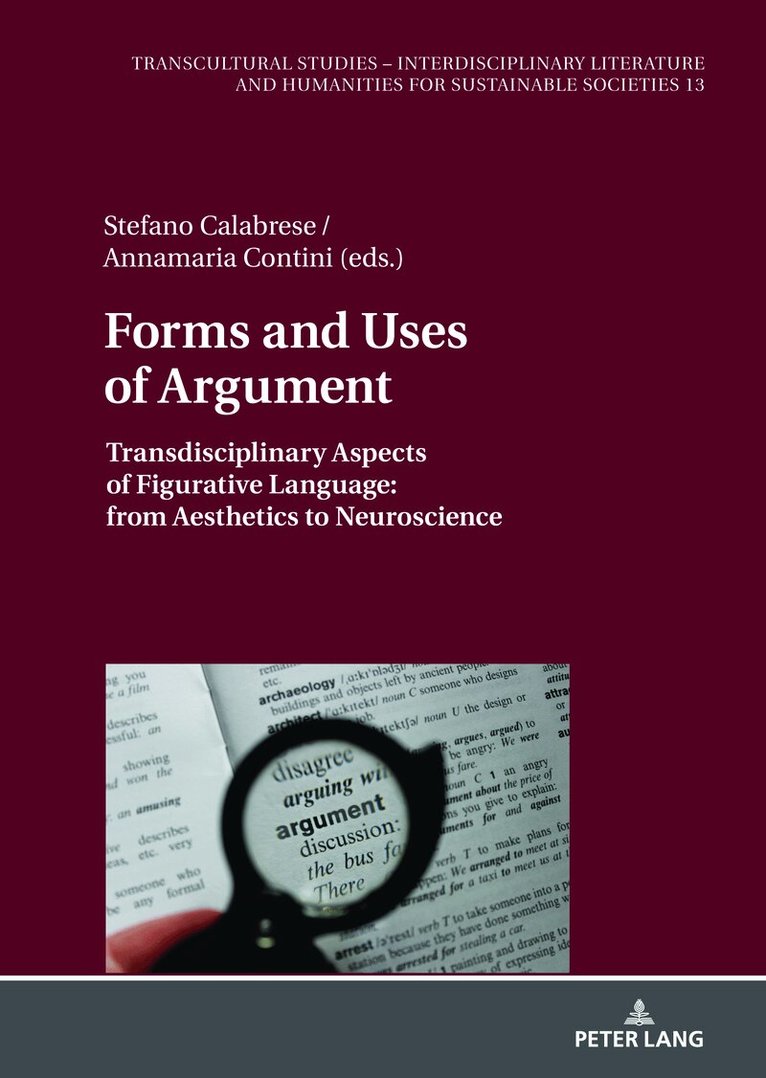
Forms and Uses of Argument
Transdisciplinary Aspects of Figurative Language: from Aesthetics to Neuroscience
Inbunden, Engelska, 2023
476 kr
Skickas inom 5-8 vardagar
This volume is the result of transdisciplinary studies conducted by professors and researchers of the Department of Education and Human Sciences at the University of Modena and Reggio Emilia. It cross-applies neuro-scientific, aesthetic, linguistic and rhetorical methods to focus on the concept of argumentation, much studied during the 20th century and then forsaken. The common thread that links the essays is the concept of figurative language intended as an argumentative tool, while throughout the 20th century it was believed that in every field of human knowledge formal approaches should prevail: only the form, it was thought, constitutes the purest essence, the “net weight” of things. In contrast to this, “Forms and Uses of Argument” intend to demonstrate that the figurative language - and first of all the metaphors – are in fact rather an archetypal “propellant” for the most widespread argumentative logics.
Del 20 - Transcultural Studies – Interdisciplinary Literature and Humanities for Sustainable Societies
Emotions in a Transdisciplinary Light
Inbunden, Engelska, 2025
824 kr
Skickas inom 3-6 vardagar
The volume is based on the assumption that, as demonstrated by the British psychologist Keith Oatley and the Portuguese neuroscientist Antonio Damasio, emotions are involuntary responses to sensory triggers and give rise to real action programs. Generated by the limbic brain and capable of releasing chemical molecules such as dopamine or cortisol, the triggering of emotional responses is involuntarily and relies on images for activation since they have the power to capture emotions, as argued by Aby Warburg. This means that, although emotions are genetically embedded in our behavioral repertoire, they are controlled and managed according to the social group and culture to which individuals belong. As a matter of fact, all individuals share the same repertoire of emotional responses, but it is culture that governs how this repertoire is expressed.Desire and lust, care and nourishment, attachment and love, joy, anger, contempt, panic, compassion, admiration, fear, envy, and jealousy find their activation space in the social context. So, for Damasio, emotions represent a toolkit essential to relational life, and this volume primarily addresses the relationship between emotions and historical-cultural contexts.