Annette Magnusson – författare
3 015 kr
Läs direkt efter köp
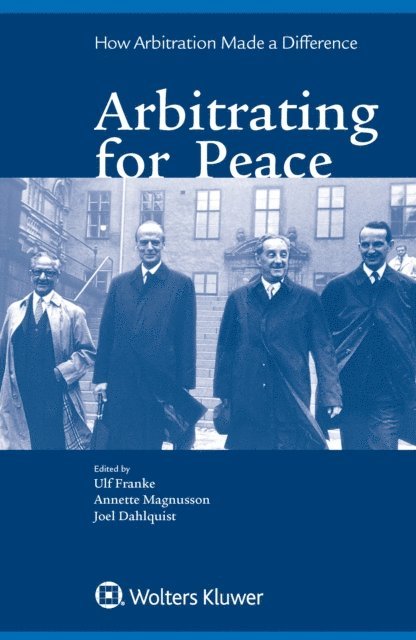
Although short of attaining the ideal of a ‘substitute for war’, arbitration has largely succeeded in peacefully resolving international disputes. Beyond that, arbitral commitments and arbitral processes have deepened civilized and cooperative international relations, promoted the development of international law and international institutions, and facilitated the well-being of mankind in multiple important ways. Particulars of that proposition are set forth in this one-of-a-kind book.
Each of the fourteen chapters is devoted to one landmark international arbitration case, primarily state-to-state but also includes commercial disputes with geopolitical dimensions.
Each chapter is written by a practitioner and/or academic of high international standing. The project was initiated by the Stockholm Chamber of Commerce, which celebrates its centennial in 2017.
By focusing on landmark cases, the book contributes to a continued dynamic development of dispute resolution in complicated or sensitive geopolitical contexts, and demonstrates how arbitration has and can continue to play an important role for international relations. Practitioners, political decision makers, and academics in any part of the world with an interest in international arbitration and international law or political history and policy on an international level will find it not only deeply informative but also immensely useful.
3 015 kr
Läs direkt efter köp
Although short of attaining the ideal of a ‘substitute for war’, arbitration has largely succeeded in peacefully resolving international disputes. Beyond that, arbitral commitments and arbitral processes have deepened civilized and cooperative international relations, promoted the development of international law and international institutions, and facilitated the well-being of mankind in multiple important ways. Particulars of that proposition are set forth in this one-of-a-kind book.
Each of the fourteen chapters is devoted to one landmark international arbitration case, primarily state-to-state but also includes commercial disputes with geopolitical dimensions.
Each chapter is written by a practitioner and/or academic of high international standing. The project was initiated by the Stockholm Chamber of Commerce, which celebrates its centennial in 2017.
By focusing on landmark cases, the book contributes to a continued dynamic development of dispute resolution in complicated or sensitive geopolitical contexts, and demonstrates how arbitration has and can continue to play an important role for international relations. Practitioners, political decision makers, and academics in any part of the world with an interest in international arbitration and international law or political history and policy on an international level will find it not only deeply informative but also immensely useful.
230 kr
Skickas inom 7-10 vardagar
221 kr
Skickas inom 7-10 vardagar
2 621 kr
Skickas inom 5-8 vardagar
2 136 kr
Läs direkt efter köp
Sweden is one of a handful of countries where the international arbitral process has reached a stage where the jurisprudence is replete with instances involving no local parties at all. In this context of credible neutrality, the Arbitration Institute of the Stockholm Chamber of Commerce (SCC) has emerged as a leading global arbitral institution. Whether the matter at issue is a business transaction dispute or a politicized conflict involving obdurate parties, the richness of its body of decided cases manifests the SCC’s authority and reliability throughout the converging world of international arbitration.
The present book, written by sixteen eminent practitioners and now in its second edition, provides a practical guide to international arbitration in Sweden, whether ad hoc or institutional. Among the many elements of practice and procedure detailed are the following:
appointment, challenge, removal, and compensation of arbitrators; procedural efficiency and costs; use of international legal sources such as IBA guidelines; choice of law by parties; SCC rules and procedures; multiparty arbitrations – joinder, intervention, consolidation; investment treaty arbitration; confidentiality; documentary evidence, witnesses, and experts; grounds for setting aside; party succession; Swedish court review of the arbitrator’s jurisdiction; and appeal of arbitrators’ compensation.In addition, readers will be exposed to a trove of pertinent references to important decisions that have, in recent decades, been generated by the stream of major international arbitrations conducted in Sweden.
Disputing parties wishing to know what will happen when their case is brought to Sweden for arbitration will find no clearer or more thorough guide. This book is an incomparable source for anyone called upon to act as arbitrator or counsel, or in any other capacity, in international arbitration in Sweden.
2 136 kr
Läs direkt efter köp
Sweden is one of a handful of countries where the international arbitral process has reached a stage where the jurisprudence is replete with instances involving no local parties at all. In this context of credible neutrality, the Arbitration Institute of the Stockholm Chamber of Commerce (SCC) has emerged as a leading global arbitral institution. Whether the matter at issue is a business transaction dispute or a politicized conflict involving obdurate parties, the richness of its body of decided cases manifests the SCC’s authority and reliability throughout the converging world of international arbitration.
The present book, written by sixteen eminent practitioners and now in its second edition, provides a practical guide to international arbitration in Sweden, whether ad hoc or institutional. Among the many elements of practice and procedure detailed are the following:
appointment, challenge, removal, and compensation of arbitrators; procedural efficiency and costs; use of international legal sources such as IBA guidelines; choice of law by parties; SCC rules and procedures; multiparty arbitrations – joinder, intervention, consolidation; investment treaty arbitration; confidentiality; documentary evidence, witnesses, and experts; grounds for setting aside; party succession; Swedish court review of the arbitrator’s jurisdiction; and appeal of arbitrators’ compensation.In addition, readers will be exposed to a trove of pertinent references to important decisions that have, in recent decades, been generated by the stream of major international arbitrations conducted in Sweden.
Disputing parties wishing to know what will happen when their case is brought to Sweden for arbitration will find no clearer or more thorough guide. This book is an incomparable source for anyone called upon to act as arbitrator or counsel, or in any other capacity, in international arbitration in Sweden.
2 605 kr
Skickas inom 5-8 vardagar
2 217 kr
Läs direkt efter köp
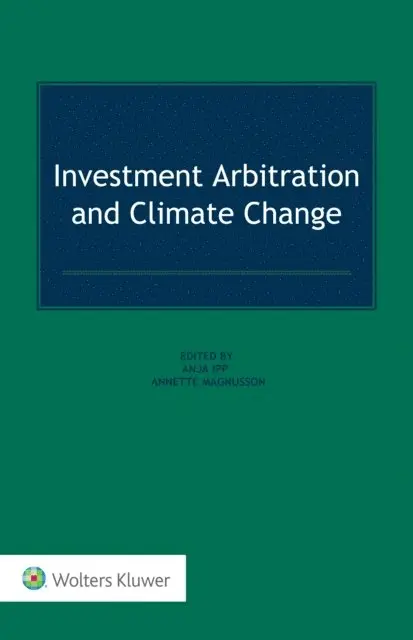
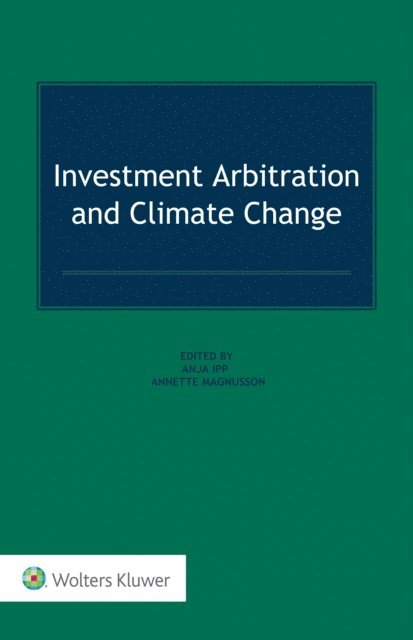
At the nexus between international investment law, climate law, and human rights law, States’ obligations to protect foreign investments clash with their right – or even their duty – to regulate to protect the planet and people. State efforts at climate change mitigation and adaptation have already triggered claims of liability under the investor-protection provisions of bilateral and multilateral investment treaties. In this comprehensive elaboration on the topic, stellar experts and practitioners describe different types of climate-related investment disputes, provide a thorough analysis of the unique procedural issues that emerge in such disputes, and evaluate the proper balance between States’ right to regulate to fight climate change and their obligations towards foreign investors.
Each of the book’s contributions offers a penetrating perspective on this complex matter, touching on such aspects as the following:
investment disputes arising from States’ climate measures or actions;
whether and how states can file counterclaims against investors in such disputes;
the appropriate role for climate science at various stages of arbitration;
how to assess damages in cases involving fossil assets left stranded by the climate transition; and
whether, on balance, existing international investment law supports or hinders the global energy transition.
Along the way, arbitrators and other practitioners will gain insight into how to argue, defend, and assess climate-related investment disputes, using not only investment-treaty case law but also international climate agreements, human rights law, and environmental law. Policymakers are shown ways to design and implement climate policy and investment treaties in order to avoid claims by foreign investors.
For policymakers, treaty and contract negotiators, dispute resolution lawyers, and international organizations, no other resource provides such incisive discussion of how to balance treaty-based investment protection against states’ inherent duty to regulate in the public interest.
2 217 kr
Läs direkt efter köp
At the nexus between international investment law, climate law, and human rights law, States’ obligations to protect foreign investments clash with their right – or even their duty – to regulate to protect the planet and people. State efforts at climate change mitigation and adaptation have already triggered claims of liability under the investor-protection provisions of bilateral and multilateral investment treaties. In this comprehensive elaboration on the topic, stellar experts and practitioners describe different types of climate-related investment disputes, provide a thorough analysis of the unique procedural issues that emerge in such disputes, and evaluate the proper balance between States’ right to regulate to fight climate change and their obligations towards foreign investors.
Each of the book’s contributions offers a penetrating perspective on this complex matter, touching on such aspects as the following:
investment disputes arising from States’ climate measures or actions;
whether and how states can file counterclaims against investors in such disputes;
the appropriate role for climate science at various stages of arbitration;
how to assess damages in cases involving fossil assets left stranded by the climate transition; and
whether, on balance, existing international investment law supports or hinders the global energy transition.
Along the way, arbitrators and other practitioners will gain insight into how to argue, defend, and assess climate-related investment disputes, using not only investment-treaty case law but also international climate agreements, human rights law, and environmental law. Policymakers are shown ways to design and implement climate policy and investment treaties in order to avoid claims by foreign investors.
For policymakers, treaty and contract negotiators, dispute resolution lawyers, and international organizations, no other resource provides such incisive discussion of how to balance treaty-based investment protection against states’ inherent duty to regulate in the public interest.
3 042 kr
Tillfälligt slut
3 531 kr
Tillfälligt slut