Antonino Salmeri – författare
2 052 kr
Skickas inom 5-8 vardagar
1 744 kr
Läs direkt efter köp
Aerospace Law and Policy Series, Volume 24
Space mining holds the potential to revolutionize the space sector, but whether this revolution will be for good or for worse depends on how it will be governed. Under the right framework, space resource activities can enable a new era of prosperous and sustainable space exploration. But with the wrong rules (or lack thereof), they have the potential to destabilize the peaceful and cooperative uses of space. This book provides an in-depth analysis of how the systemic nature of international law, existing provisions of international space law and a growing number of national legislations are shaping the multi-level governance of space mining, including an unprecedented assessment of possible adjudication and enforcement options.
The author investigates the multi-level framework of space law provision by provision, foregrounding relevant implications for the governance of space mining. Questions addressed include the following:
Which national and international provisions govern the conduct of space resource activities?
Are these provisions sufficient, and can they be enforced?
How can we evolve the existing framework to govern large-scale, long-term space resource activities?
What practical lessons can be learnt from comparable regulatory regimes governing the sea, telecommunications and Antarctica?
The author moves from general to particular, beginning with the status of international law as a legal order and ending with the specific options available for enforcing norms applicable to space mining. The book concludes by evaluating the tenure of the current governance system and proposing three pragmatic correctives to stabilize it in the short, medium, and long term.
Professionals and academics involved or interested in space mining will find this book indispensable. It will provide them with a full and clear picture of the regulatory status quo, as well as with expert advice on how to navigate the complex dynamics of contemporary policymaking efforts in this area. Space mining operators can further use this book to understand the implications of domestic and international provisions applicable to their activities. Finally, regulators and policymakers can leverage the analysis conducted in this book to identify the key aspects to be addressed for the safe, sustainable, rational and peaceful conduct of space resource activities in accordance with international law and as the province of all humankind.
1 744 kr
Läs direkt efter köp
Aerospace Law and Policy Series, Volume 24
Space mining holds the potential to revolutionize the space sector, but whether this revolution will be for good or for worse depends on how it will be governed. Under the right framework, space resource activities can enable a new era of prosperous and sustainable space exploration. But with the wrong rules (or lack thereof), they have the potential to destabilize the peaceful and cooperative uses of space. This book provides an in-depth analysis of how the systemic nature of international law, existing provisions of international space law and a growing number of national legislations are shaping the multi-level governance of space mining, including an unprecedented assessment of possible adjudication and enforcement options.
The author investigates the multi-level framework of space law provision by provision, foregrounding relevant implications for the governance of space mining. Questions addressed include the following:
Which national and international provisions govern the conduct of space resource activities?
Are these provisions sufficient, and can they be enforced?
How can we evolve the existing framework to govern large-scale, long-term space resource activities?
What practical lessons can be learnt from comparable regulatory regimes governing the sea, telecommunications and Antarctica?
The author moves from general to particular, beginning with the status of international law as a legal order and ending with the specific options available for enforcing norms applicable to space mining. The book concludes by evaluating the tenure of the current governance system and proposing three pragmatic correctives to stabilize it in the short, medium, and long term.
Professionals and academics involved or interested in space mining will find this book indispensable. It will provide them with a full and clear picture of the regulatory status quo, as well as with expert advice on how to navigate the complex dynamics of contemporary policymaking efforts in this area. Space mining operators can further use this book to understand the implications of domestic and international provisions applicable to their activities. Finally, regulators and policymakers can leverage the analysis conducted in this book to identify the key aspects to be addressed for the safe, sustainable, rational and peaceful conduct of space resource activities in accordance with international law and as the province of all humankind.
1 447 kr
Läs direkt efter köp
Aerospace Law and Policy Series, Volume 22
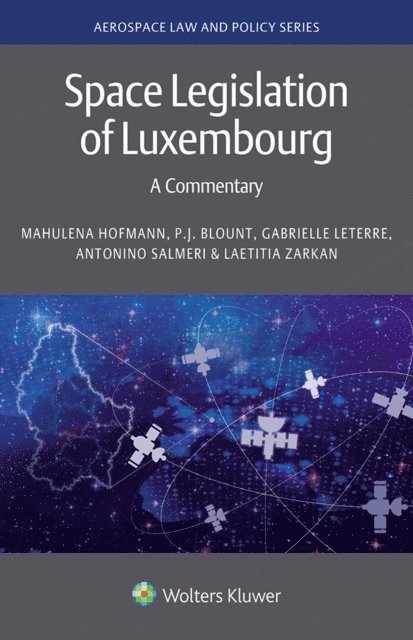
For more than three decades, Luxembourg has been at the forefront of commercial and cooperative initiatives that have shaped a vibrant space economy. Since 2017, this formidable role in global enterprise has been brought to legal fruition with three farseeing laws designed to make Luxembourg the most favorable jurisdiction for registering commercial missions to exploit space resources. This book presents expert article-by-article commentary on these laws by scholars from the staff of the renowned SES Chair in Space, Satellite Communications and Media Law of the University of Luxembourg, as well as the first non online publication in English of the laws otherwise only available in French.
For investors and operators seeking a safe and attractive legal environment in space resources activities, the Commentary will greatly clarify such crucial matters as the following:
whether the authorization procedure is smooth or cumbersome, affordable or expensive;
whether and which insurance is required;
whether potential liability for damage caused by a space object will be capped or not; and
procedures and consequences attached to termination of space activity.
Each section of the Commentary follows the same structure: first the English text of the article, then its drafting history (genesis and context), then legal interpretation, and finally evaluation, including comparison with space laws of other countries.
The pace of innovation in space-related technology continues to accelerate, but making tomorrow’s technical possibilities a reality requires practical legal support today. This valuable tool for the further economic development of a dynamic and competitive commercial sector offers a clear legal framework ensuring that private operators, investors and entrepreneurs working in space can be confident about their rights, including their rights to the resources they extract. The book also represents a milestone in space law for academics and practitioners in the field.
1 447 kr
Läs direkt efter köp
Aerospace Law and Policy Series, Volume 22
For more than three decades, Luxembourg has been at the forefront of commercial and cooperative initiatives that have shaped a vibrant space economy. Since 2017, this formidable role in global enterprise has been brought to legal fruition with three farseeing laws designed to make Luxembourg the most favorable jurisdiction for registering commercial missions to exploit space resources. This book presents expert article-by-article commentary on these laws by scholars from the staff of the renowned SES Chair in Space, Satellite Communications and Media Law of the University of Luxembourg, as well as the first non online publication in English of the laws otherwise only available in French.
For investors and operators seeking a safe and attractive legal environment in space resources activities, the Commentary will greatly clarify such crucial matters as the following:
whether the authorization procedure is smooth or cumbersome, affordable or expensive;
whether and which insurance is required;
whether potential liability for damage caused by a space object will be capped or not; and
procedures and consequences attached to termination of space activity.
Each section of the Commentary follows the same structure: first the English text of the article, then its drafting history (genesis and context), then legal interpretation, and finally evaluation, including comparison with space laws of other countries.
The pace of innovation in space-related technology continues to accelerate, but making tomorrow’s technical possibilities a reality requires practical legal support today. This valuable tool for the further economic development of a dynamic and competitive commercial sector offers a clear legal framework ensuring that private operators, investors and entrepreneurs working in space can be confident about their rights, including their rights to the resources they extract. The book also represents a milestone in space law for academics and practitioners in the field.