Arnold KAUFMANN – författare
Visar alla böcker från författaren Arnold KAUFMANN. Handla med fri frakt och snabb leverans.
6 produkter
6 produkter
Häftad, Tyska, 1912
516 kr
Skickas inom 10-15 vardagar
E-bok
PDF, Tyska, 2013478 kr
Läs direkt efter köp
Dieser Buchtitel ist Teil des Digitalisierungsprojekts Springer Book Archives mit Publikationen, die seit den Anfängen des Verlags von 1842 erschienen sind. Der Verlag stellt mit diesem Archiv Quellen für die historische wie auch die disziplingeschichtliche Forschung zur Verfügung, die jeweils im historischen Kontext betrachtet werden müssen. Dieser Titel erschien in der Zeit vor 1945 und wird daher in seiner zeittypischen politisch-ideologischen Ausrichtung vom Verlag nicht beworben.
E-bok
PDF, Tyska, 2013524 kr
Läs direkt efter köp
Inbunden, Engelska, 1986
1 623 kr
Skickas inom 10-15 vardagar
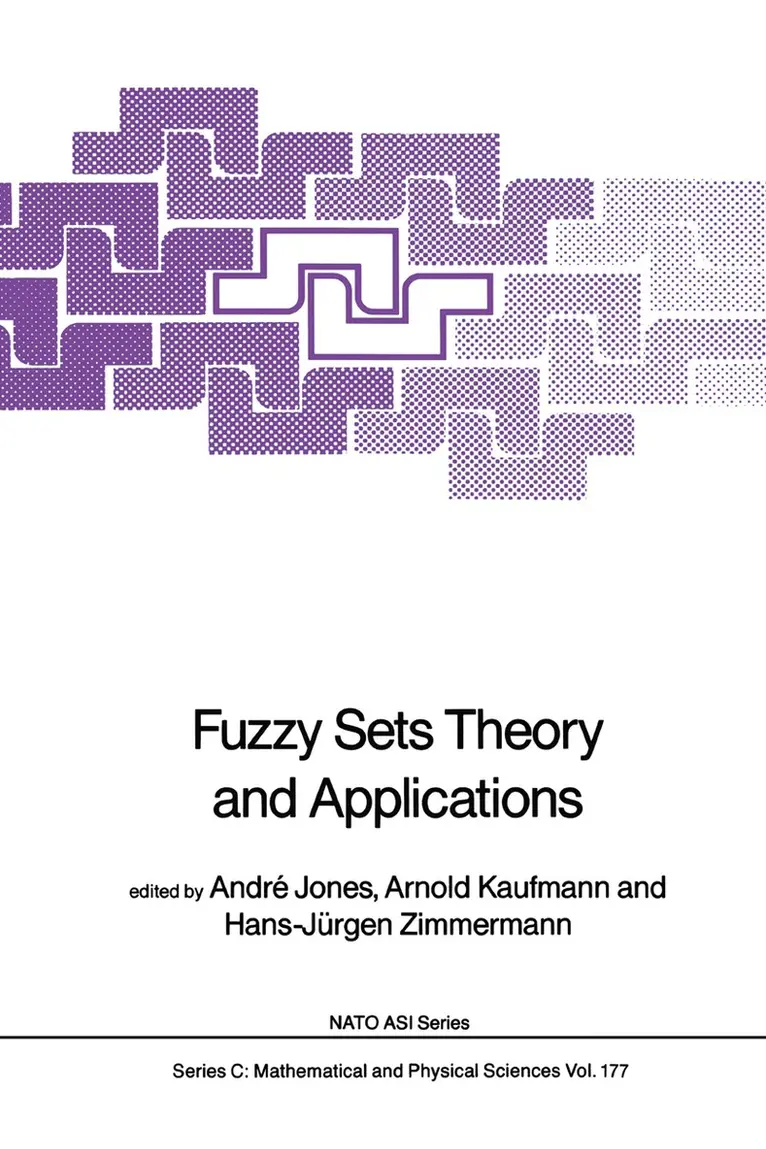
Problems in decision making and in other areas such as pattern recogni tion, control, structural engineering etc. involve numerous aspects of uncertainty. Additional vagueness is introduced as models become more complex but not necessarily more meaningful by the added details. During the last two decades one has become more and more aware of the fact that not all this uncertainty is of stochastic (random) cha racter and that, therefore, it can not be modelled appropriately by probability theory. This becomes the more obvious the more we want to represent formally human knowledge. As far as uncertain data are concerned, we have neither instru ments nor reasoning at our disposal as well defined and unquestionable as those used in the probability theory. This almost infallible do main is the result of a tremendous work by the whole scientific world. But when measures are dubious, bad or no longer possible and when we really have to make use of the richness of human reasoning in its variety, then the theories dealing with the treatment of uncertainty, some quite new and other ones older, provide the required complement, and fill in the gap left in the field of knowledge representation. Nowadays, various theories are widely used: fuzzy sets, belief function, the convenient associations between probability and fuzzines~ etc ••• We are more and more in need of a wide range of instruments and theories to build models that are more and more adapted to the most complex systems.
E-bok
PDF, Engelska, 20122 049 kr
Läs direkt efter köp
Problems in decision making and in other areas such as pattern recogni tion, control, structural engineering etc. involve numerous aspects of uncertainty. Additional vagueness is introduced as models become more complex but not necessarily more meaningful by the added details. During the last two decades one has become more and more aware of the fact that not all this uncertainty is of stochastic (random) cha racter and that, therefore, it can not be modelled appropriately by probability theory. This becomes the more obvious the more we want to represent formally human knowledge. As far as uncertain data are concerned, we have neither instru ments nor reasoning at our disposal as well defined and unquestionable as those used in the probability theory. This almost infallible do main is the result of a tremendous work by the whole scientific world. But when measures are dubious, bad or no longer possible and when we really have to make use of the richness of human reasoning in its variety, then the theories dealing with the treatment of uncertainty, some quite new and other ones older, provide the required complement, and fill in the gap left in the field of knowledge representation. Nowadays, various theories are widely used: fuzzy sets, belief function, the convenient associations between probability and fuzzines~ etc ••• We are more and more in need of a wide range of instruments and theories to build models that are more and more adapted to the most complex systems.
Häftad, Engelska, 2011
1 623 kr
Skickas inom 10-15 vardagar
Problems in decision making and in other areas such as pattern recogni tion, control, structural engineering etc. involve numerous aspects of uncertainty. Additional vagueness is introduced as models become more complex but not necessarily more meaningful by the added details. During the last two decades one has become more and more aware of the fact that not all this uncertainty is of stochastic (random) cha racter and that, therefore, it can not be modelled appropriately by probability theory. This becomes the more obvious the more we want to represent formally human knowledge. As far as uncertain data are concerned, we have neither instru ments nor reasoning at our disposal as well defined and unquestionable as those used in the probability theory. This almost infallible do main is the result of a tremendous work by the whole scientific world. But when measures are dubious, bad or no longer possible and when we really have to make use of the richness of human reasoning in its variety, then the theories dealing with the treatment of uncertainty, some quite new and other ones older, provide the required complement, and fill in the gap left in the field of knowledge representation. Nowadays, various theories are widely used: fuzzy sets, belief function, the convenient associations between probability and fuzzines~ etc ••• We are more and more in need of a wide range of instruments and theories to build models that are more and more adapted to the most complex systems.