Arthur Clay - Böcker
Visar alla böcker från författaren Arthur Clay. Handla med fri frakt och snabb leverans.
8 produkter
8 produkter
394 kr
Skickas inom 5-8 vardagar
285 kr
Skickas inom 5-8 vardagar
377 kr
Skickas inom 5-8 vardagar
238 kr
Skickas inom 5-8 vardagar
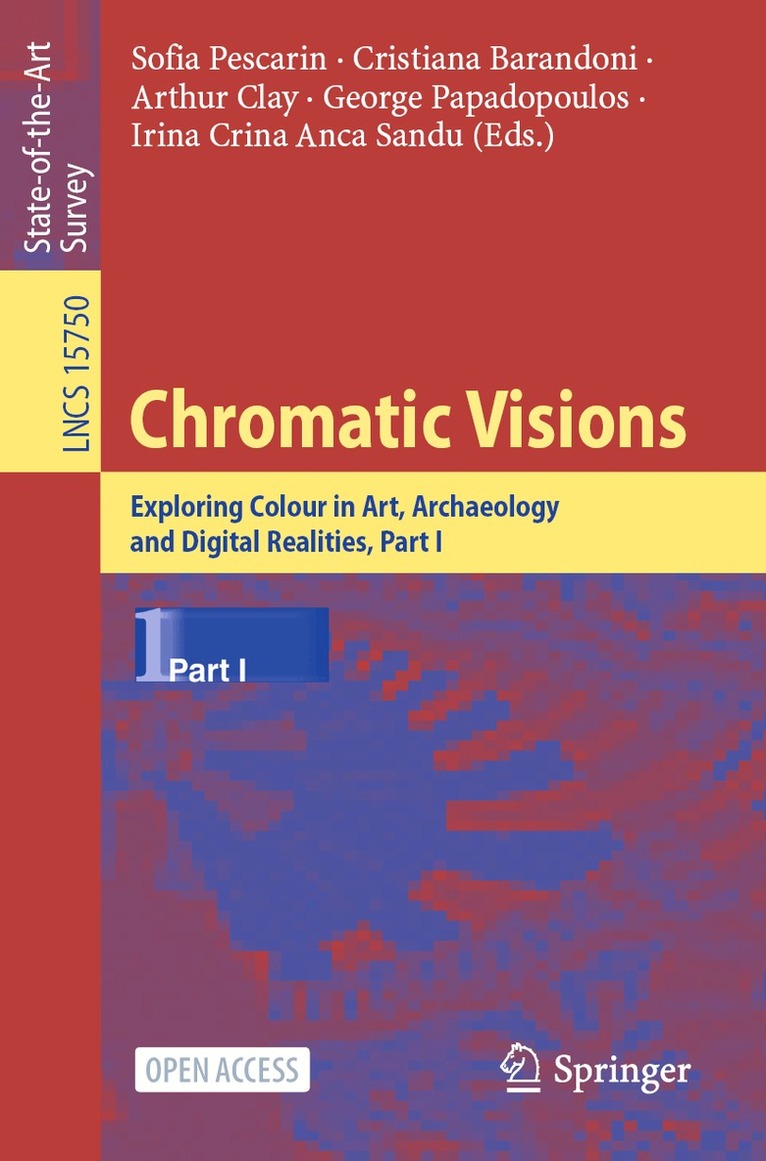
Del 15750 - Lecture Notes in Computer Science
Chromatic Visions
Exploring Colour in Art, Archaeology and Digital Realities, Part I
Häftad, Engelska, 2025
443 kr
Skickas inom 10-15 vardagar
This open access book explores the challenges and opportunities of preserving, reconstructing, exhibiting, and communicating the phenomenon of colour change in heritage collections and artworks through advanced digital technologies, from the perspectives of the authors, many of whom belong to renowned institutions around Europe. Developed within the Horizon Europe project PERCEIVE, this is the first of two volumes offering a comprehensive, interdisciplinary approach to chromatic heritage.Focusing on perception, historical transformations of colour, digital heritage design, and civic participation, the book introduces five key scenarios: from ancient polychrome sculpture and paintings to textiles, historical photographs, and digital-born artworks. Through these, it investigates how colour can be experienced, interpreted, and cared for in both physical and virtual spaces.Combining scientific investigations and concept-oriented design, the volume presents new methodologies based on the concepts of care, authenticity, civic participation and accessibility. It is an essential resource for researchers, curators, designers, and all those engaged in the digital transformation of cultural heritage.
607 kr
Skickas inom 10-15 vardagar
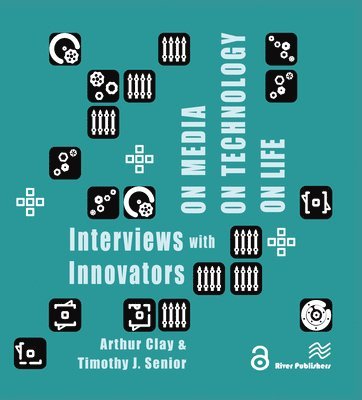
The book 'On Media, On Technology, On Life: Interviews with Innovators' features thirteen artist-researchers whose artworks reconfigure the relationships between living bodies, microorganisms, tools, techniques, and institutions to ask new questions of life itself. When encountered for the first time, these are works that seem to challenge a conventional understanding of what artists and scientists do. Through the words of the artists themselves, these interviews explore what it means to spearhead innovative new partnerships able to create work that takes on a life of its own. By posing new questions at the interface between media, technology, and life, the book explores themes such as the life of multi-species bodies, the future of food security in the age of biotechnology, the microbial lives of historic archives, and the biohacker communities of the future. Together, they reveal how we are all actors in this theatre of life innovation.
1 371 kr
Skickas inom 5-8 vardagar
The book ‘On Media, On Technology, On Life: Interviews with Innovators’ features thirteen artist-researchers whose artworks reconfigure the relationships between living bodies, microorganisms, tools, techniques, and institutions to ask new questions of life itself. When encountered for the first time, these are works that seem to challenge a conventional understanding of what artists and scientists do. Through the words of the artists themselves, these interviews explore what it means to spearhead innovative new partnerships able to create work that takes on a life of its own. By posing new questions at the interface between media, technology, and life, the book explores themes such as the life of multi-species bodies, the future of food security in the age of biotechnology, the microbial lives of historic archives, and the biohacker communities of the future. Together, they reveal how we are all actors in this theatre of life innovation.
410 kr
Skickas inom 5-8 vardagar
Features a collection of twenty-five interviews with practitioners who are testing the boundaries between the sciences, arts and humanities. Divided into three chapters: On Science, On Art, and On Society, these interviews illustrate to the reader how models of hybridity can nurture new forms of innovation across disciplines and sectors.Fostering innovation in this way is not a simple linear process, but, rather, a complex and multifarious one. It requires the networking of different resources and talents, the pooling of skills, the challenging of boundaries, and the exploration of risk. In facing many of our 21st century problems, new forms of convergence between disciplinary practices are now seen as a necessity, and point to an understanding of innovation that must include some form of hybridity if it is to prove effective.Models of hybrid innovation that can draw on diverse resources, and which can be implemented as a catalyst to trigger innovation, are becoming increasingly common in a variety of settings. A sense of urgency can be felt amongst many communities to reach outside the four walls of their institutions and establish – with all force – innovative platforms that can help tackle the complex challenges and opportunities they encounter. Amongst the many topics addressed in this book, for example, authors ask whether neuroscience can uncover the laws of aesthetics, whether citizen science will open scientific research to a larger community of stakeholders, whether corporate responsibility and grass-roots innovation can bring about a fairer society based on the sharing of opportunities and resources, and whether new approaches to tourism can help build inclusive and sustainable local economies.By providing platforms for knowledge exchange and co-creation across different disciplines, we will see the continued emergence of new forms of understanding and insight. Taken together, we are seeing the potential for hybrid models of innovation to usher in an era of more sustainable and responsible governance, economics, research, education and citizenship.Readers interested in innovation, and the processes that drive it, will find in each themed chapter unique insights from established, as well as upcoming, innovators. Offering examples from their own fields of expertise, we hope these interviews will act as a spark for future discussion, and inspire others to explore the exciting possibilities that cross-disciplinary collaboration can offer. We also hope that the Korean-Swiss context from which the book stems may serve as a model for nurturing cross-cultural exchange in this endeavour.