Asghar Sabbaghi – författare
Visar alla böcker från författaren Asghar Sabbaghi. Handla med fri frakt och snabb leverans.
4 produkter
4 produkter
Del 13 - Natural Resource Management and Policy
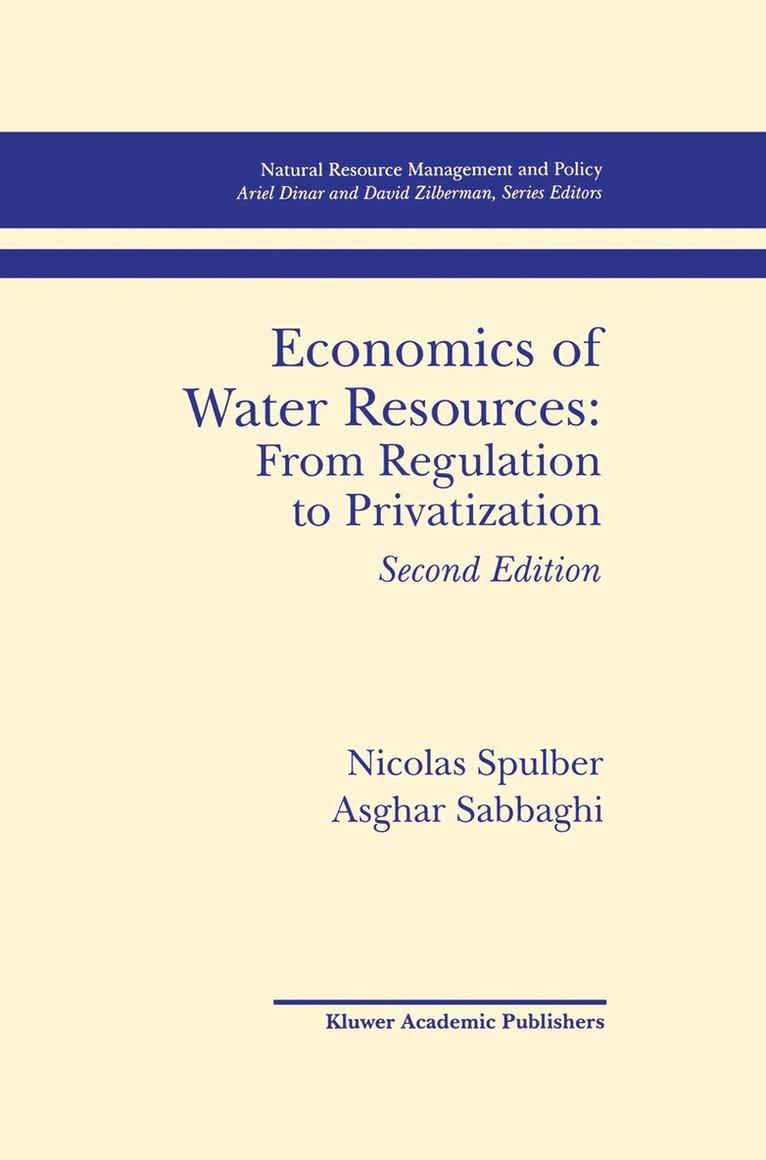
Economics of Water Resources: From Regulation to Privatization
Inbunden, Engelska, 1998
1 631 kr
Skickas inom 10-15 vardagar
The appearance of this Second Edition has been encouraged by the favorable reception of the first. This has offered us the opportunity to update the materials and to expand the exposition ofour central theses concerning (1) the integration of water quantity-quality issues and the treatment of water as a multi-product commodity, with the market playing a major role in determining water quality-discriminant pricing; (2) the drawbacks of public controls, regulation and enforcement, and the need to expand privatization of water supply and of water and wastewater treatment facilities to ensure their appropriate development and modernization through increased reliance on private capital; (3) the unification and centralization of water management on the river basin level in order to handle effectively the expanding pressures for water availability, for the elimination of waterborne disease, for extensive and effective pollution abatement as well as coping with the related issues of soil erosion, siltation in streams, channels, and reservoirs, protection against distress from drought and floods, and with the myriad problems relating to the environment, recreation, and navigation. We have maintained the division ofthe book into four major parts and 12 chapters.
Del 13 - Natural Resource Management and Policy
Economics of Water Resources: From Regulation to Privatization
Häftad, Engelska, 2012
1 634 kr
Skickas inom 10-15 vardagar
The appearance of this Second Edition has been encouraged by the favorable reception of the first. This has offered us the opportunity to update the materials and to expand the exposition ofour central theses concerning (1) the integration of water quantity-quality issues and the treatment of water as a multi-product commodity, with the market playing a major role in determining water quality-discriminant pricing; (2) the drawbacks of public controls, regulation and enforcement, and the need to expand privatization of water supply and of water and wastewater treatment facilities to ensure their appropriate development and modernization through increased reliance on private capital; (3) the unification and centralization of water management on the river basin level in order to handle effectively the expanding pressures for water availability, for the elimination of waterborne disease, for extensive and effective pollution abatement as well as coping with the related issues of soil erosion, siltation in streams, channels, and reservoirs, protection against distress from drought and floods, and with the myriad problems relating to the environment, recreation, and navigation. We have maintained the division ofthe book into four major parts and 12 chapters.
E-bok
PDF, Engelska, 20121 977 kr
Läs direkt efter köp
The appearance of this Second Edition has been encouraged by the favorable reception of the first. This has offered us the opportunity to update the materials and to expand the exposition ofour central theses concerning (1) the integration of water quantity-quality issues and the treatment of water as a multi-product commodity, with the market playing a major role in determining water quality-discriminant pricing; (2) the drawbacks of public controls, regulation and enforcement, and the need to expand privatization of water supply and of water and wastewater treatment facilities to ensure their appropriate development and modernization through increased reliance on private capital; (3) the unification and centralization of water management on the river basin level in order to handle effectively the expanding pressures for water availability, for the elimination of waterborne disease, for extensive and effective pollution abatement as well as coping with the related issues of soil erosion, siltation in streams, channels, and reservoirs, protection against distress from drought and floods, and with the myriad problems relating to the environment, recreation, and navigation. We have maintained the division ofthe book into four major parts and 12 chapters.
E-bok
PDF, Engelska, 20131 100 kr
Läs direkt efter köp
The purpose of this book is to develop a general economic model which integrates the quantity and quality issues of water resource management and to provide, along with a detailed criticism of the policy instruments now in use, alternative proposals concerning the efficient allocation and distribution of water. In particular we treat water as a multi-product commodity where the market plays a major role in determining water quality-discriminant pricing and its value to the user. We examine the process of moving from administrative allocation and regulation to privatization of the water industry as the key element in promoting effective competition and in providing economic incentives for greater efficiency. Water quantity and quality, considered independently of each other, have been the subject of numerous studies during the last twenty years. Let us recall briefly the most outstanding among them. A variety of models have been constructed concerning the optimal scheduling and sequence of water-supply projects: dynamic programming for solving multi-bjective functions in water resource development; planning models for coordinating regional water-resource supply and demand, etc. Other studies have devised water-quality management models, including multi-period design of regional or municipal wastewater systems; cost-allocation methods to induce effluent dischargers to participate in regional water systems; models to predict the quality of effluent (in particular, whether it meets certain established standards); models for finding optimal waste-removal policies at each of the polluting sources, and so on.