(Āśram Vidyā Order) Raphael – författare
230 kr
Skickas inom 5-8 vardagar
At the Source of Life
Questions and Answers concerning the Ultimate Reality
176 kr
Skickas inom 5-8 vardagar
178 kr
Skickas inom 5-8 vardagar
176 kr
Skickas inom 5-8 vardagar
156 kr
Skickas inom 5-8 vardagar
Initiation Into the Philosophy of Plato
199 kr
Skickas inom 5-8 vardagar
211 kr
Skickas inom 5-8 vardagar
Drgdrsyaviveka
A philosophical investigation into the nature of the 'Seer' and the 'seen'
178 kr
Skickas inom 5-8 vardagar
On the Order of Nature
For a Phylosophical Ascesis
199 kr
Skickas inom 5-8 vardagar
102 kr
Skickas
Bhagavadgita
The Celestial Song
234 kr
Skickas inom 5-8 vardagar
Pathway of Fire According to the Qabbalah
'Ehjeh 'Aser 'Ehjeh, I am That I am
167 kr
Skickas inom 5-8 vardagar
179 kr
Skickas inom 5-8 vardagar
Beyond Doubt
Approaches to Non-duality
187 kr
Skickas inom 5-8 vardagar
Brahmasūtra
287 kr
Skickas inom 5-8 vardagar
Pathway of Non-Duality
Advaitavada
198 kr
Skickas inom 5-8 vardagar
107 kr
Läs direkt efter köp
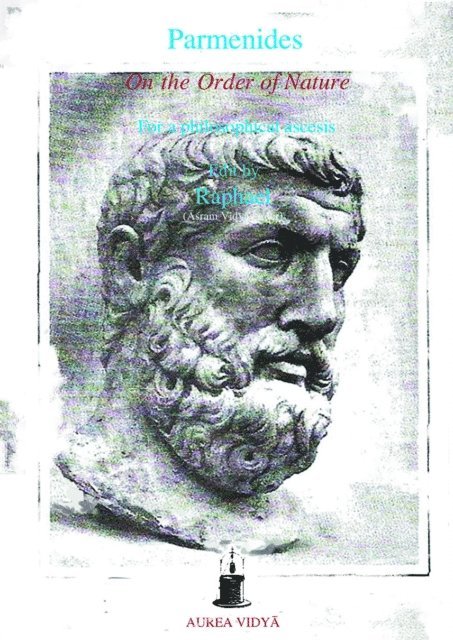
With PARMENIDES began what is called, in more specific terms, true Philosophy. The Eleatic, and his Poem, constitute a "beacon" whose light illumined Plato and even Aristotle, and consequently all the philosophers that followed. Parmenides laid down several fundamental philosophical principles:
1. The Being as foundation of all the existent2. The principle of identity, Being is identical to itself3. The principle of non-contradiction4. The principle of a-temporality or eternal present5. An initiatory philosophical vision of an experiential order
For Parmenides the primary aim is the research for the ultimate Truth, and he, Parmenides, has introduced the mortals to the straight path of wisdom:
"... and here immediately through the gate the maidens steered the chariot and the mares straight onto the road. The Goddess kindly welcomed me and took my right hand in hers and addressing me she uttered so: "O young companion, led by the mares and immortal charioteers, you come to our home: rejoice, for no adverse Moira sent you to travel this path - which is far from the way traveled by men - but Themis and Dike"
The transition from one state of consciousness to another higher one, in a completely objectivistic society, is a revolutionary event, and also of this consists Parmenides' greatness and importance in contemporary life.
Aparoksanubhuti
Self-Realization
200 kr
Skickas inom 5-8 vardagar
107 kr
Läs direkt efter köp
This Pathway of Non-duality (Advaitavada) provides an answer to the apparently rational doubts and contradictions that are expressed both in the realm of philosophy and in the realm of science, which focuses nowdays on discovering a constant or law which will serve as the foundation for every branch of scientific knowledge.
Non-dualism, dualism, monism, the Real and the unreal, Parmenides and his vision, Advaita Vedanta, metaphysical Realization: these are just some of the topics covered by Raphael in a series of writings couched in the form of questions and answers and gathered together in this volume. It constitutes a valid means of approach to the most important issues ever discussed by philosophers and seekers of the truth: Being and non-being, the One and the many, the Absolute and the relative.
Having realized the Unity of the Tradition which considers the Whole (as Plato would say), Raphael expresses himself with a conceptual methodology well suited to the receptivity of the modern mind. He enables his readers to deepen their understanding, at the conscious as well as the conceptual level, of what may be described as the most difficult metaphysical visions. Having traversed the ‘Path without support or relationship’ (Asparshavada), he brings into the light of knowledge the fundamental realities of the most daring pathways to realization ever propounded by the greatest thinkers and philosophers of both East and West.
The ‘Path of non-generation’ (Ajativada), as expounded by Gaudapada, makes it clear that the supreme Being is pure actuality, which excludes all multiplicity, all duality, and all ontological unity, as well as all transition from potentiality to actuality. In the text, this view is compared to that of Parmenides, for whom Being is and does not become: it is unity and actuality, everlasting and not subject to birth (ajati) or death.
Advaita Vedānta (Non-duality), as presented by Shankara, envisages a Unity beyond the realm of mathematics, a ‘Not-two’ which does not grow and which is without any relationship (asparsha). This metaphysical, non-dual Unity may be compared to the One Good or the Supreme Good of Plato and to the One of Plotinus.
The text makes references both to the Upanishads and to the most illuminating passages from those Philosophers who have the closest links with the initiatory Tradition of the Sacred Mysteries in ancient Greece.
From Orpheus to Pythagoras, from Plato to Plotinus, the vision of the metaphysical unity has always been reflected upon and transmitted. Since these teachings engage the very consciousness of our being, we may speak of a Western metaphysics of realization, and in this volume Raphael accentuates and enlivens this ever-present Philosophia perennis and encourages us to actually realize it.
77 kr
Läs direkt efter köp
This text offers a series of dialogues between RAPHAEL and a group of people who are spurred by a lack of satisfaction in living, and experience a need for inquiry.
It is often believed that the human being is none other than history and temporality, and therefore that the very reality of life is simply time-history-becoming.
To hold that all is relative, becoming and duality, and to deny the existence of a "constant" is a position that leads to a series of philosophical lacks, deficiencies and contradictions that are reflected in our existence.
Thus a metaphysical "vision" is called for, a firm position of consciousness rooted in the knowledge of non-duality (Advaita), which implies emerging from the perspective of time, space and cause.
In these dialogues, Raphael touches on topics such as Sensorial Materialism, Philosophy of Being, Transformation of Consciousness and Asparśavāda (the path without supports). These topics are developed in the light of a specific kind of Comprehension that is devoid of contradiction and opposition and is therefore capable of offering each individual a possible realization corresponding to his or hers particular state of consciousness.
Five Upanisads
Isa Kaivalya Sarvasara Amrtabindu Atharvasira
190 kr
Skickas inom 5-8 vardagar
Philosophy of Being
A conception of life for coming out of the turmoil of individual and social conflict
189 kr
Skickas inom 5-8 vardagar
77 kr
Läs direkt efter köp
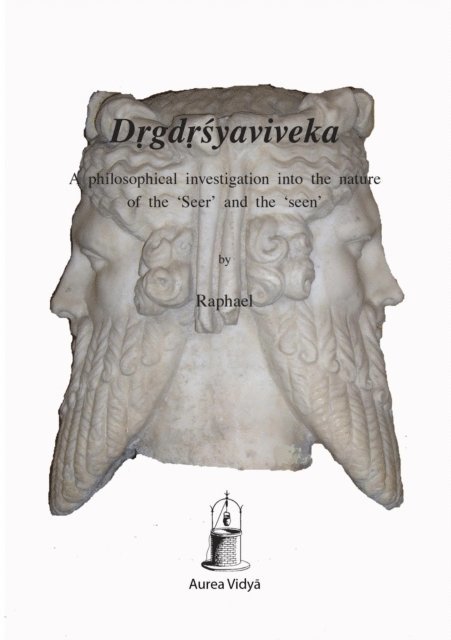
The Dṛgdṛśyaviveka, which is attributed to ŚAṄKARA, invites us to discern (viveka) between Real and non-real, between the ātman (Self), the "Seer," and the non-ātman (non-Self), the "seen," between Infinite and finite, between Life and death. The human being''s greatest conflicts stem from attachment to and identification with the non-ātman, with the finite. Knowledge, on the other hand, leads to the unveiling of sat, True Existence.
RAPHAEL comments: A star is born, grows, matures, ages and dies, and these events are an uninterrupted flow of change. There is never a moment when the physical world undergoes no change or atomic or molecular transformation. If we are in agreement that the Absolute must be eternally "constant", "unvarying" then we cannot look for it in the world of phenomena, whether objective or subjective.
Thus the Dṛgdṛśyaviveka expounds a detailed description of the different kinds of concentration (samādhi), of the three theories empirically concerning the jīva, and other questions of vital importance to the Vedānta teaching.
In Svāmi Nikhilānanda''s words: "This work, which contains only forty-six ślokas is an excellent vade-mecum (handbook) for students of advanced courses in Advaita philosophy."
ŚAṄKARA has been one of the greatest philosophers of India. He dedicated his brief and intense life (788-820) to re-establish the authority of the Śruti, to codify the Advaita Vedānta, the doctrine of Non-duality, and to anchor the Metaphysical Tradition of the Veda through the foundation of monasteries (maṭhas) and monastic orders. With his bhāṣya (commentary) to the Upaniṣads, the Brahmasūtra, and the Bhagavadgītā, as well as with his own writings, Śaṅkara has profoundly influenced not only India''s philosophical development, but that of the entire world.