Ayodeji Ogunnaike – författare
Visar alla böcker från författaren Ayodeji Ogunnaike. Handla med fri frakt och snabb leverans.
3 produkter
3 produkter
Inbunden, Engelska, 2026
451 kr
Kommande
The first major work of Yoruba mythology retells hundreds of traditional tales from West Africa, Cuba, and Brazil. Beautifully illustrated throughout. Yoruba mythology is sacred to the traditional Yoruba religion and culture of the Yoruba people of West Africa found primarily in Nigeria, Bénin Republic, and Togo. It is a community of more than 100 million practitioners, who can be found on every continent. An oral tradition, many of the stories revolve around Olodumare, a Supreme Being, and the source of all creation and a number of divinities, or Orisa, who control the elements of nature, events, and human behavior including Obatala (creation), Oduduwa (the warrior), Sango (lightning, fire, dance, and drumming), Oya (wind, storms, and thunder), Esu (chaos and trickery), Yamoja (motherhood and protection), and Iku (death), to name just a few. Yoruba Mythology is the first-ever full-scale collection of more than 300 myths of this ancient, profound, and beautiful storytelling tradition. Authors Ayodeji Ogunnaike and Oludamini Ogunnaike have spent decades learning and collecting these myths and are uniquely qualified to write this book. Many of the stories they include are recalled from their own childhood where Yoruba myths are traditionally told to young children, while many more are the result a years-long research and encounters with Yoruba practitioners in Nigeria, Cuba, and Brazil. A gift to both those familiar to Yoruba culture and tradition and those who are encountering it for the first time,Yoruba Mythology is an important and long-awaited contribution to the mythological canon.
Inbunden, Engelska, 2026
1 290 kr
Kommande
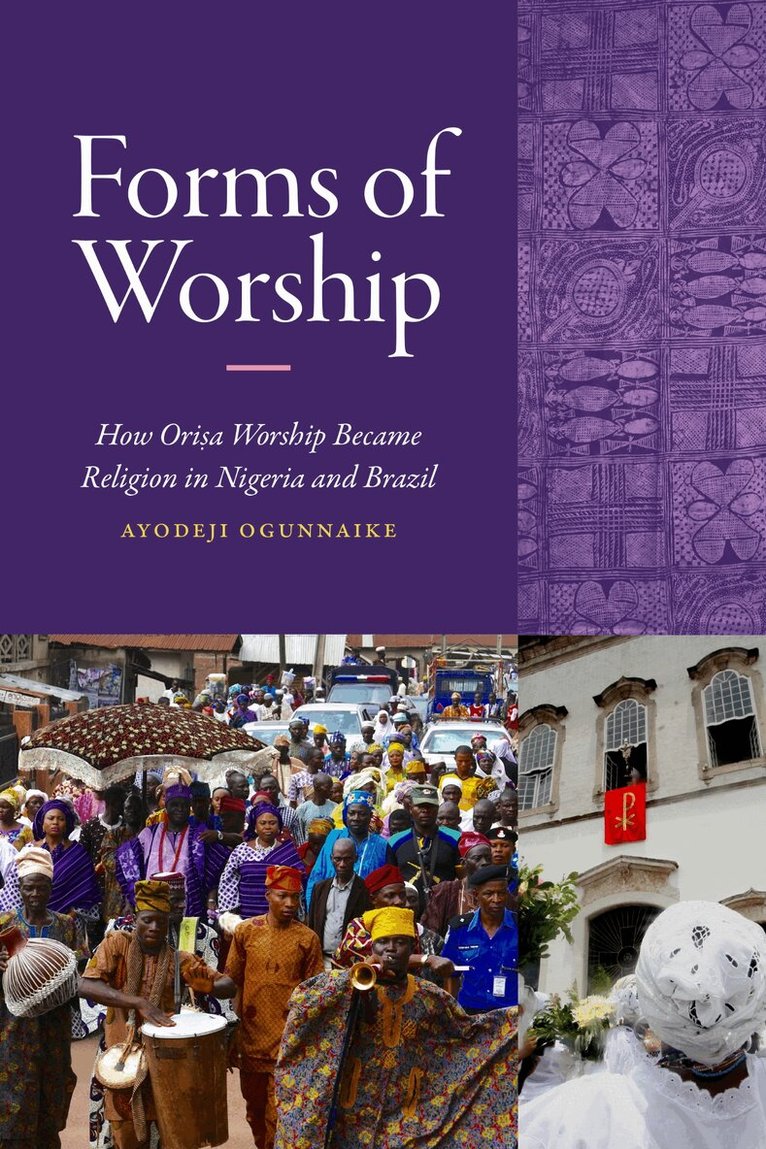
The worship of Yoruba deities is commonly understood as an indigenous African religion, but Ayodeji Ogunnaike argues these traditions were fundamentally different from the modern Western concept of religion. In Forms of Worship, Ogunnaike analyzes how the configuration of oriṣa worship changed across the Yoruba diaspora and homeland. As the meaning of the Yoruba word ẹsin, usually translated as “religion,” is closer to “form of worship,” he examines how reorienting understandings of oriṣa traditions as multiple forms of worship changes how religious identity, practice, and dynamics can be understood in contemporary and historical perspectives. By developing indigenous models for religious phenomena, Ogunnaike accounts for Yoruba cultural dynamics including the high degree of religious harmony, syncretism, and interaction prevalent both in Nigeria and Brazil. Furthermore, he tracks the subtle and largely unperceived shift in oriṣa worship toward a more modern, closed, and rigid conception of a religion and its resulting complications. Forms of Worship demonstrates how the advent of Western religious rigidity regarding practice and identity has led to rising religious tensions and fragmentation.
Häftad, Engelska, 2026
307 kr
Kommande
The worship of Yoruba deities is commonly understood as an indigenous African religion, but Ayodeji Ogunnaike argues these traditions were fundamentally different from the modern Western concept of religion. In Forms of Worship, Ogunnaike analyzes how the configuration of oriṣa worship changed across the Yoruba diaspora and homeland. As the meaning of the Yoruba word ẹsin, usually translated as “religion,” is closer to “form of worship,” he examines how reorienting understandings of oriṣa traditions as multiple forms of worship changes how religious identity, practice, and dynamics can be understood in contemporary and historical perspectives. By developing indigenous models for religious phenomena, Ogunnaike accounts for Yoruba cultural dynamics including the high degree of religious harmony, syncretism, and interaction prevalent both in Nigeria and Brazil. Furthermore, he tracks the subtle and largely unperceived shift in oriṣa worship toward a more modern, closed, and rigid conception of a religion and its resulting complications. Forms of Worship demonstrates how the advent of Western religious rigidity regarding practice and identity has led to rising religious tensions and fragmentation.