Baaquie Belal Ehsan Baaquie – författare
Visar alla böcker från författaren Baaquie Belal Ehsan Baaquie. Handla med fri frakt och snabb leverans.
4 produkter
4 produkter
E-bok
Engelska, 20201 083 kr
Läs direkt efter köp
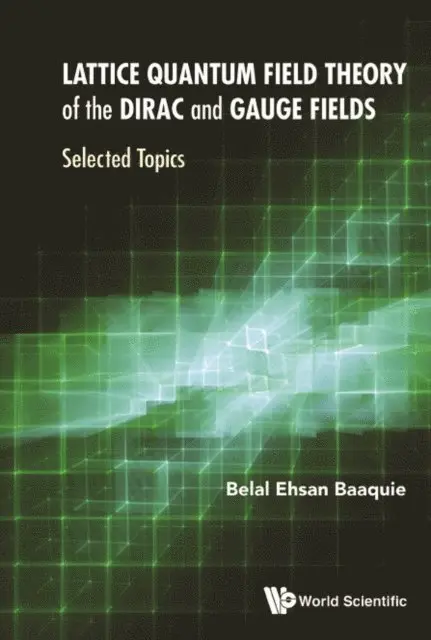
Quantum Chromodynamics is the theory of strong interactions: a quantum field theory of colored gluons (Yang-Mills gauge fields) coupled to quarks (Dirac fermion fields). Lattice gauge theory is defined by discretizing spacetime into a four-dimensional lattice — and entails defining gauge fields and Dirac fermions on a lattice. The applications of lattice gauge theory are vast, from the study of high-energy theory and phenomenology to the numerical studies of quantum fields.Lattice Quantum Field Theory of the Dirac and Gauge Fields: Selected Topics examines the mathematical foundations of lattice gauge theory from first principles. It is indispensable for the study of Dirac and lattice gauge fields and lays the foundation for more advanced and specialized studies.
E-bok
PDF, Engelska, 19891 661 kr
Läs direkt efter köp
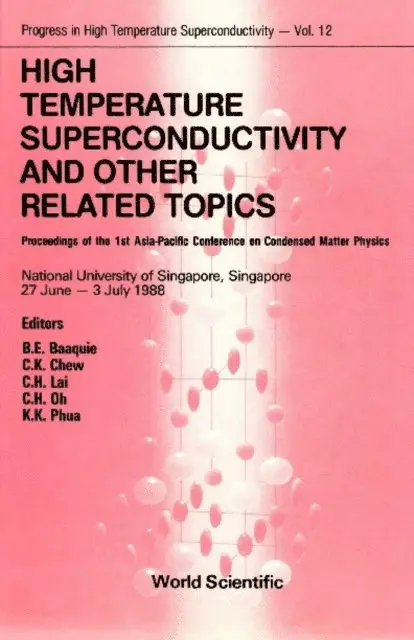
This proceedings covers topics on high Tc superconducting materials, their structure and properties, the devices and their applications. It also covers the theoretical studies as well as state-of-the-art developments in high Tc superconductivity.
E-bok
PDF, Engelska, 2010788 kr
Läs direkt efter köp
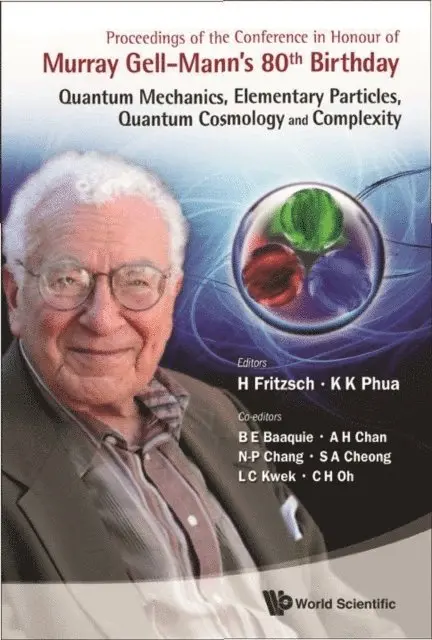
The Conference on Quantum Mechanics, Elementary Particles, Quantum Cosmology and Complexity was held in honour of Professor Murray Gell-Mann''s 80th birthday in Singapore on 24-26 February 2010. The conference paid tribute to Professor Gell-Mann''s great achievements in the elementary particle physics.This notable birthday volume contains the presentations made at the conference by many eminent scientists, including Nobel laureates C N Yang, G ''t Hooft and K Wilson. Other invited speakers include G Zweig, N Samios, M Karliner, G Karl, M Shifman, J Ellis, S Adler and A Zichichi.About Murray Gell-MannMurray Gell-Mann, born September 15, 1929, won the 1969 Nobel Prize in physics for his work on the theory of elementary particles.His contributions span the entire history of particle physics, from the early days of the particle zoo to the modern day QCD. Along the way, even as he proposed new quantum numbers to bring order into the zoo, he had fun in naming them. And thus was born Strangeness, Flavor, Hadrons, Baryons, Leptons, the Eightfold Way, Color, Quarks, Gluons and, with Harald Fritzsch, the standard field theory of strong interactions, Quantum Chromodynamics (QCD).He also proposed with Richard Feynman the V-A theory of beta decay. Gell-Mann discovered the Current Algebra, proposed (with Levy) the sigma model of pions and the see-saw mechanism for the neutrino masses.
E-bok
Engelska, 2015286 kr
Läs direkt efter köp
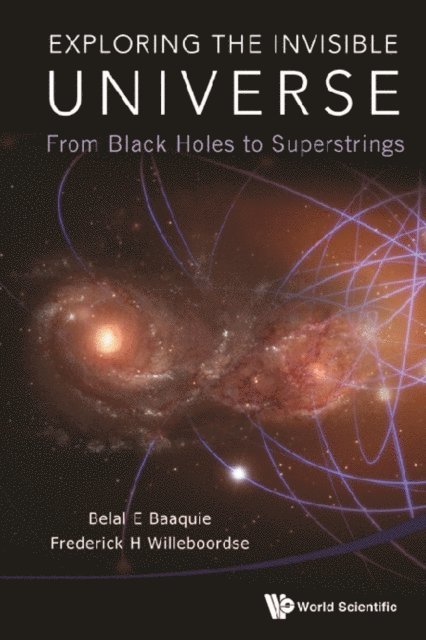
''Why''? Why is the world, the Universe the way it is? Is space infinitely large? How small is small? What happens when one continues to divide matter into ever smaller pieces? Indeed, what is matter? Is there anything else besides what can be seen? Pursuing the questions employing the leading notions of physics, one soon finds that the tangible and visible world dissolves — rather unexpectedly — into invisible things and domains that are beyond direct perception. A remarkable feature of our Universe is that most of its constituents turn out to be invisible, and this fact is brought out with great force by this book.Exploring the Invisible Universe covers the gamut of topics in advanced modern physics and provides extensive and well substantiated answers to these questions and many more. Discussed in a non-technical, yet also non-trivial manner, are topics dominated by invisible things — such as Black Holes and Superstrings as well as Fields, Gravitation, the Standard Model, Cosmology, Relativity, the Origin of Elements, Stars and Planetary Evolution, and more. Just giving the answer, as so many books do, is really not telling anything at all. To truly answer the ''why'' questions of nature, one needs to follow the chain of reasoning that scientists have used to come to the conclusions they have. This book does not shy away from difficult-to-explain topics by reducing them to one-line answers and power phrases suitable for a popular talk show. The explanations are rigorous and straight to the point. This book is rarely mathematical without being afraid, however, to use elementary mathematics when called for. In order to achieve this, a large number of detailed figures, specially developed for this book and found nowhere else, convey insights that otherwise might either be inaccessible or need lengthy and difficult-to-follow explanations.After Exploring the Invisible Universe, a reader will have a deeper insight into our current understanding of the foundations of Nature and be able to answer all the questions above and then some. To understand Nature and the cutting edge ideas of contemporary physics, this is the book to have.