Barrett J. Taylor – författare
Visar alla böcker från författaren Barrett J. Taylor. Handla med fri frakt och snabb leverans.
5 produkter
5 produkter
Häftad, Engelska, 2019
433 kr
Skickas inom 5-8 vardagar
American higher education is often understood as a vehicle for social advancement. However, the institutions at which students enroll differ widely from one another. Some enjoy tremendous endowment savings and/or collect resources via research, which then offsets the funds that students contribute. Other institutions rely heavily on student tuition payments. These schools may struggle to remain solvent, and their students often bear the lion’s share of educational costs. Unequal Higher Education identifies and explains the sources of stratification that differentiate colleges and universities in the United States. Barrett J. Taylor and Brendan Cantwell use quantitative analysis to map the contours of this system. They then explain the mechanisms that sustain it and illustrate the ways in which rising institutional inequality has limited individual opportunity, especially for students of color and low-income individuals.
Inbunden, Engelska, 2019
1 604 kr
Skickas inom 5-8 vardagar
American higher education is often understood as a vehicle for social advancement. However, the institutions at which students enroll differ widely from one another. Some enjoy tremendous endowment savings and/or collect resources via research, which then offsets the funds that students contribute. Other institutions rely heavily on student tuition payments. These schools may struggle to remain solvent, and their students often bear the lion’s share of educational costs. Unequal Higher Education identifies and explains the sources of stratification that differentiate colleges and universities in the United States. Barrett J. Taylor and Brendan Cantwell use quantitative analysis to map the contours of this system. They then explain the mechanisms that sustain it and illustrate the ways in which rising institutional inequality has limited individual opportunity, especially for students of color and low-income individuals.
Häftad, Engelska, 2022
392 kr
Skickas inom 5-8 vardagar
Higher education is a central institution in U.S. democracy. In the 2010s, however, many states that spent previous decades building up their higher education systems began to tear them down. Growing hostility toward higher education reflected changing social forces that remade the politics of U.S. higher education. The political Right became increasingly reliant on angry white voters as higher education became more racially diverse. The Republican party became more closely connected to extremely wealthy donors as higher education became more costly. In Wrecked, Barrett J. Taylor shows how these social changes set a collision course for the Right and higher education. These attacks fed a policy agenda of deinstitutionalization, which encompassed stark divestment from higher education but was primarily characterized by an attack on the institution's social foundation of public trust. In response to these attacks, higher education officials have offered a series of partial defenses that helped higher education to cope in the short-term but did nothing to defend the institution itself against the long-term threat of declining public trust. The failure to address underlying issues of mistrust allowed conflict to escalate to the point at which many states are now wrecking their public higher education systems. Wrecked offers a unique and compelling perspective linking higher education policymaking to broader social and political forces acting in the twenty-first century.
Inbunden, Engelska, 2022
1 603 kr
Skickas inom 5-8 vardagar
Higher education is a central institution in U.S. democracy. In the 2010s, however, many states that spent previous decades building up their higher education systems began to tear them down. Growing hostility toward higher education reflected changing social forces that remade the politics of U.S. higher education. The political Right became increasingly reliant on angry white voters as higher education became more racially diverse. The Republican party became more closely connected to extremely wealthy donors as higher education became more costly. In Wrecked, Barrett J. Taylor shows how these social changes set a collision course for the Right and higher education. These attacks fed a policy agenda of deinstitutionalization, which encompassed stark divestment from higher education but was primarily characterized by an attack on the institution's social foundation of public trust. In response to these attacks, higher education officials have offered a series of partial defenses that helped higher education to cope in the short-term but did nothing to defend the institution itself against the long-term threat of declining public trust. The failure to address underlying issues of mistrust allowed conflict to escalate to the point at which many states are now wrecking their public higher education systems. Wrecked offers a unique and compelling perspective linking higher education policymaking to broader social and political forces acting in the twenty-first century.
Häftad, Engelska, 2026
382 kr
Kommande
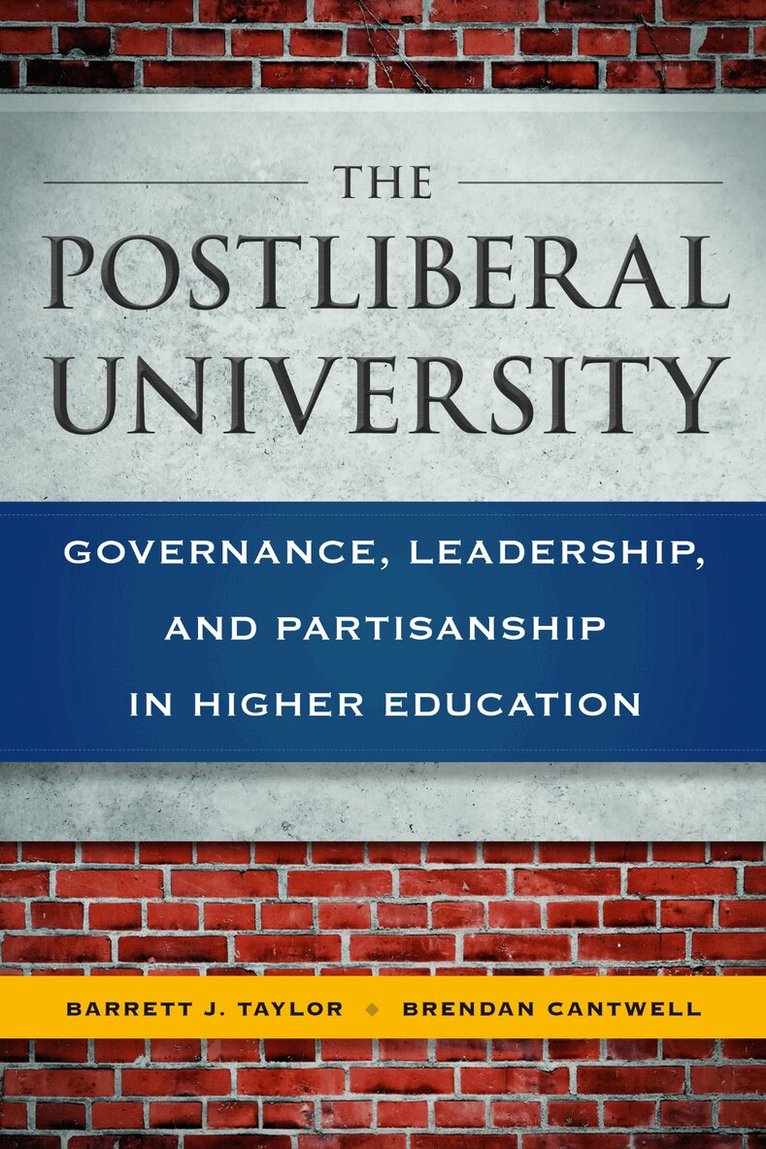
An urgent exploration of the political and social conditions that shape contemporary higher education governanceIn the 2010s, many state governments began to meddle in the core academic activities of their universities. By the 2020s, such attacks were becoming widespread at the state and federal levels: grants and funding have been cancelled, DEI offices dismantled, student protesters detained, and international students' visas revoked. In The Postliberal University, Barrett J. Taylor and Brendan Cantwell explain that decades of precedent have set the stage for partisan control of higher education. In fact, contemporary attacks are a sign that a new understanding is being negotiated between the state, the academy, and the public—a "postliberal" accord that frames higher education as a partisan good rather than a public or private good.This book is an urgent guide to understanding the background of uncertainty and partisan conflict that defines our current moment in higher education. Drawing on original quantitative and qualitative data, along with real-world cases from universities across the country, Taylor and Cantwell explore how political partisans, supported by a substantial share of the public, are using volatility and expanded state power to repurpose higher education legacies, displace the people who work on campuses, and consolidate state control over higher education. To help readers understand how dramatically things have changed, the authors present a robust conceptual account of governance accords and extensive evidence of the demands on public higher education. Then, they provide recommendations and strategies for leaders, policymakers, scholars, and others seeking to uphold higher education's mission in the years to come.The Postliberal University is essential reading for anyone seeking to understand current higher education politics and policy, comprehend the leadership challenges resulting from this landscape, and gain practical strategies for navigating this fast-changing terrain.