
Häftad, Engelska, 1995
653 kr
Skickas inom 3-6 vardagar
653 kr
Skickas inom 3-6 vardagar
422 kr
Skickas inom 5-8 vardagar
866 kr
Skickas inom 5-8 vardagar

1 028 kr
Läs direkt efter köp
509 kr
Läs direkt efter köp
509 kr
Läs direkt efter köp

331 kr
Skickas inom 5-8 vardagar

427 kr
Läs direkt efter köp
Bad Attitude(s) on Trial is a critical analysis of pornography in the context of contemporary Canada. The notion that pornography both reflects sexual domination and ''victimizes'' women has recently found expression in law in the landmark Canadian Supreme Court decision of R. v. Butler (1992). Many feminists embrace this new law as progressive, but in the post-Butler years, straight, mainstream pornography is still flourishing, while sexual representations that challenge conventional notions of sexuality, such as those centering on gay and lesbian sex and s/m sex, are the focus of censorship. It is the censorship of sexual others that the authors critique from a legal, cultural, gay, and philosophical standpoint.
Lise Gotell examines the intervention of the Women''s Legal Education and Action Fund (LEAF) in the Butler decision and provides an overview of socio-legal debates on pornography and censorship. Brenda Cossman examines the Butler decision itself and challenges the dominant reading of this case as a feminist victory. Becki Ross critically examines the expert testimony she delivered in defense of Bad Attitude, an American lesbian sex magazine seized by police from Glad Day Bookshop in Toronto in 1992. She details the difficulties she encountered in explicating and contextualizing the specificities, nuances, and complexities of lesbian s/m fantasy in a court of law. In the final chapter, Shannon Bell advances a conception of pornography that is not distinguishable from philosophy, using philosophy to make pornography.
Bad Attitude(s) on Trial provides a new debate on pornography and feminism. It will be of particular interest to students of both women''s, and gay and lesbian issues, but will also be relevant for scholars of law, political science, and philosophy, as well as for anyone interested in a different, provocative view of the Butler decision.
537 kr
Läs direkt efter köp
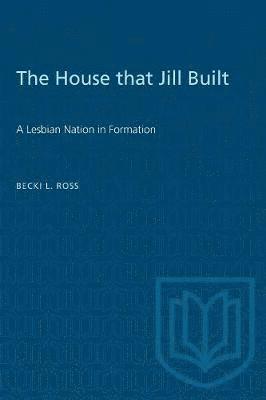
The decade of the 1970s is commonly remembered for its kitschy contributions to popular culture -- bean-bag chairs, platform shoes, bell-bottoms, disaster movies, disco, hot tubs, and hot pants. In The House That Jill Built, Becki Ross offers a rare view of this decade -- one that shows community-based activism challenging the prevailing tenets of individualism and conspicuous consumerism. Ross explores the dedicated struggle of a largely white, middle-class group of lesbian feminists to subvert the history of lesbian invisibility and persecution by claiming a collective, empowering, public presence in Toronto during the mid- to late 1970s.
Gathering information from archival sources and numerous interviews with lesbians who were active in the feminist, left, and gay-liberation movements in the 1970s, Ross provides a window onto complex developments in community, identity, and visionary politics. She uses the Lesbian Organization of Toronto (LOOT, 1976-80) as a centrepiece, tracing the route that LOOT members took in enacting their desire to politicize the personal, in order to be lesbian in all aspects of their lives. Ross investigates the properties intrinsic to ''lesbian nationalism'': fashion, sexuality, relationships, living arrangements, group membership, service provision, cultural production, and political strategy-making.
The House That Jill Built convincingly analyses the significant achievements of lesbian feminism in the 1970s as well as the limitations of identity-based organizing. The book is especially useful for those interested in the fields of women''s studies, cultural studies, queer theory, and social movements.