Ben Jongbloed - Böcker
Visar alla böcker från författaren Ben Jongbloed. Handla med fri frakt och snabb leverans.
4 produkter
4 produkter
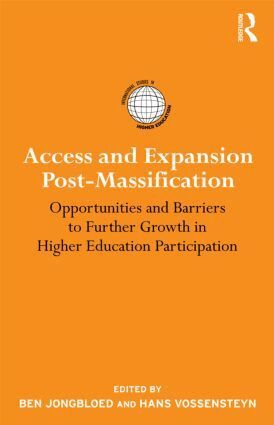
Access and Expansion Post-Massification
Opportunities and Barriers to Further Growth in Higher Education Participation
Inbunden, Engelska, 2015
2 224 kr
Skickas inom 10-15 vardagar
The twenty-first century has the potential to be the era of universal higher education access: the post-massification century. The growth of knowledge-based service industries and an increased need for technological and social innovations require more education, training, and re-training at the post-secondary level. This edited collection addresses the crucial issues emerging from this ongoing expansion of higher education, focusing on how national systems of higher education can respond to demands for further expansion when traditional routes to higher education have been largely exhausted. Does it make a difference how secondary education systems are organised? Can we encourage under-represented groups to participate in higher education, offering them new ways of experiencing higher education without sacrificing quality? What role will new suppliers of higher education, such as private providers, and modes of delivery, such as MOOCs, play? Are there innovative ways to manage the finances of universal access, including tuition fees and student loans? Will all social groups benefit equally from expansion, and find the institution and programme that fits their needs? Expansion will require different modes of delivery, new system models, revised qualification structures, changes to the role played by government, and a revision of the public–private finance mix. While this may lead to tensions in terms of the quality, efficiency, or equality of opportunity in the higher education system, there are also new opportunities for students and higher education institutions.With experienced researchers offering insights, national strategies and policy examples from around the world, Access and Expansion Post-Massification will give researchers and policymakers the tools they need to expand higher education into the era of the knowledge society.
1 034 kr
Skickas inom 10-15 vardagar
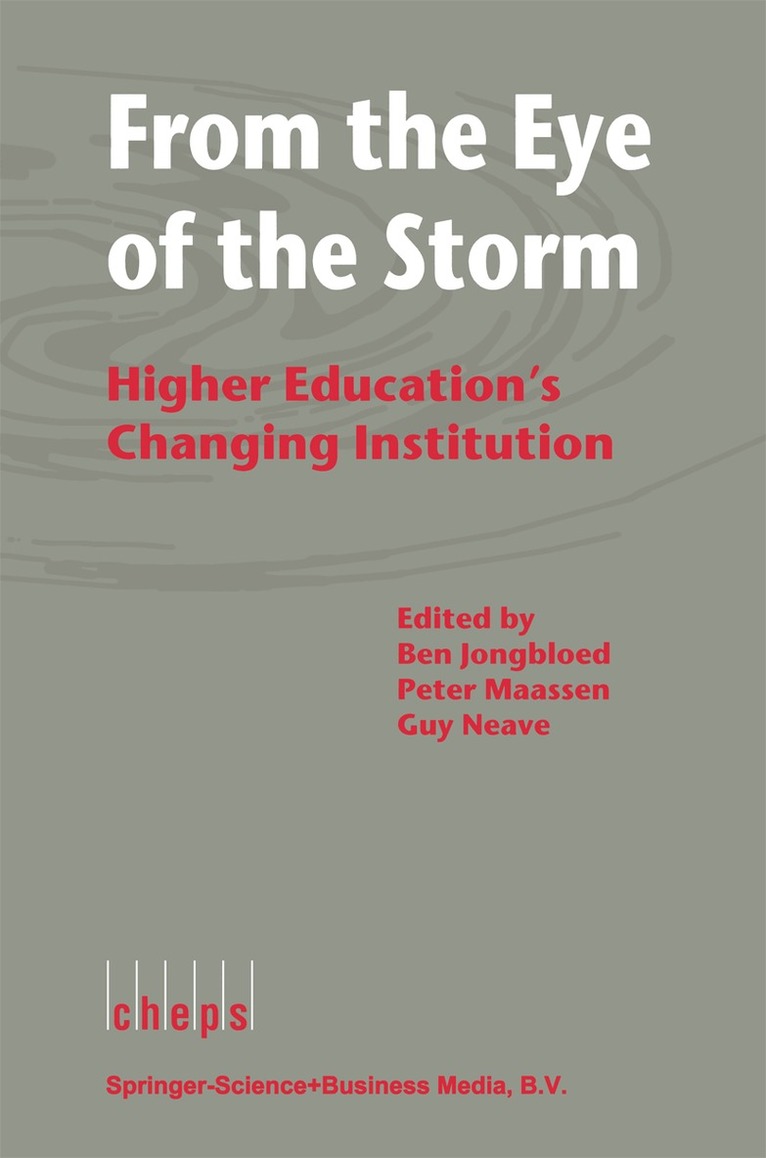
Universities and colleges have been under severe pressure to expand student numbers in order to fulfill new and more business-like approaches and to raise levels of efficiency and quality. Over the coming years, institutes of higher education will face increasing competition for students and funds, as well as the need to prove their relevance to society and become an integral partof the global information economy of the 21st century. They are confronted with such important questions as: how is higher education meeting this challenge? How far is the pressure for change reflected in the institute's working practices? This volume contains a series of chapters that focus on the institutional dimension of higher education policy. They have been written by researchers from the Center for Higher Education Policy Studies (CHEPS) of the University of Twente (The Netherlands) in collaboration with some of their colleagues from outside the Center and cover a broad range of areas in which the Center has been actively involved over the past 15 years.
Access and Expansion Post-Massification
Opportunities and Barriers to Further Growth in Higher Education Participation
Häftad, Engelska, 2017
639 kr
Skickas inom 10-15 vardagar
The twenty-first century has the potential to be the era of universal higher education access: the post-massification century. The growth of knowledge-based service industries and an increased need for technological and social innovations require more education, training, and re-training at the post-secondary level. This edited collection addresses the crucial issues emerging from this ongoing expansion of higher education, focusing on how national systems of higher education can respond to demands for further expansion when traditional routes to higher education have been largely exhausted. Does it make a difference how secondary education systems are organised? Can we encourage under-represented groups to participate in higher education, offering them new ways of experiencing higher education without sacrificing quality? What role will new suppliers of higher education, such as private providers, and modes of delivery, such as MOOCs, play? Are there innovative ways to manage the finances of universal access, including tuition fees and student loans? Will all social groups benefit equally from expansion, and find the institution and programme that fits their needs? Expansion will require different modes of delivery, new system models, revised qualification structures, changes to the role played by government, and a revision of the public–private finance mix. While this may lead to tensions in terms of the quality, efficiency, or equality of opportunity in the higher education system, there are also new opportunities for students and higher education institutions.With experienced researchers offering insights, national strategies and policy examples from around the world, Access and Expansion Post-Massification will give researchers and policymakers the tools they need to expand higher education into the era of the knowledge society.
3 325 kr
Skickas inom 7-10 vardagar
Given the recent re-evaluation of research funding policy as an issue central to national governments and the EU, it is imperative that underlying rationales and channels for investment in research and development are examined. A pioneering analysis of the complexity, allocation and management of public funding of research, this Handbook explores the strategies whereby research can be successfully targeted and supported to resolve problems of broad public concern.Used effectively, the Handbook finds, research has the potential to support economic growth, create jobs, enhance social welfare, protect the environment and expand the frontiers of human knowledge. Taking a multi-level approach, chapters strategize ways to address various funding objectives through analysis of policy design, policy instruments, research organizations and researchers, while remedying disparities resulting from the distribution of research funds. The Handbook’s expansive scope, which covers variation in goals and instrument management over time and across countries, facilitates an approach that not only scrutinizes existing paradigms of public research funding but also looks to the future.With authoritative analysis and theoretical frameworks by leading scholars, the Handbook employs an interdisciplinary approach that combines sociology of sciences, political sciences and economics. It will prove a useful resource for scholars and researchers in science policy studies, alongside policy analysts in ministries and research funding organizations seeking to better understand their working environment.