Benjamin Appel – författare
Visar alla böcker från författaren Benjamin Appel. Handla med fri frakt och snabb leverans.
11 produkter
11 produkter
Häftad, Engelska, 2022
355 kr
Skickas inom 5-8 vardagar
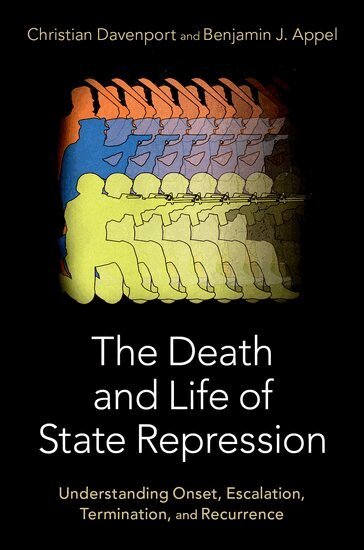
The Death and Life of State Repression addresses a problem that dates back at least 75 years, if not before. Since World War II, individuals and institutions from around the world have been concerned with state repression/human rights violations and since about 1990, a robust empirical literature has emerged to investigate what drives this behavior up or down (i.e., exploring variation). While useful, this work has generally ignored important aspects of the "Death/Life cycle" of state repression: i.e., its onset, escalation, termination and recurrence. Such an approach is important because different explanations and policies might be relevant for different parts of the cycle. Exploring a new database of repressive spells from 1976-2006 and new theory regarding spells, The Death and Life of State Repression breaks new ground in a variety of different ways. The book argues that repression is a sticky process that is largely slow-moving and non-adaptive. Consequently, change in this behavior is rare unless the ruling cohort is perturbed in some manner. What perturbs is somewhat surprising. The authors do not argue or find support for the predominant variables/policies advanced by the international community (i.e., naming/shaming, international law, military intervention and economic sanctions). Rather, their research advances and finds that political democratization plays a crucial role in reducing and stopping most aspects of repressive spells, and democratization itself is influenced by non-violent direct action. The book has major implications for those who wish to study state repression, as well as those who have an interest in trying to reduce and stop it from occurring across the Death/Life cycle. The path to less repressive behavior has never been clearer.
E-bok
PDF, Engelska, 2022301 kr
Läs direkt efter köp
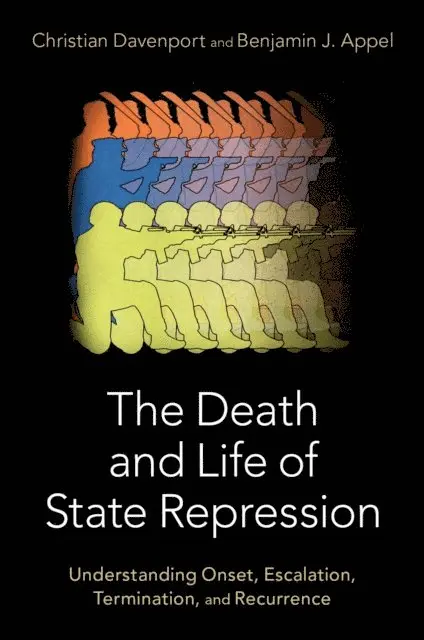
The Death and Life of State Repression addresses a problem that dates back at least 75 years, if not before. Since World War II, individuals and institutions from around the world have been concerned with state repression/human rights violations and since about 1990, a robust empirical literature has emerged to investigate what drives this behavior up or down (i.e., exploring variation). While useful, this work has generally ignored important aspects of the "Death/Life cycle" of state repression: i.e., its onset, escalation, termination and recurrence. Such an approach is important because different explanations and policies might be relevant for different parts of the cycle. Exploring a new database of repressive spells from 1976-2006 and new theory regarding spells, The Death and Life of State Repression breaks new ground in a variety of different ways. The book argues that repression is a sticky process that is largely slow-moving and non-adaptive. Consequently, change in this behavior is rare unless the ruling cohort is perturbed in some manner. What perturbs is somewhat surprising. The authors do not argue or find support for the predominant variables/policies advanced by the international community (i.e., naming/shaming, international law, military intervention and economic sanctions). Rather, their research advances and finds that political democratization plays a crucial role in reducing and stopping most aspects of repressive spells, and democratization itself is influenced by non-violent direct action. The book has major implications for those who wish to study state repression, as well as those who have an interest in trying to reduce and stop it from occurring across the Death/Life cycle. The path to less repressive behavior has never been clearer.
E-bok
Engelska, 2022301 kr
Läs direkt efter köp
The Death and Life of State Repression addresses a problem that dates back at least 75 years, if not before. Since World War II, individuals and institutions from around the world have been concerned with state repression/human rights violations and since about 1990, a robust empirical literature has emerged to investigate what drives this behavior up or down (i.e., exploring variation). While useful, this work has generally ignored important aspects of the "Death/Life cycle" of state repression: i.e., its onset, escalation, termination and recurrence. Such an approach is important because different explanations and policies might be relevant for different parts of the cycle. Exploring a new database of repressive spells from 1976-2006 and new theory regarding spells, The Death and Life of State Repression breaks new ground in a variety of different ways. The book argues that repression is a sticky process that is largely slow-moving and non-adaptive. Consequently, change in this behavior is rare unless the ruling cohort is perturbed in some manner. What perturbs is somewhat surprising. The authors do not argue or find support for the predominant variables/policies advanced by the international community (i.e., naming/shaming, international law, military intervention and economic sanctions). Rather, their research advances and finds that political democratization plays a crucial role in reducing and stopping most aspects of repressive spells, and democratization itself is influenced by non-violent direct action. The book has major implications for those who wish to study state repression, as well as those who have an interest in trying to reduce and stop it from occurring across the Death/Life cycle. The path to less repressive behavior has never been clearer.
Inbunden, Engelska, 2022
1 191 kr
Skickas
The Death and Life of State Repression addresses a problem that dates back at least 75 years, if not before. Since World War II, individuals and institutions from around the world have been concerned with state repression/human rights violations and since about 1990, a robust empirical literature has emerged to investigate what drives this behavior up or down (i.e., exploring variation). While useful, this work has generally ignored important aspects of the "Death/Life cycle" of state repression: i.e., its onset, escalation, termination and recurrence. Such an approach is important because different explanations and policies might be relevant for different parts of the cycle. Exploring a new database of repressive spells from 1976-2006 and new theory regarding spells, The Death and Life of State Repression breaks new ground in a variety of different ways. The book argues that repression is a sticky process that is largely slow-moving and non-adaptive. Consequently, change in this behavior is rare unless the ruling cohort is perturbed in some manner. What perturbs is somewhat surprising. The authors do not argue or find support for the predominant variables/policies advanced by the international community (i.e., naming/shaming, international law, military intervention and economic sanctions). Rather, their research advances and finds that political democratization plays a crucial role in reducing and stopping most aspects of repressive spells, and democratization itself is influenced by non-violent direct action. The book has major implications for those who wish to study state repression, as well as those who have an interest in trying to reduce and stop it from occurring across the Death/Life cycle. The path to less repressive behavior has never been clearer.

E-bok
Engelska, 201258 kr
Läs direkt efter köp
The Dark Stain is a novel of tremendous force and vitality. It is a story of lust and hatred and passion . . . nakedly portrayed and in words the meaning of which can escape no one. The locale is Harlem, but what happens in its exciting pages has already been paralleled in many American cities and may happen in many more. It is the story of Sam Miller, a New York cop, who was unwillingly forced to kill a crazed negro. This killing sets off a series of events that threatens to explode into the riot. How an American Fascist group thies to exploit the situation gives the author an opportunity to tell a story that has all the elements of a thriller and all the threat of a warning.Suzy Buckles, beautiful and in love with Sam, is aware of the forces this killing will let loose. Hal Clair, negro leader, so light-hued that he passes for white, tries to act as the appeaser. Marian Burrow, his secretary, light-brown, desirable, a reefer smoker, hates the whites but is attractive to them and attracted by them. Bill Trent is a former gangster who has graduated into a salesman for Fascism. Ex-Governor Heney is a suave rabble rouser who has a particular appeal for people with fat bank accounts. Haydn Norris is a rich ma’s son, an international Fascist, without emotional hatreds; Big Boy Bose is vice lord of Harlem, whose distrust of the whites makes him a valuable ally. These are the leading characters, but there are many others, each of whom plays a role in this drama that is as timely as tomorrow’s headlines . . . The story of an America that can happen here.
E-bok
Engelska, 201258 kr
Läs direkt efter köp
It’s coming . . . the pleasure state!In this biting and satiric novel, a major American writer looks forward to the day - surely not far away - when machines have taken over all productive work, the government consists of a battery of Thinking Machines, and the people are turned loose on a perpetual spree.Visit Atomic Amusement Park (and don’t miss the Proton-Neutron Tunnel of Love!) . . . try Russo-Playo, the spy game played with real bullets! . . . See Paris and Tokyo, the exotic “fun cities” built in Miami, Florida.For this is the America of the Future, a whole country transformed into one gigantic playland. Everybody calls it “The Funhouse” - and why not?It’s Heaven on Earth . . .Isn’t it?
E-bok
Engelska, 201258 kr
Läs direkt efter köp
Benjamin Appel is of that rare species, a native New Yorker. Born in 1907, he was raised in the tough, Hell’s-kitchen district of the West 50’s. Like any other kid in a tough city neighborhood, he had to fight for his self-respect as a human being. At De Witt Clinton high school he was a football, crew, and track star. After graduation, he entered the University of Pennsylvania but later transferred to New York University and then Lafayette. He took a post-graduate course at Columbia. While at Lafayette, he published his first book, a volume of verse. Since then he has written five books and has had more than one hundred short stories published. His books are a study of American crime and lawlessness, beginning with small-time holdups, going on to crime as an organized monopoly, emphasizing it in prostitution, labor racketeering, and finally, crime organized into native fascism. He has held a variety of jobs - bank clerk, factory hand, farm hand, lumberjack, tenement house inspector, professional fisherman. Until recently, when he was called to Washington, D.C. to take a position with the OCD, he was employed as a workman in the plant of the Republic Aviation Corporation on Long Island. He is married and has one daughter.His best-known books are Brain Guy, People Talk, Run Around, and Power House. (1943)
E-bok
Engelska, 201258 kr
Läs direkt efter köp
A holy man in an unholy bindWilliam Kaspar was not your everday sinner. Quite the reverse.William had renounced the pleasures of the flesh. He had quelled his ambitions and appetites. He had donned the robes of a Buddhist monk to search for Nirvana in the human jungle of New York.But when a beautiful woman led him all the way into temptation . . . when a goatish sailor became his guide through the lower depths of depravity . . . when the Evil One Himself gave William one diabolical change to save the entire earth from destruction . . .William had to say yes . . .
Häftad, Engelska
477 kr
Skickas inom 3-6 vardagar
Häftad, Engelska, 2016
211 kr
Skickas inom 5-8 vardagar
Häftad, Engelska, 2008
211 kr
Skickas inom 5-8 vardagar