Benjavan Rerkasem – författare
Visar alla böcker från författaren Benjavan Rerkasem. Handla med fri frakt och snabb leverans.
6 produkter
6 produkter
Inbunden, Engelska, 2002
1 633 kr
Skickas inom 10-15 vardagar
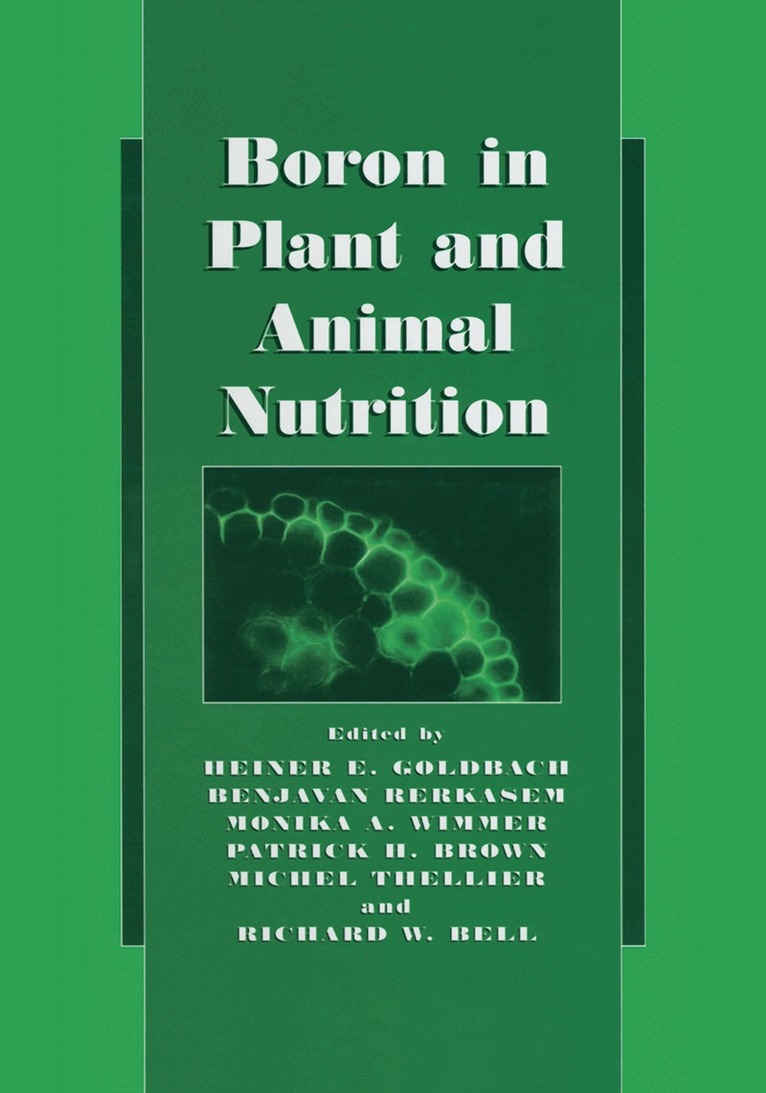
The Boron '97 meeting was a great success in summarising all recent developments in basic and applied research on boron's function, especially in plants. New techniques have since been developed and new insight has been gained into the role of boron in plant and animal metabolism. Nevertheless, there were still lots of open questions. The aim of the present workshop held in Bonn as a satellite meeting to the International Plant Nutrition Colloquium was thus to gather all actual information which has been gained since the Boron '97 meeting and to compile knowledge, both from animal and plant sciences. Furthermore, applied aspects had to be addressed too, as there is an increasing awareness of boron deficiencies even in crops such as wheat, which have formerly not been considered as responsive to boron application. Genetic differences in boron demand and efficiency within one species are a further important topic which has gained importance since the 1997 meeting. More in-depth knowledge on the mechanisms of boron efficiency are required as an increased efficiency will be one major possibility to maintain and improve crop yields for resource-poor farmers. Nevertheless, it has also clearly been shown that an adequate supply of boron is needed to obtain high yields of crops with a high quality, and that a sustainable agriculture has to provide an adequate boron supply to compensate for inevitable losses through leaching (especially in the humid tropics and temperate regions) and for the boron removal by the crop.
Inbunden, Engelska, 1997
874 kr
Skickas inom 10-15 vardagar
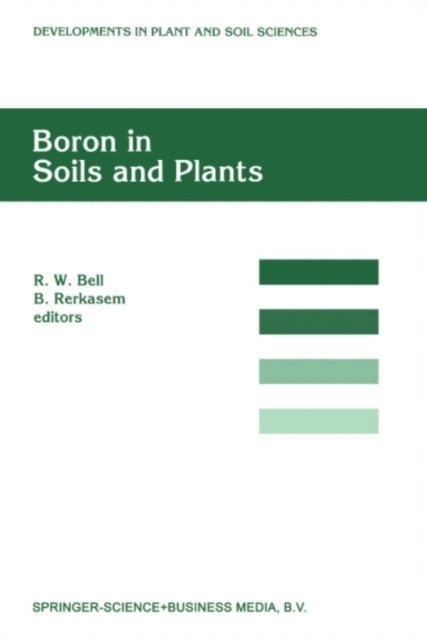
The present volume and its companion, "Boron in Soil and Plants: Reviews", contain details of late-20th century advances in boron nutrition. They are designed as references for researchers, university lecturers and graduate students. There is also sufficient practical information on the use of boron in agriculture, forestry and horticulture for advisers and fertilizer representatives to find these volumes valuable references. For agriculture, horticulture, and forestry, papers on the effectiveness of boron fertilizers and the selection of boron-efficient and boron-tolerant cultivars should attract interest. Physiologists should be interested in findings on the location of boron in cells, the function of boron in cell walls and the techniques used for these studies. Boron toxicity is a significant problem in many areas of the world. However, papers in the present volume challenge a long-held dogma of boron research that a narrow range exists between deficiency and toxicity of boron.
Häftad, Engelska, 2012
1 633 kr
Skickas inom 10-15 vardagar
The Boron '97 meeting was a great success in summarising all recent developments in basic and applied research on boron's function, especially in plants. New techniques have since been developed and new insight has been gained into the role of boron in plant and animal metabolism. Nevertheless, there were still lots of open questions. The aim of the present workshop held in Bonn as a satellite meeting to the International Plant Nutrition Colloquium was thus to gather all actual information which has been gained since the Boron '97 meeting and to compile knowledge, both from animal and plant sciences. Furthermore, applied aspects had to be addressed too, as there is an increasing awareness of boron deficiencies even in crops such as wheat, which have formerly not been considered as responsive to boron application. Genetic differences in boron demand and efficiency within one species are a further important topic which has gained importance since the 1997 meeting. More in-depth knowledge on the mechanisms of boron efficiency are required as an increased efficiency will be one major possibility to maintain and improve crop yields for resource-poor farmers. Nevertheless, it has also clearly been shown that an adequate supply of boron is needed to obtain high yields of crops with a high quality, and that a sustainable agriculture has to provide an adequate boron supply to compensate for inevitable losses through leaching (especially in the humid tropics and temperate regions) and for the boron removal by the crop.
E-bok
PDF, Engelska, 20122 036 kr
Läs direkt efter köp
The Boron ''97 meeting was a great success in summarising all recent developments in basic and applied research on boron''s function, especially in plants. New techniques have since been developed and new insight has been gained into the role of boron in plant and animal metabolism. Nevertheless, there were still lots of open questions. The aim of the present workshop held in Bonn as a satellite meeting to the International Plant Nutrition Colloquium was thus to gather all actual information which has been gained since the Boron ''97 meeting and to compile knowledge, both from animal and plant sciences. Furthermore, applied aspects had to be addressed too, as there is an increasing awareness of boron deficiencies even in crops such as wheat, which have formerly not been considered as responsive to boron application. Genetic differences in boron demand and efficiency within one species are a further important topic which has gained importance since the 1997 meeting. More in-depth knowledge on the mechanisms of boron efficiency are required as an increased efficiency will be one major possibility to maintain and improve crop yields for resource-poor farmers. Nevertheless, it has also clearly been shown that an adequate supply of boron is needed to obtain high yields of crops with a high quality, and that a sustainable agriculture has to provide an adequate boron supply to compensate for inevitable losses through leaching (especially in the humid tropics and temperate regions) and for the boron removal by the crop.
Häftad, Engelska, 2012
549 kr
Skickas inom 10-15 vardagar
The economic significance of boron (B) in agriculture, horticulture, and forestry has been beyond dispute for several decades. Even in the last two decades, the areas where B deficiency limits plant production has grown with increased reports from China, south Asia and southeast Asia. The present volume is reflective of the growing awareness of the significance of low soil B with reports from Australia, Bangladesh, Brazil, north, central and southern China, India, Nepal, and the North West Frontier Province of Pakistan contained herein. Boron deficiency also continues to be a problem for crop yield and quality in areas where B deficiency has been known for some time, for example in Germany and the USA. The problem of low soil B is not limited to effects on field crop yield, with papers reporting on depressed wood yield and quality in timber trees (Lambert et al. ), and depressed fruit quality (Dong et al. ; Smith et al. : Zude et al. ) also appearing in the present volume. Globally, Shorrocks (1997)1 estimates that ?? tonnes of B fertiliser is applied annually in agriculture. The economic benefits from the use of B fertiliser have not been quantified but are clearly enormous. Paradoxically, the clear economic imperatives for using B fertiliser on low B soils are not matched by a similar clarity of understanding of the role and functions of B in plants.
E-bok
PDF, Engelska, 2012687 kr
Läs direkt efter köp
The economic significance of boron (B) in agriculture, horticulture, and forestry has been beyond dispute for several decades. Even in the last two decades, the areas where B deficiency limits plant production has grown with increased reports from China, south Asia and southeast Asia. The present volume is reflective of the growing awareness of the significance of low soil B with reports from Australia, Bangladesh, Brazil, north, central and southern China, India, Nepal, and the North West Frontier Province of Pakistan contained herein. Boron deficiency also continues to be a problem for crop yield and quality in areas where B deficiency has been known for some time, for example in Germany and the USA. The problem of low soil B is not limited to effects on field crop yield, with papers reporting on depressed wood yield and quality in timber trees (Lambert et al. ), and depressed fruit quality (Dong et al. ; Smith et al. : Zude et al. ) also appearing in the present volume. Globally, Shorrocks (1997)1 estimates that ?? tonnes of B fertiliser is applied annually in agriculture. The economic benefits from the use of B fertiliser have not been quantified but are clearly enormous. Paradoxically, the clear economic imperatives for using B fertiliser on low B soils are not matched by a similar clarity of understanding of the role and functions of B in plants.