Bernhelm Boo-Bavnbek – författare
2 822 kr
Läs direkt efter köp
BetaSys uses the example of regulated exocytosis in pancreatic β-cells, and its relevance to diabetes, to illustrate the major concepts of systems biology, its methods and applications.
1 672 kr
Läs direkt efter köp
1 672 kr
Läs direkt efter köp
This highly interdisciplinary volume brings together a carefully curated set of case studies examining complex systems with multiple time scales (MTS) across a variety of fields: materials science, epidemiology, cell physiology, mathematics, climatology, energy transition planning, ecology, economics, sociology, history, and cultural studies. The book addresses the vast diversity of interacting processes underlying the behaviour of different complex systems, highlighting the multiplicity of characteristic time scales that are a common feature of many and showcases a rich variety of methodologies across disciplinary boundaries.
Self-organizing, out-of-equilibrium, ever-evolving systems are ubiquitous in the natural and social world. Examples include the climate, ecosystems, living cells, epidemics, the human brain, and many socio-economic systems across history. Their dynamical behaviour poses great challenges in the pressing context of the climate crisis, since they may involve nonlinearities, feedback loops, and the emergence of spatial-temporal patterns, portrayed by resilience or instability, plasticity or rigidity; bifurcations, thresholds and tipping points; burst-in excitation or slow relaxation, and worlds of other asymptotic behaviour, hysteresis, and resistance to change.
Chapters can be read individually by the reader with special interest in such behaviours of particular complex systems or in specific disciplinary perspectives. Read together, however, the case studies, opinion pieces, and meta-studies on MTS systems presented and analysed here combine to give the reader insights that are more than the sum of the book’s individual chapters, as surprising similarities become apparent in seemingly disparate and unconnected systems. MTS systems call into question naïve perceptions of time and complexity, moving beyond conventional ways of description, analysis, understanding, modelling, numerical prediction, and prescription of the worldaround us.
This edited collection presents new ways of forecasting, introduces new means of control, and – perhaps as the most demanding task – it singles out a sustainable description of an MTS system under observation, offering a more nuanced interpretation of the floods of quantitative data and images made available by high- and low-frequency measurement tools in our unprecedented era of information flows.
Chapter “Multiplicity of Time Scales in Blood Cell Formation and Leukemia” is available open access under a Creative Commons Attribution 4.0 International License via link.springer.com.
1 825 kr
Läs direkt efter köp
Note to the interested reader to have a look at the companion to this volume Challenges for Sciences and Communication I | ISBN: 978-3-031-28048-1.
This highly interdisciplinary volume brings together a carefully curated set of case studies examining complex systems with multiple time scales (MTS) across a variety of fields: materials science, epidemiology, cell physiology, mathematics, climatology, energy transition planning, ecology, economics, sociology, history, and cultural studies. The book addresses the vast diversity of interacting processes underlying the behaviour of different complex systems, highlighting the multiplicity of characteristic time scales that are a common feature of many and showcases a rich variety of methodologies across disciplinary boundaries.
Self-organizing, out-of-equilibrium, ever-evolving systems are ubiquitous in the natural and social world. Examples include the climate, ecosystems, living cells, epidemics, the human brain, and many socio-economic systems across history. Their dynamical behaviour poses great challenges in the pressing context of the climate crisis, since they may involve nonlinearities, feedback loops, and the emergence of spatial-temporal patterns, portrayed by resilience or instability, plasticity or rigidity; bifurcations, thresholds and tipping points; burst-in excitation or slow relaxation, and worlds of other asymptotic behaviour, hysteresis, and resistance to change.
Chapters can be read individually by the reader with special interest in such behaviours of particular complex systems or in specific disciplinary perspectives. Read together, however, the case studies, opinion pieces, and meta-studies on MTS systems presented and analysed here combine to give the reader insights that are more than the sum of the book’s individual chapters, as surprising similarities become apparent in seemingly disparate and unconnected systems. MTS systems call into question naïve perceptionsof time and complexity, moving beyond conventional ways of description, analysis, understanding, modelling, numerical prediction, and prescription of the world around us.
This edited collection presents new ways of forecasting, introduces new means of control, and – perhaps as the most demanding task – it singles out a sustainable description of an MTS system under observation, offering a more nuanced interpretation of the floods of quantitative data and images made available by high- and low-frequency measurement tools in our unprecedented era of information flows.1 687 kr
Läs direkt efter köp
Mathematics has for centuries been stimulated, financed and credited by military purposes. Some mathematical thoughts and mathematical technology have also been vital in war. During World War II mathematical work by the Anti-Hitler coalition was part of an aspiration to serve humanity and not help destroy it. At present, it is not an easy task to view the bellicose potentials of mathematics in a proper perspective.
The book presents historical evidence and recent changes in the interaction between mathematics and the military. It discusses the new mathematically enhanced development of military technology which seems to have changed the very character of modern warfare.
687 kr
Läs direkt efter köp
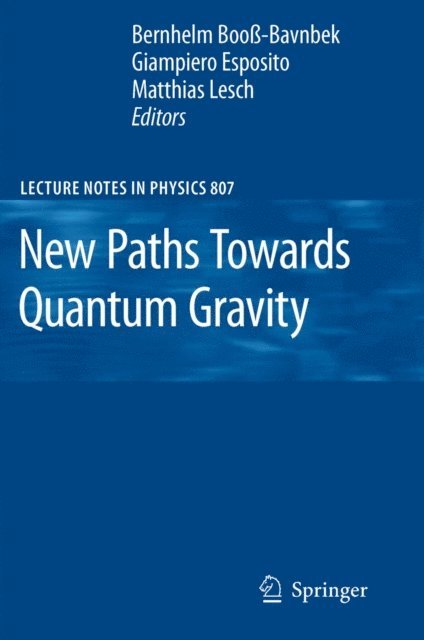
Aside from the obvious statement that it should be a theory capable of unifying general relativity and quantum field theory, not much is known about the true nature of quantum gravity.
New ideas - and there are many of them for this is an exciting field of research - often diverge to a degree where it seems impossible to decide in which of the many possible direction(s) the ongoing developments should be further sustained.
The division of the book in two (overlapping) parts reflects the duality between the physical vision and the mathematical construction. The former is represented by tutorial reviews on non-commutative geometry, on space-time discretization and renormalization and on gauge field path integrals. The latter one by lectures on cohomology, on stochastic geometry and on mathematical tools for the effective action in quantum gravity.
The book will benefit everyone working or entering the field of quantum gravity research.