Bertha K. Becker – författare
Visar alla böcker från författaren Bertha K. Becker. Handla med fri frakt och snabb leverans.
2 produkter
2 produkter
Häftad, Engelska, 1992
378 kr
Skickas inom 7-10 vardagar
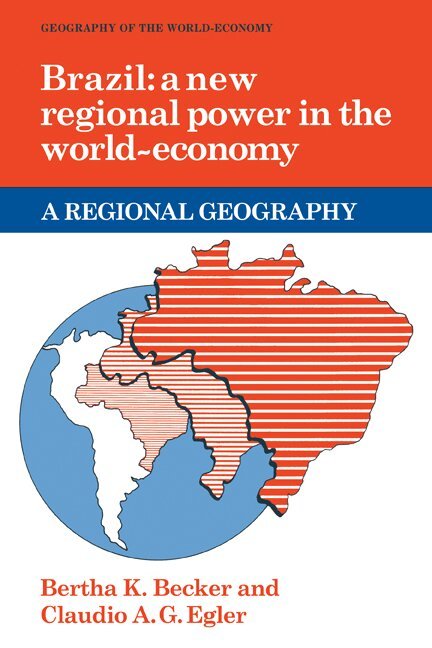
Brazil is a country of immense diversity. It continental dimensions contain the most important industrial complex of the South as well as the largest rainforest reserve in the world, the Amazon. The 1970s witnessed a period of immense economic growth in Brazil, yet more than half the population live in poverty. In this textbook Professors Becker and Egler examine these contemporary dilemmas by exploring the process of Brazil's entry into the capitalist world-economy. They trace this development from the country's origins as a Portuguese colony to its status as a regional power in Latin America and the eighth-largest world economy. Becker and Egler combine geography, history, economics and political science in a comprehensive view of Brazil's development and this innovative and compelling approach enables comparative analysis with other countries. Brazil: A New Regional Power in the World Economy will be widely read by students and specialists of geography, Latin American history, political science, development economics, urban and regional planning and public administration. It will also be an invaluable reference source for journalists, government analysts and policy-makers in international development agencies.
E-bok
Engelska, 1985587 kr
Läs direkt efter köp
This set of volumes is based on a UNCRD study of the impact of national policies and programmes on rural development in eight developing countries of Asia, Africa and Latin America.The Brazilian phenomenon of rural poverty in the midst of plenty is enigmatic in many ways, but it is true. It is a clear case of mal-development. Brazil is a country of vast natural resources, a part of it still untouched by man. Unlike China and India, it is thinly populated and highly urbanized. It has acquired a strong industrial base. A large section of Brazil''s population—urban as well as rural—is, however, poor and mal-nourished.This volume critically examines the national policies and programmes launched by the government to help the rural poor in the context of the newly emerging class structure and concludes that the process of modernization within the framework of the classical capitalist model has further strengthened the powerful and weakened the powerless. International capital has played a crucial role in the economy of Brazil and in the direction, pace and content of its development.The volume examines in depth the implications of the capitalist model of development for rural municipios and families living in remote Amazonia. Continuing deprivation of the poor is what the Brazilian model of development has produced.Somewhat different is the case of Nigeria with 75 per cent of its 80 million people living in rural areas. Being an oil-rich nation, it has the resources to invest in agriculture, industry and social services. It has, however, failed to manage its resources and neglected its rural economy, so that it depends on imports to feed its people. Many of its development projects did not produce expected results particularly the projects which were initiated and managed by multi-national agencies. The study focuses attention on food and fibres which are becoming scarce in the country and calls for a direct attack on poverty and involvement of the rural people in the planning of their future.