Bertrand Roehner – författare
Visar alla böcker från författaren Bertrand Roehner. Handla med fri frakt och snabb leverans.
5 produkter
5 produkter
E-bok
Franska, 2004247 kr
Läs direkt efter köp
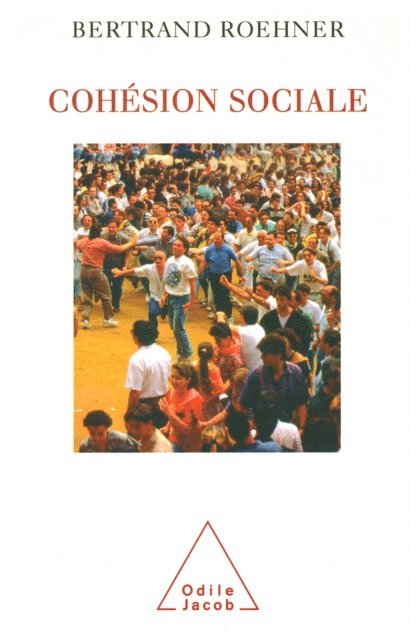
Comment nos sociétés résistent aux changements ? Quelle est cette cohésion qui assure leur pérennité dans l’histoire ? Bertrand Roehner l’observe d’abord dans des événements tests comme la destruction des tours de Manhattan (2001), dans des catastrophes comme le tremblement de terre de Tokyo (1923), des émeutes de rejet comme à Aigues-Mortes en France (1893) ou de protestation comme à Brixton en Angleterre (1981), ou encore dans la résistance à une occupation étrangère comme en France (1940). Il la mesure ensuite aux réactions du corps social, par exemple au nombre de temples hindous brûlés après la destruction d’une mosquée en Inde (1992). Cet essai montre ainsi que les méthodes de la physique peuvent féconder les sciences sociales. Bertrand Roehner est membre du laboratoire de physique théorique de l’université Pierre-et-Marie-Curie-Paris-VII. Il a notamment publié Theory of Markets chez Springer, Application of Physics in Economic Modelling et Patterns and Repertoire à Harvard University Press.
Del 35 - Evolutionary Economics and Social Complexity Science
Overlords: A Study Where Physics Meets the Muse of History
Volume 1 Oppression and Roads to War
Inbunden, Engelska, 2026
1 434 kr
Skickas inom 10-15 vardagar
E-bok
Engelska, 20261 672 kr
Läs direkt efter köp
This book examines the driving forces that lead to civil wars and revolutions. The authors’ approach differs from the familiar historical narrative, as they differentiate between “causes” or ‘actions of great men’ and “mechanisms” that arise from social activity and behaviour. The latter include early-stage conflicts or outbreaks of violence which, if not checked, can lead to social division and more violent incidents. The approach rooted in methods used in physical experimentation is illustrated in part one using the Fire of London and American war of Independence. Part two examines narratives for uprisings in a range of occupied countries across both the world. Part three implements the approach developed in part one on a broad basis to explore common features of invasions and conflict. A separate chapter looks at the lifetime of political empires and explores why religious empires have much greater longevity. The scientific methods lead to the possibility of prediction and some observations are made of current events in the middle east and Ukraine.
Del 36 - Evolutionary Economics and Social Complexity Science
Overlords: A Study Where Physics Meets the Muse of History
Volume 2 A Cliophysical Investigation
Inbunden, Engelska, 2026
1 324 kr
Skickas inom 10-15 vardagar
This book examines the driving forces that lead to civil wars. The authors’ approach differs from the familiar historical narrative or story, as they differentiate between “causes” arising from individual wishes and “mechanisms” that arise from social activity and behavior.The latter include early-stage conflicts or outbreaks of violence which, if not checked, can lead to social division and more violent incidents. This approach is illustrated using the examples of the American and Irish wars of independence. In both cases, similarities are seen in the emergence of local violent incidents and the use of propaganda to create cohesion consensus within the different opponents. That approach is then employed on a broader basis, looking at revolution in England, France, China, and other countries.A second part, aiming to show the reader how this approach, rooted in methods used in physical experimentation, can be used and applied to other historical situations for predictive purposes.
E-bok
Engelska, 20261 722 kr
Läs direkt efter köp
This book examines the driving forces that lead to civil wars. The authors’ approach differs from the familiar historical narrative or story, as they differentiate between “causes” arising from individual wishes and “mechanisms” that arise from social activity and behavior.The latter include early-stage conflicts or outbreaks of violence which, if not checked, can lead to social division and more violent incidents. This approach is illustrated using the examples of the American and Irish wars of independence. In both cases, similarities are seen in the emergence of local violent incidents and the use of propaganda to create cohesion consensus within the different opponents. That approach is then employed on a broader basis, looking at revolution in England, France, China, and other countries.A second part, aiming to show the reader how this approach, rooted in methods used in physical experimentation, can be used and applied to other historical situations for predictive purposes.