
BjA¶rn Egner – författare
757 kr
Läs direkt efter köp
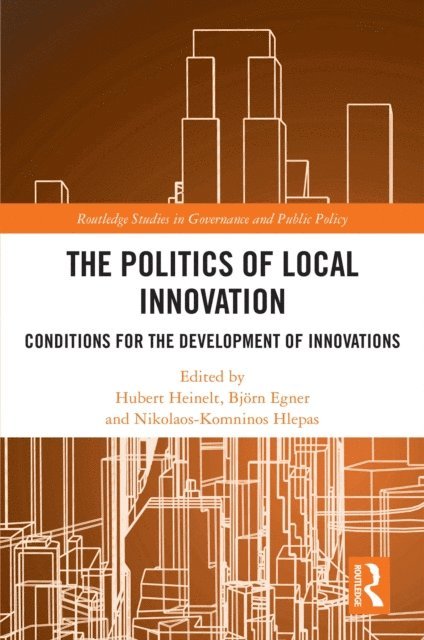
Some cities manage to mobilize innovation potentials and respond to challenges, such as demographic change and immigration as well as economic restructuring, while others do not. This book solves this problem by answering the following question: what are the conditions for the development of local innovation?
In order to identify these conditions, the book explores case study cities which are perceived as success cases of local innovation by the respective local community, and sometimes also nationally or internationally. The conditions for local innovations are not sought primarily in economic, social, or institutional circumstances. Instead, this book focuses on the communicative interactions by which local actors develop locally embedded knowledge or a specific social imaginary about those circumstances, as well as the constraints and opportunities deriving from them. The authors focus on a comparative case study of ten cities—Bensheim, Frankfurt, Kassel, Leipzig, and Offenbach in Germany, and Athens, Chania, Elefsina, Kalamata, and Thessaloniki in Greece. The book is based on content analysis of policy documents and local newspapers as well as in-depth interviews with key local actors.
This book will be of interest to scholars and students of political science and policy analysis, as well as sociology, geography, urban studies, and planning. It will also interest local politicians and bureaucrats concerned with achieving innovation in cities.
757 kr
Läs direkt efter köp
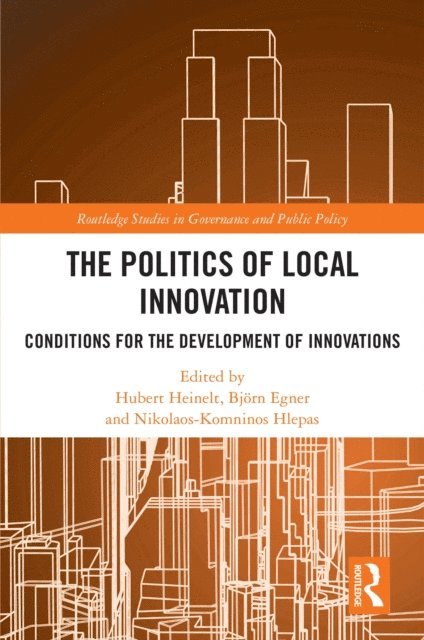
Some cities manage to mobilize innovation potentials and respond to challenges, such as demographic change and immigration as well as economic restructuring, while others do not. This book solves this problem by answering the following question: what are the conditions for the development of local innovation?
In order to identify these conditions, the book explores case study cities which are perceived as success cases of local innovation by the respective local community, and sometimes also nationally or internationally. The conditions for local innovations are not sought primarily in economic, social, or institutional circumstances. Instead, this book focuses on the communicative interactions by which local actors develop locally embedded knowledge or a specific social imaginary about those circumstances, as well as the constraints and opportunities deriving from them. The authors focus on a comparative case study of ten cities—Bensheim, Frankfurt, Kassel, Leipzig, and Offenbach in Germany, and Athens, Chania, Elefsina, Kalamata, and Thessaloniki in Greece. The book is based on content analysis of policy documents and local newspapers as well as in-depth interviews with key local actors.
This book will be of interest to scholars and students of political science and policy analysis, as well as sociology, geography, urban studies, and planning. It will also interest local politicians and bureaucrats concerned with achieving innovation in cities.
891 kr
Läs direkt efter köp
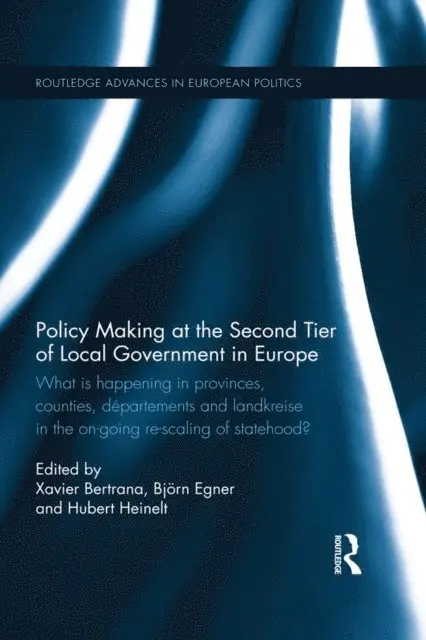
Debates about multi-level governance have led to a profound restructuring of regional and local government. The second level of local government is under review in most European countries, with the aim to strengthen the institutional capacity of municipalities or to develop appropriate institutional structures for governing fragmented urban areas.
This book provides a thematic and cross-national analysis of the key actors in local government that form the crucial components of effective and democratic policy making. Focussing on the second tier of local government, it examines new empirical data on councillors from this level of government in 15 European countries and integrates important variables such as party politics, notions of democracy, finance, multi-level settings. Divided into five parts, it addresses:
Attitudes of county/provincial councillors towards administrative and territorial reforms;
Their role perceptions and role behaviour;
Their political orientation;
Actor constellations and governance arrangements;
Political socialization and recruitment, professionalization and career patterns of county/provincial councillors.
This book will be of interest to students and scholars of local government, urban studies, regional studies, political science, sociology and geography.
891 kr
Läs direkt efter köp
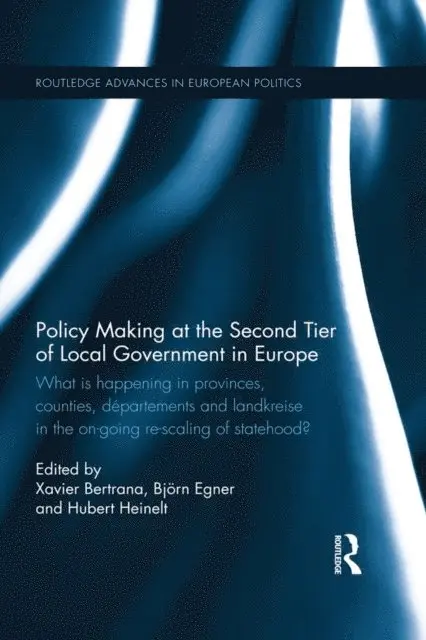
Debates about multi-level governance have led to a profound restructuring of regional and local government. The second level of local government is under review in most European countries, with the aim to strengthen the institutional capacity of municipalities or to develop appropriate institutional structures for governing fragmented urban areas.
This book provides a thematic and cross-national analysis of the key actors in local government that form the crucial components of effective and democratic policy making. Focussing on the second tier of local government, it examines new empirical data on councillors from this level of government in 15 European countries and integrates important variables such as party politics, notions of democracy, finance, multi-level settings. Divided into five parts, it addresses:
Attitudes of county/provincial councillors towards administrative and territorial reforms;
Their role perceptions and role behaviour;
Their political orientation;
Actor constellations and governance arrangements;
Political socialization and recruitment, professionalization and career patterns of county/provincial councillors.
This book will be of interest to students and scholars of local government, urban studies, regional studies, political science, sociology and geography.