Bjørn Grinde – författare
Visar alla böcker från författaren Bjørn Grinde. Handla med fri frakt och snabb leverans.
7 produkter
7 produkter
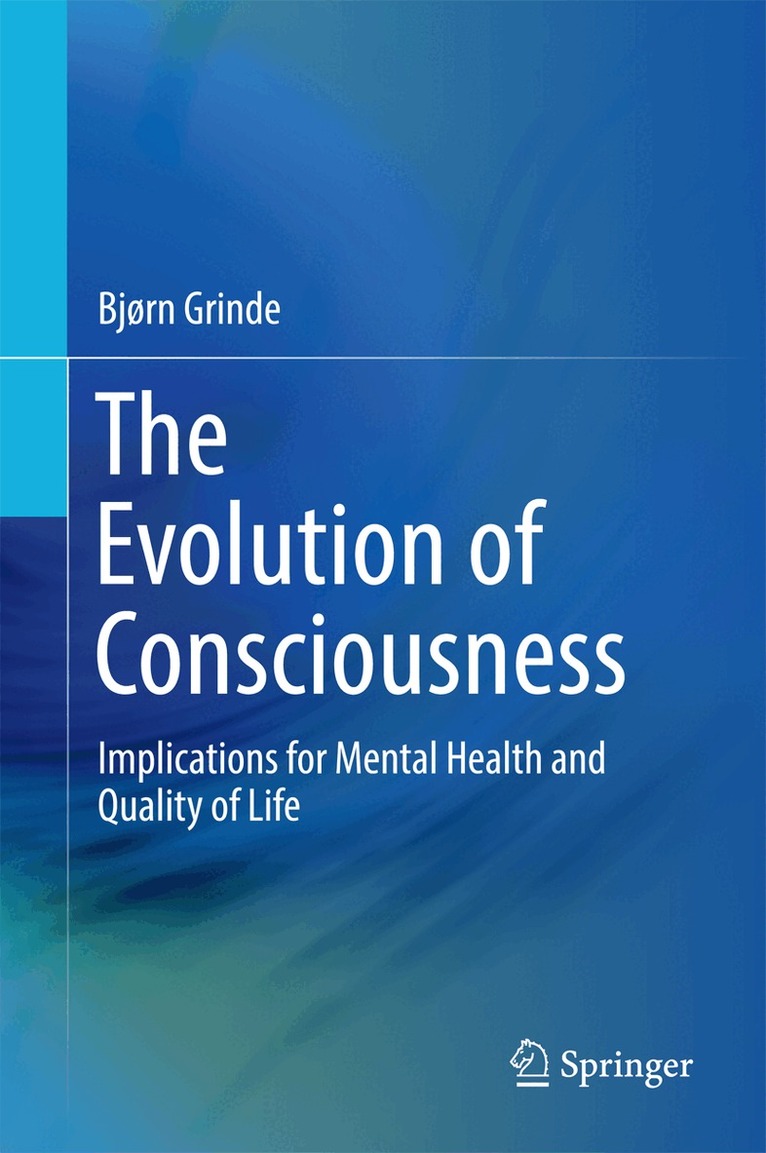
Evolution of Consciousness
Implications for Mental Health and Quality of Life
Inbunden, Engelska, 2016
1 066 kr
Skickas inom 10-15 vardagar
In short, the evidence suggests that consciousness first evolved some 300 million years ago as a consequence of the introduction of feelings. More specifically, you can strengthen the capacity for positive feelings and reduce the sway of negative feelings.
1 098 kr
Skickas inom 10-15 vardagar
In short, the evidence suggests that consciousness first evolved some 300 million years ago as a consequence of the introduction of feelings. More specifically, you can strengthen the capacity for positive feelings and reduce the sway of negative feelings.
319 kr
Skickas inom 5-8 vardagar
339 kr
Skickas inom 5-8 vardagar
312 kr
Skickas inom 5-8 vardagar
319 kr
Skickas inom 5-8 vardagar
624 kr
Skickas inom 10-15 vardagar
The brief presents a model for happiness based on current knowledge in evolutionary biology and neurobiology. Briefly, the primary purpose of nervous systems is to direct an animal toward behaviour relevant for survival and procreation. In primitive animals actions are based on reflexes, while in humans the modules directing behaviour engage positive and negative affect (good and bad feelings), and they are swayed by cognitive processes. The reason why evolution opted for this strategy was the improved flexibility in response – i.e., we learn from previous experiences. The human capacity for happiness is an accidental consequence.An array of brain modules has evolved to care for various pursuits, but recent studies suggest that they converge on shared neural circuits designed to generate positive and negative mood. Happiness can be construed as the net output of the relevant modules. The briefs suggests a strategy for how to avoid having negative feelings (such as anxiety, depression and chronic pain) dominate the mind, and how to exercise positive feelings. In short, the book offers both a deeper understanding of what happiness is about, and a framework for improving well-being.An array of brain modules has evolved to care for various pursuits, but recent studies suggest that they converge on shared neural circuits designed to generate positive and negative mood. Happiness can be construed as the net output of the relevant modules. The book suggests a strategy for how to avoid having negative feelings (such as anxiety, depression and chronic pain) dominate the mind, and how to exercise positive feelings. In short, the book offers both a deeper understanding of what happiness is about, and a framework for improving well-being.