Bjorn Harsman – författare
Visar alla böcker från författaren Bjorn Harsman. Handla med fri frakt och snabb leverans.
2 produkter
2 produkter
Del 238 - Contributions to Economic Analysis
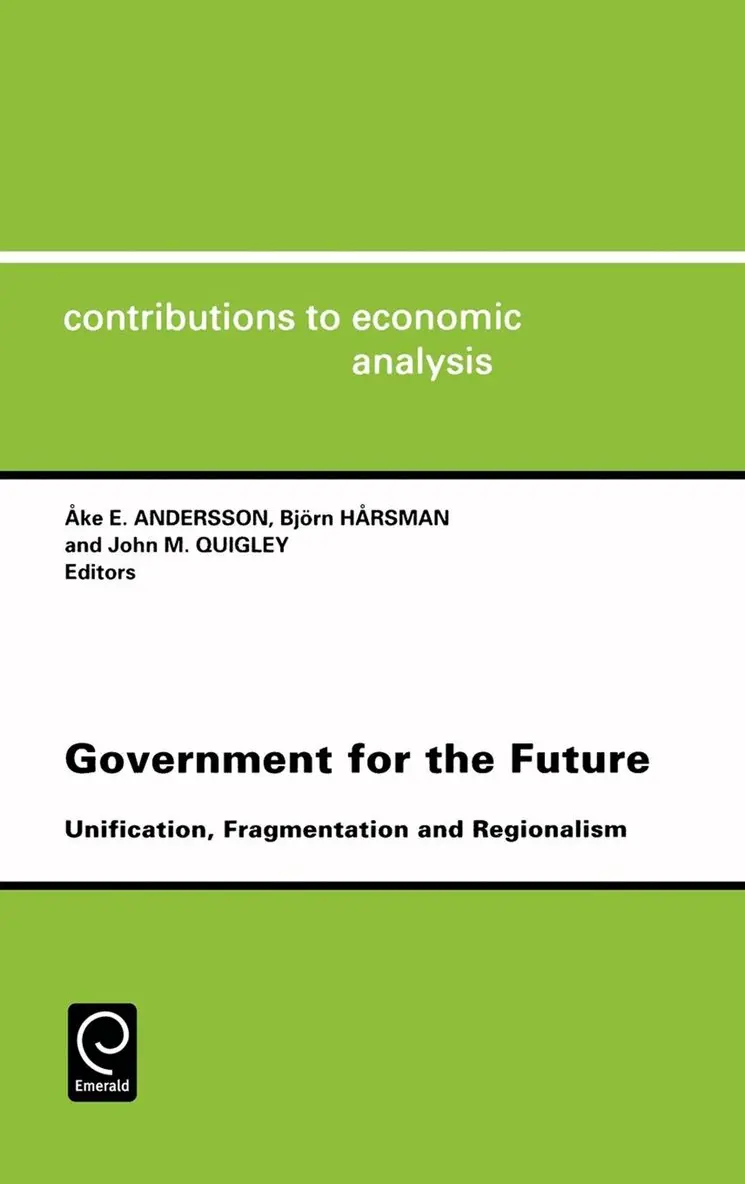
Government for the Future
Unification, Fragmentation and Regionalism
Inbunden, Engelska, 1997
2 453 kr
Skickas inom 5-8 vardagar
The aim of this volume is to encourage comparative explorations of the links between economic regionalism and government behaviour. At present, the relation between government and the economy is in a state of flux. In the old "developed" world, supranational organizations such as the EU and the WTO, are exerting more influence over economic life. Simultaneously, regional governments have emerged to provide public services to local populations. In some European countries, economic decision making is no longer in the power of the nation state, but has been transferred to international and local organizations. The papers in this volume have been contributed by a broad range of policy makers, journalists, and academics. Theories of the public sector are reviewed, restructured and extended, in order to cover the new spatial and dynamic situation. The volume provides historical and institutional perspectives on the public sector, and presents empirical case studies of the public sectors in Sweden, USA, Belgium, Malaysia, England and Singapore.
E-bok
PDF, Engelska, 20121 416 kr
Läs direkt efter köp
International comparisons of economic institutions and government poli cies are fraught with difficulties. After1he selective barriers of language and culture are overcome, differences in programs and outcomes are far more subtle than those that can be revealed by highly aggregated national data. Rela tively "soft" comparisons are the norm in international comparative research. This is particularly true in comparative analyses of housing and the operation of housing markets. Housing markets are local or regional in character, and the effects of government programs on market outcomes depend upon important economic characteristics of the local environment. Moreover, the institutions that influence the production, distribution, and consumption of housing differ enormously across nations. The distribution of housing and the role of the market in provision depend upon historical and social factors as well. Aggregate national data are unlikely to allow for much depth in comparisons across societies. Yet in the absence of such comparisons, the very visibility of housing may lead to inadequate or erroneous generalizations. Photographs emphasing the aesthetics of ''''well planned" housing agglomorations or urban slums are compelling. Documen tation that middle-class households must wait in a queue for a decade to be housed is notably less graphic.