Brantina Chirinda - Böcker
Visar alla böcker från författaren Brantina Chirinda. Handla med fri frakt och snabb leverans.
8 produkter
8 produkter
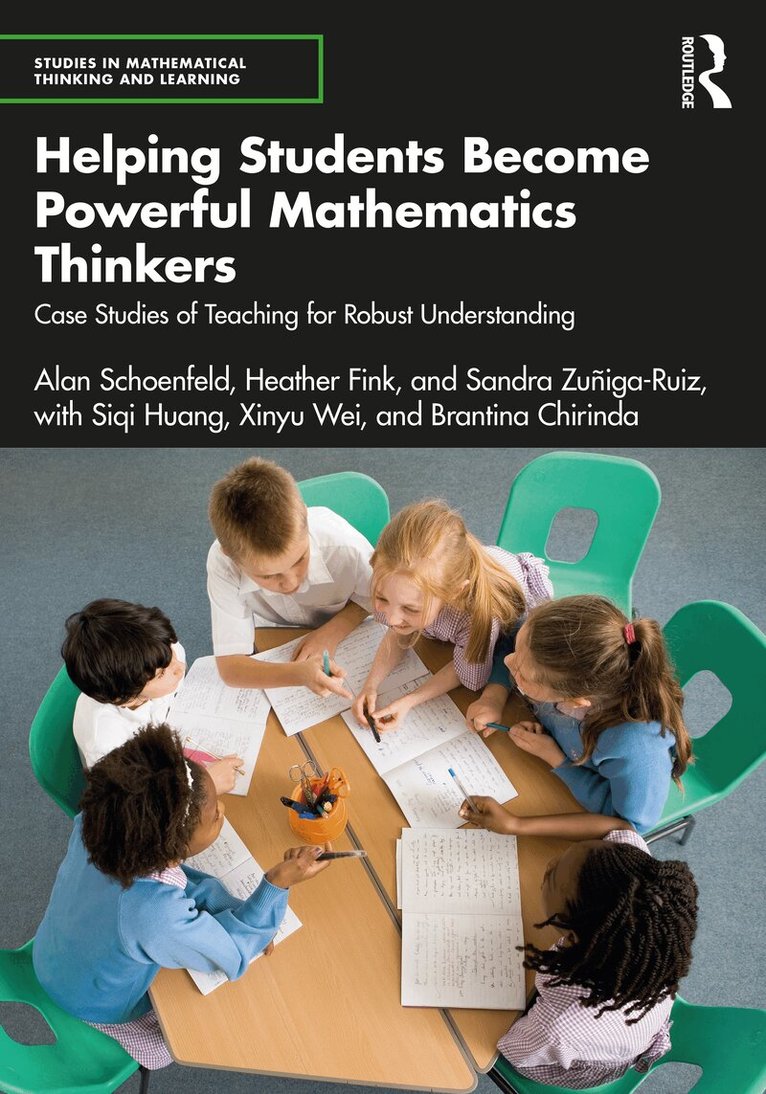
Helping Students Become Powerful Mathematics Thinkers
Case Studies of Teaching for Robust Understanding
Häftad, Engelska, 2023
730 kr
Skickas inom 10-15 vardagar
This book supports teacher educators, teachers, coaches, administrators, math-ed faculty, and researchers in understanding and using the Teaching for Robust Understanding (TRU) Framework to improve instruction. Detailed case studies take readers on deep dives into five essential dimensions of classroom practice: The Mathematics; Cognitive Demand; Equitable Access; Agency, Ownership, and Identity; and Formative Assessment.Three case studies form the core of the book. Each case uses the TRU framework to pose conversational questions to the reader on different aspects of the lessons, focusing on the ways that students are led to engage with mathematics and how they make sense of it. These include “What’s important in this classroom episode?,” “What might students be experiencing?,” or “What might the impact of alternative teaching decisions have been in this situation?”. The book concludes with guides for planning, observation, and reflection that readers can use in their own work, continuing the journey toward the ambitious and equitable instruction that each case study describes.This book will support all mathematics educators in developing deeper understandings of mathematics classrooms and in problematizing their own mathematics instruction. By exploring the challenges students face, the decisions teachers make, and the ways that students learn, readers will experience TRU as a powerful way of thinking about instruction – one that can shape lesson planning and reflection and make teaching more impactful and equitable.
Helping Students Become Powerful Mathematics Thinkers
Case Studies of Teaching for Robust Understanding
Inbunden, Engelska, 2023
1 914 kr
Skickas inom 10-15 vardagar
This book supports teacher educators, teachers, coaches, administrators, math-ed faculty, and researchers in understanding and using the Teaching for Robust Understanding (TRU) Framework to improve instruction. Detailed case studies take readers on deep dives into five essential dimensions of classroom practice: The Mathematics; Cognitive Demand; Equitable Access; Agency, Ownership, and Identity; and Formative Assessment.Three case studies form the core of the book. Each case uses the TRU framework to pose conversational questions to the reader on different aspects of the lessons, focusing on the ways that students are led to engage with mathematics and how they make sense of it. These include “What’s important in this classroom episode?,” “What might students be experiencing?,” or “What might the impact of alternative teaching decisions have been in this situation?”. The book concludes with guides for planning, observation, and reflection that readers can use in their own work, continuing the journey toward the ambitious and equitable instruction that each case study describes.This book will support all mathematics educators in developing deeper understandings of mathematics classrooms and in problematizing their own mathematics instruction. By exploring the challenges students face, the decisions teachers make, and the ways that students learn, readers will experience TRU as a powerful way of thinking about instruction – one that can shape lesson planning and reflection and make teaching more impactful and equitable.
Del 6 - Africa in the Global Space
Science, Mathematics, and Technology Education in Zimbabwe
Research, Policy and Practice
Inbunden, Engelska, 2023
857 kr
Skickas inom 5-8 vardagar
Historical and current educational perspectives are epistemologically challenging to weave together. The contributors brought together in this book have risen to that challenge and, in the process, have produced a detailed and thorough account of the issues and processes at play.Science, Mathematics, and Technology (SMT) education is recognised globally as a means of developing critically needed human capital. In Zimbabwe, SMT subjects constitute a significant component of the curriculum which, since political independence in 1980, has emphasised application-oriented, experientially-based teaching and learning. Efforts to mainstream this approach have resulted in several significant reforms to the country’s education system. Relatedly, there are ongoing attempts to boost uptake in SMT subjects and, through them, to develop such professional skills as problem-solving, lifelong learning, teamwork, critical thinking, and the capacity to contribute and adapt to our rapidly changing world.There is a self-evident need to document progress made in these efforts and, in the process, to carefully examine issues at play, challenges met, and solutions developed. This book, developed through a partnership involving Zimbabwean editors and authors, was developed to fulfil this need. It is long overdue.
1 585 kr
Skickas inom 10-15 vardagar
This book is about mathematics teaching and learning in Africa during the Fourth Industrial Revolution. The Fourth Industrial Revolution (4IR) has evolved to utilize new technologies in the teaching and learning of Mathematics. It is characterized by the fusion of the biological, physical and digital worlds and embodies a new era of innovation in mathematics education, leading to the rapid emergence of new technologies for mathematics teaching and learning. Because 4IR in mathematics education is happening differently in various parts of Africa, the authors of the various chapters in this volume have positioned their work in their respective local contexts. The chapters address a wide variety of interests, concerns, and implications regarding 4IR and Mathematics Education in Africa. Additionally, a number of chapters address teaching mathematics in the context of the COVID-19 pandemic that has gripped the world. Other chapters discuss the implications of inequalities in Africa that effect mathematics education during 4IR. Chapters also incorporate arguments, observations, and suggestions to, improve and transform the teaching and learning of mathematics in Africa during the 4IR.This book highlights a new era of innovation in mathematics education in the context of the Fourth Industrial Revolution, leading to the rapid emergence of new technologies in mathematics teaching and learning. It is a valuable resource for graduate students, people with research interests in the fourth industrial revolution and mathematics educators at any level, including all mathematics teachers; mathematics education curriculum designers and policymakers.
616 kr
Skickas inom 5-8 vardagar
1 585 kr
Skickas inom 10-15 vardagar
This book is about mathematics teaching and learning in Africa during the Fourth Industrial Revolution. The Fourth Industrial Revolution (4IR) has evolved to utilize new technologies in the teaching and learning of Mathematics. It is characterized by the fusion of the biological, physical and digital worlds and embodies a new era of innovation in mathematics education, leading to the rapid emergence of new technologies for mathematics teaching and learning. Because 4IR in mathematics education is happening differently in various parts of Africa, the authors of the various chapters in this volume have positioned their work in their respective local contexts. The chapters address a wide variety of interests, concerns, and implications regarding 4IR and Mathematics Education in Africa. Additionally, a number of chapters address teaching mathematics in the context of the COVID-19 pandemic that has gripped the world. Other chapters discuss the implications of inequalities in Africa that effect mathematics education during 4IR. Chapters also incorporate arguments, observations, and suggestions to, improve and transform the teaching and learning of mathematics in Africa during the 4IR.This book highlights a new era of innovation in mathematics education in the context of the Fourth Industrial Revolution, leading to the rapid emergence of new technologies in mathematics teaching and learning. It is a valuable resource for graduate students, people with research interests in the fourth industrial revolution and mathematics educators at any level, including all mathematics teachers; mathematics education curriculum designers and policymakers.
1 585 kr
Skickas inom 10-15 vardagar
By examining the successes and challenges of STEM education in Zimbabwe, we can learn valuable lessons about improving STEM education in underserved communities.This book contributes to the international debate surrounding the optimal STEM education for students in underserved schools.
Del 11 - Africa in the Global Space
STEM Education in the Post-Pandemic Learning Space
Digitalization in Africa
Inbunden, Engelska, 2025
853 kr
Skickas inom 5-8 vardagar
As a result of the COVID-19 pandemic, the global educational landscape has undergone significant transformation, with digitalization advancing as a basis for contemporary learning paradigms. STEM Education in the Post-Pandemic Learning Space: Digitalization in Africa explores the dynamic connection between Science, Technology, Engineering, and Mathematics (STEM) education and the advancement of digitalization across the African continent. This edited volume brings together insightful contributions from academics, educators, researchers, and practitioners who explore the challenges, opportunities, and innovations that define this educational transformation.From integrating digital tools, devices, resources, and platforms in remote educational environments to developing inclusive policies that bridge the digital divide, this book considers the complex influences of digitalization on STEM education in Africa. It features case studies, empirical research, and theoretical discussions that emphasize the adaptability of educational contexts in traversing unique times. This book will be an important resource for academics, educators, researchers, policymakers, and practitioners dedicated to embracing the power of digitalization to foster equitable, inclusive, and high-quality STEM education post-COVID-19.