C. F. Hogg – författare
Visar alla böcker från författaren C. F. Hogg. Handla med fri frakt och snabb leverans.
3 produkter
3 produkter
Häftad, Engelska
477 kr
Skickas inom 3-6 vardagar
E-bok
Engelska, 2022189 kr
Läs direkt efter köp
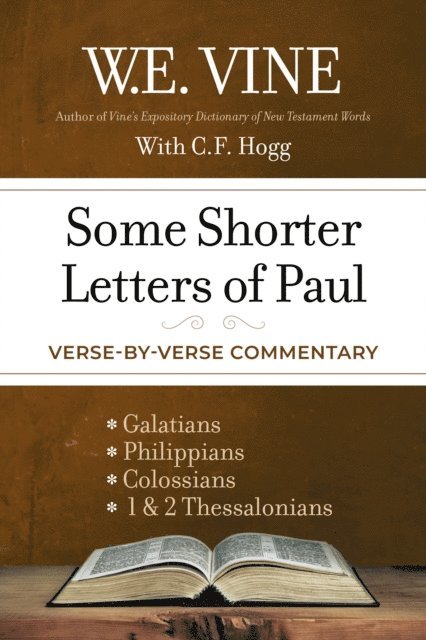
Some Shorter Letters of Paul contains commentaries on Galatians, Philippians, Colossians, and 1 and 2 Thessalonians. The commentaries on Galatians and Thessalonians were written by W.E. Vine and C.F. Hogg together. "These two teachers made an ideal combination," said F.F. Bruce. "They were basically agreed in their interpretation of the great biblical doctrines, and when Mr. Hogg''s theological penetration and command of felicitous and forceful English were united with Mr. Vine''s special gifts, the result was hard to match. For the student of the English New Testament, these two commentaries will long remain standard works."Vine and Hogg explained that in Thessalonians Paul "is concerned mainly for the spiritual well-being of those to whom he writes; in Galatians he is concerned for the integrity of the gospel he preached. In Thessalonians he aims at the confirmation of the gospel in the hearts of the believers; in Galatians he is set for its defense against an attack which he was persuaded . . . would have made Christianity a mere sect of the Jews."The commentaries on Philippians and Colossians were written by W.E. Vine alone. Philippians is a very personal letter in which Paul thanks the Christians for a gift they had sent him and gives "wise and weighty counsel" about various issues. Colossians deals with both Judaistic and Gnostic errors, showing "Christ as the power against every evil, doctrinal and moral, and the power for all manner of godly living." The outlines of each of these letters of Paul are particularly helpful for sermon preparation and teaching.These commentaries by W.E. Vine and C.F. Hogg excel in the rich tradition of careful, exegetical word study and expository commentary. They take into consideration every reference to a particular word in the Bible as well as the range of its uses in ancient Greek. Pastors, scholars, and serious students will enjoy these in-depth commentaries from the man who gave us Vine''s Complete Expository Dictionary of Old and New Testament Words.
E-bok
Engelska, 2022187 kr
Läs direkt efter köp
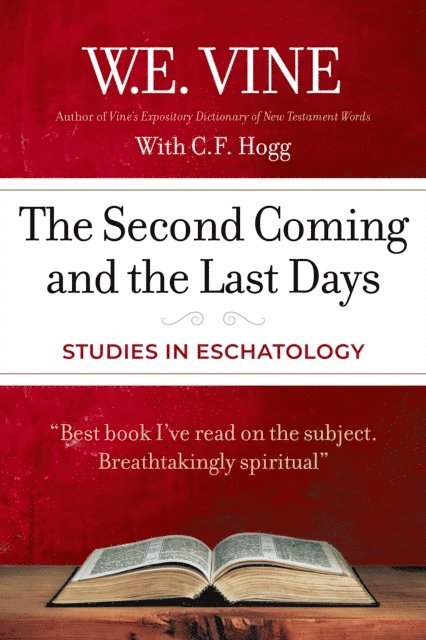
Premillennialism is an understanding of God''s plan for the end times which says, in the words of F.F. Bruce, that there is "an interval between the resurrection-rapture of the Church and the return of Christ to earth ''with power and great glory,'' and places in this interval the great tribulation of the end time." W.E. Vine, with the help of C.F. Hogg, explores this doctrine. Bruce says that Vine and Hogg "deviated in several important respects from the usual" teaching of premillennialism, "for the most part the result of better exegesis."The Second Coming and the Last Days contains W.E. Vine''s two best-known books on eschatology and numerous shorter articles."Touching the Coming of the Lord," written with C.F. Hogg, is, says one reviewer, "The best book I''ve ever read on the subject. It is breathtakingly spiritual, rigorously sequent (logical). This book is well worth your while." The chapters are the expectancy of Christ; the resurrection and the rapture; the parousia of the Lord; the judgment seat of Christ; the epiphany of the parousia; the final Gentile world ruler and his dominion; the effect of the hope; and a synopsis of the Bible doctrine of the second advent.When World War I broke out in 1914, W.E. Vine was asked how then-current events fit into an understanding of prophecy. His comments and study were written in "The Roman Empire in the Light of Prophecy" which discusses "the rise, progress, and end of the fourth world-empire." This has been called "classic Bible prophecy study."Other articles in The Second Coming and the Last Days are "The Church and the Tribulation," "The Rapture and the Great Tribulation," Witnesses to the Second Advent," "The Coming Priest-King," "The Sealed Book of the Apocalypse," and "The Four Women of the Apocalypse." W.E. Vine wrote these books before World War II and the creation of the state of Israel in 1948, the first independent Jewish state since 63 B.C. Vine and Hogg would have liked to have applied their understanding of prophecy to the events of the last nearly 100 years. One of the many things that makes these writings so interesting is that they did not have that opportunity.