C. Fred Fox – författare
Visar alla böcker från författaren C. Fred Fox. Handla med fri frakt och snabb leverans.
2 produkter
2 produkter
E-bok
PDF, Engelska, 2013979 kr
Läs direkt efter köp
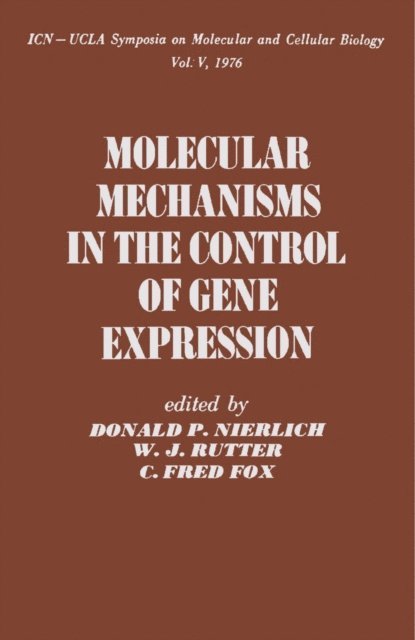
Molecular Mechanisms in the Control of Gene Expression documents the proceedings of the ICN-UCLA conference on Molecular Mechanisms in the Control of Gene Expression, organized through the Molecular Biology Institute of UCLA, held in Keystone, Colorado, 21-26 March 1976. The conference focused on three topics: the action of repressors on specific nucleotide sequences in DNA; how DNA and histones are intertwined in eucaryotic chromosomes; and in the development of new techniques that appear to lift genes from complex genomes. The volume contains 65 chapters organized into nine parts. The papers in Part I examine the organization of prokaryotic and eukaryotic chromosomes. Part II presents studies on the interaction of RNA a polymerase and regulatory molecules with defined DNA sites. Parts III and IV focus on RNA polymerases of eukaryotes and the regulation of transcription in eukaryotic systems, respectively. Part V contains papers dealing with nucleic acid sequences, transcription, and processing. Part VI covers cellular aspects in the study of gene expression. Part VII takes up cloning while Part VIII is devoted to genetic analysis through restriction mapping and molecular cloning. Finally, Part IX summarizes the recent progress reported at the conference and also indicates some of the limitations that can be placed upon interpretation of data.
E-bok
PDF, Engelska, 2013979 kr
Läs direkt efter köp
The Immune System: Genes Receptors, Signals provides information pertinent to the complexity of immune mechanisms. This book describes the immune response genes and products, which point to another multigene system controlling immune responsiveness. Organized into 37 chapters, this book begins with an overview of the details of antibody structure that continue to be of importance to an understanding of the regulation of the immune reactions. This text then examines the evidence that individual antibody species are capable of binding many structurally dissimilar haptens. Other chapters consider the conceptual framework generally accepted by immunologists, which states that antibodies are specific for the antigen used to elicit the immune response. This book discusses as well the mechanism underlying the biosynthesis of antibody binding sites, which is unprecedented in its adaptability. The final chapter deals with the genetic controls of specific immune responses. This book is a valuable resource for immunologists and research workers.