Caitlin E. Buck – författare
Visar alla böcker från författaren Caitlin E. Buck. Handla med fri frakt och snabb leverans.
5 produkter
5 produkter
Del 35 - Statistics in Practice
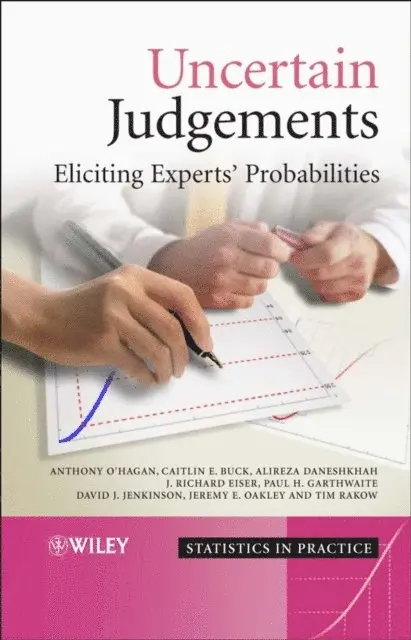
Uncertain Judgements
Eliciting Experts' Probabilities
Inbunden, Engelska, 2006
884 kr
Skickas inom 5-8 vardagar
Elicitation is the process of extracting expert knowledge about some unknown quantity or quantities, and formulating that information as a probability distribution. Elicitation is important in situations, such as modelling the safety of nuclear installations or assessing the risk of terrorist attacks, where expert knowledge is essentially the only source of good information. It also plays a major role in other contexts by augmenting scarce observational data, through the use of Bayesian statistical methods. However, elicitation is not a simple task, and practitioners need to be aware of a wide range of research findings in order to elicit expert judgements accurately and reliably. Uncertain Judgements introduces the area, before guiding the reader through the study of appropriate elicitation methods, illustrated by a variety of multi-disciplinary examples. This is achieved by: Presenting a methodological framework for the elicitation of expert knowledge incorporating findings from both statistical and psychological research.Detailing techniques for the elicitation of a wide range of standard distributions, appropriate to the most common types of quantities.Providing a comprehensive review of the available literature and pointing to the best practice methods and future research needs.Using examples from many disciplines, including statistics, psychology, engineering and health sciences.Including an extensive glossary of statistical and psychological terms.An ideal source and guide for statisticians and psychologists with interests in expert judgement or practical applications of Bayesian analysis, Uncertain Judgements will also benefit decision-makers, risk analysts, engineers and researchers in the medical and social sciences.
E-bok
PDF, Engelska, 20061 026 kr
Läs direkt efter köp
Elicitation is the process of extracting expert knowledge about some unknown quantity or quantities, and formulating that information as a probability distribution. Elicitation is important in situations, such as modelling the safety of nuclear installations or assessing the risk of terrorist attacks, where expert knowledge is essentially the only source of good information. It also plays a major role in other contexts by augmenting scarce observational data, through the use of Bayesian statistical methods. However, elicitation is not a simple task, and practitioners need to be aware of a wide range of research findings in order to elicit expert judgements accurately and reliably. Uncertain Judgements introduces the area, before guiding the reader through the study of appropriate elicitation methods, illustrated by a variety of multi-disciplinary examples.
This is achieved by:
Presenting a methodological framework for the elicitation of expert knowledge incorporating findings from both statistical and psychological research. Detailing techniques for the elicitation of a wide range of standard distributions, appropriate to the most common types of quantities. Providing a comprehensive review of the available literature and pointing to the best practice methods and future research needs. Using examples from many disciplines, including statistics, psychology, engineering and health sciences. Including an extensive glossary of statistical and psychological terms.An ideal source and guide for statisticians and psychologists with interests in expert judgement or practical applications of Bayesian analysis, Uncertain Judgements will also benefit decision-makers, risk analysts, engineers and researchers in the medical and social sciences.
Del 31 - Statistics in Practice
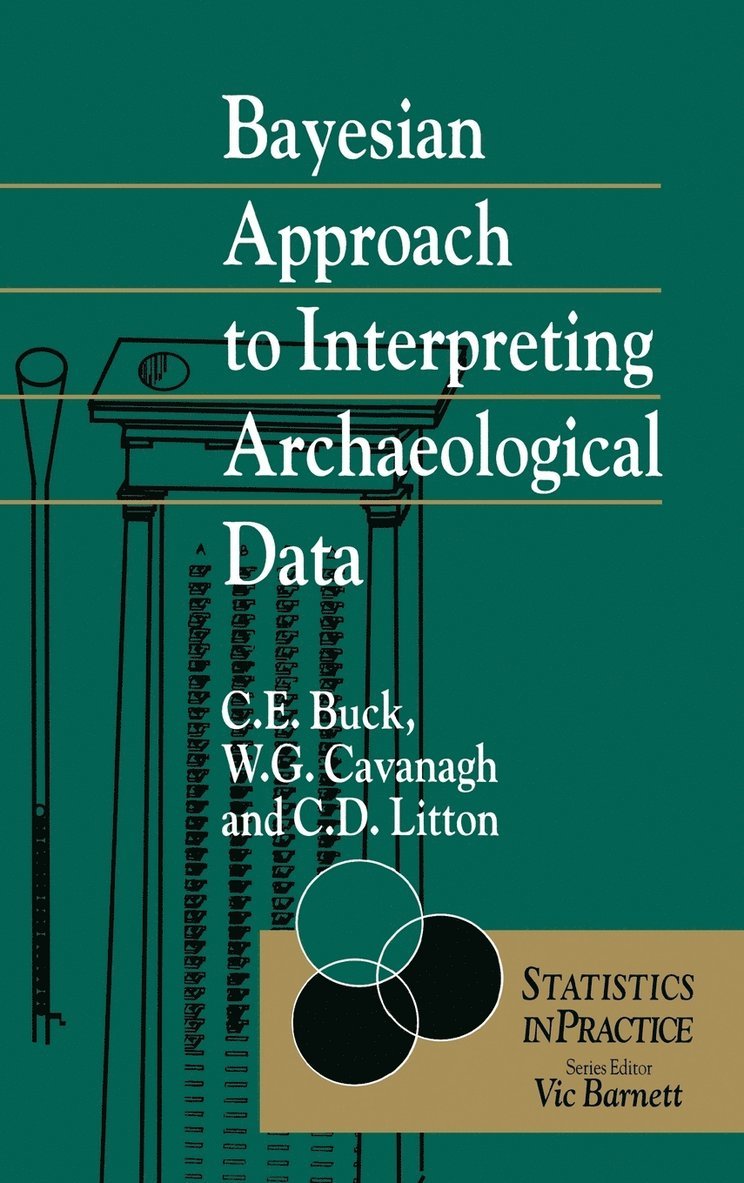
Bayesian Approach to Intrepreting Archaeological Data
Inbunden, Engelska, 1996
2 025 kr
Skickas inom 5-8 vardagar
Statistics in Practice A new series of practical books outliningthe use of statistical techniques in a wide range of applicationareas: Human and Biological SciencesEarth and Environmental SciencesIndustry, Commerce and FinanceThe authors of this important text explore the processes throughwhich archaeologists analyse their data and how these can be mademore rigorous and effective by sound statistical modelling. Theyassume relatively little previous statistical or mathematicalknowledge. Introducing the idea underlying the Bayesian approach tothe statistical analysis of data and their subsequentinterpretation, the authors demonstrate the major advantage of thisapproach, i.e. that it allows the incorporation of relevant priorknowledge or beliefs into the analysis. By doing so it provides alogical and coherent way of updating beliefs from those held beforeobserving the data to those held after taking the data intoaccount. To illustrate the power and effectiveness of mathematicaland statistical modelling within the Bayesian framework, a varietyof real case studies are presented covering areas of commoninterest to archaeologists. These case studies cover applicationsin areas such as radiocarbon dating, spatial analysis, provenancestudies and other dating methods. Background to these case studiesis provided for those readers not so familiar with the subject.Thus, the book provides an examination of the theoretical andpractical consequences of Bayesian analysis for examining problemsin archaeology. Students of archaeology and related disciplines andprofessional archaeologists will find the book an informative andpractical introduction to the subject.
E-bok
PDF, Engelska, 2012538 kr
Läs direkt efter köp
In summary, Bayesian methods are already seen by many as an essential tool to aid in formal chronology building in archaeology. At present, most researchers use packages like OxGal and BGal to make use of such tools and typically see them as radiocarbon calibration tools (indeed both are described as such on their own WWW welcome pages). On reflection, however, I think that it is clear that these packages offer more than just calibration, they are modest Bayesian chronological data interpretation environments. Given this observation, and the fact that the current tools are built on a sound foundation offlexible and scalable theory,I think that we are in a good position to move towards fully integrated tools for Bayesian chronology building. All of the current and planned research projects outlined above will contribute to the extension of the framework in one way or another. Since such work is motivated by a desire to provide practical solutions to real, current and pressing issues associated with chronology building, I feel sure that we can look forward to many more years of fast moving, productive and practical research in Bayesian chronology building. References Ammerman, A. J. and Cavalli-Sforza, 1. L. (1971). Measurement of the rate of spread of early farming in Europe. Man , 6, 674-688. Ammerman, A. J. and Cavalli-Sforza, 1. L. (1984). The Neolithic transition and the genetics of populations in Europe. Princeton University Press, Princeton. Anderson, A. , Allingham, B. and Smith, I. (1996a).
Del 177 - Lecture Notes in Statistics
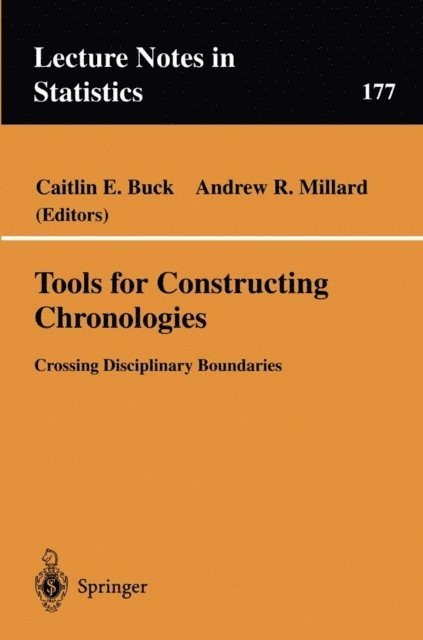
Tools for Constructing Chronologies
Crossing Disciplinary Boundaries
Häftad, Engelska, 2004
492 kr
Skickas inom 10-15 vardagar
In summary, Bayesian methods are already seen by many as an essential tool to aid in formal chronology building in archaeology. At present, most researchers use packages like OxGal and BGal to make use of such tools and typically see them as radiocarbon calibration tools (indeed both are described as such on their own WWW welcome pages). On reflection, however, I think that it is clear that these packages offer more than just calibration, they are modest Bayesian chronological data interpretation environments. Given this observation, and the fact that the current tools are built on a sound foundation offlexible and scalable theory,I think that we are in a good position to move towards fully integrated tools for Bayesian chronology building. All of the current and planned research projects outlined above will contribute to the extension of the framework in one way or another. Since such work is motivated by a desire to provide practical solutions to real, current and pressing issues associated with chronology building, I feel sure that we can look forward to many more years of fast moving, productive and practical research in Bayesian chronology building. References Ammerman, A. J. and Cavalli-Sforza, 1. L. (1971). Measurement of the rate of spread of early farming in Europe. Man , 6, 674-688. Ammerman, A. J. and Cavalli-Sforza, 1. L. (1984). The Neolithic transition and the genetics of populations in Europe. Princeton University Press, Princeton. Anderson, A. , Allingham, B. and Smith, I. (1996a).