Cameron Gokee – författare
Visar alla böcker från författaren Cameron Gokee. Handla med fri frakt och snabb leverans.
5 produkter
5 produkter
Inbunden, Engelska, 2016
1 430 kr
Skickas inom 5-8 vardagar
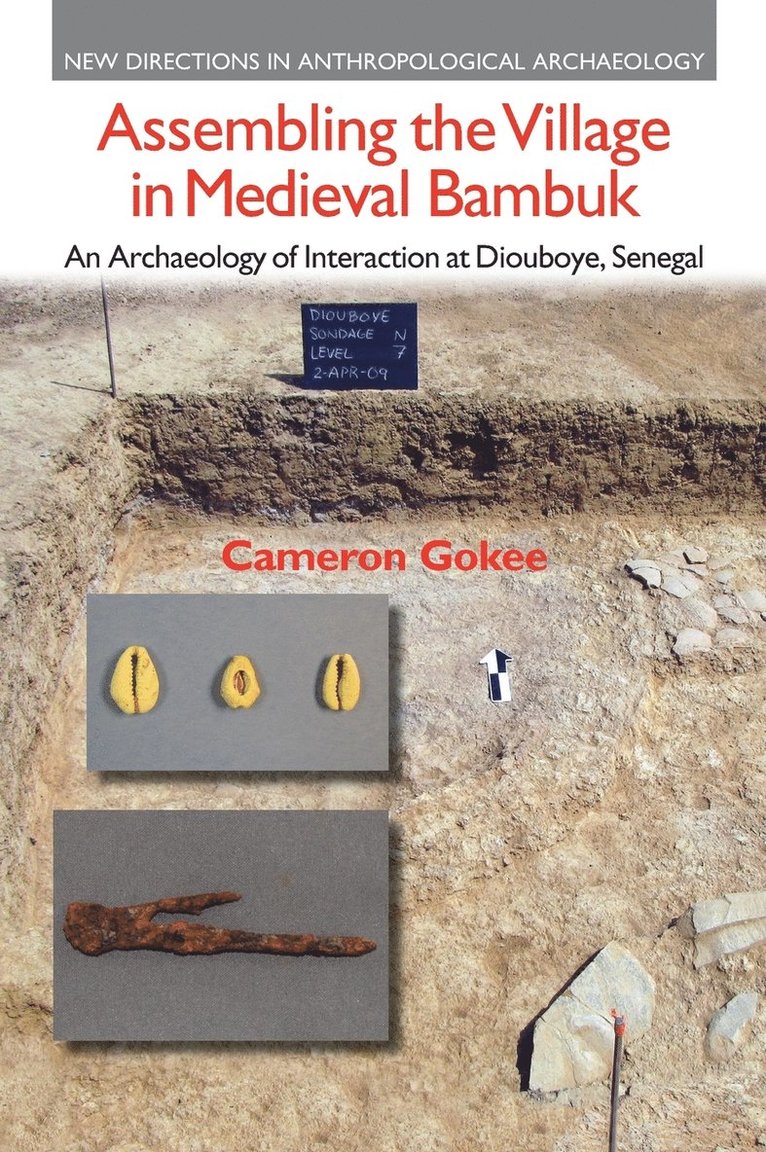
The land of Bambuk was an important source of gold for trans-Saharan trade and the imperial polities of Ghana and Mali, yet the non-centralized societies of this region remain largely peripheral in the historiography of West Africa. Drawing on recent archaeological research at the site of Diouboye in eastern Senegal, this book explores social life in medieval Bambuk from the standpoint of a village occupied over several centuries (1000-1400 CE). Material and spatial data from excavations, together with those from survey of the middle Falemme River basin, enable a critical look at how interactions across multiple scales-among neighboring houses, between cultural and craft traditions, and within a much broader political economy-created both possibilities for and challenges to the ongoing production of a local community at Diouboye. By moving back and forth across these scales centered on a single village, Assembling the Village in Medieval Bambuk outlines a relational archaeology of community applicable to the study of seemingly peripheral societies and processes of pre-modern globalization across Africa and beyond.
Inbunden, Engelska, 2023
1 235 kr
Skickas inom 10-15 vardagar
This book explores the interplay between African archaeology and geospatial methods from three broad perspectives. First, several contributors examine the technical possibilities and limits of using satellite imagery to detect archaeological sites and model their physical environs. A second perspective is the integration of new geospatial data and methods into site- and landscape-scale analyses to better address questions about social organization and subjective experience in African pasts. A final perspective considers the interplay between geospatial technologies and community archaeology in Africa. Recognizing that GIS and RS supersede traditional divisions in African archaeology, such as different periods, geographic regions, and theoretical orientations, the chapters aim to be widely applicable. Arranged by methodological emphasis, the case studies move from technical discussions of specific geospatial tools to general applications for addressing specific sociohistorical topics. Each chapter clearly explains the links between their archaeological questions and analytical methods, as well as how their results advance our understanding of African pasts and heritage resources. Many of the chapters can serve as learning models for archaeologists who are new to GIS or curious about its applications to their work. Others represent recent advances in geospatial applications of greater interest to more seasoned GIS practitioners, demonstrating the potential for African scholarship to contribute to methodological innovations. This book is of interest to students and researchers of African and historical archaeology and anthropology.Previously published in African Archaeological Review Volume 37, issue 1, March 2020
E-bok
PDF, Engelska, 20231 565 kr
Läs direkt efter köp
This book explores the interplay between African archaeology and geospatial methods from three broad perspectives. First, several contributors examine the technical possibilities and limits of using satellite imagery to detect archaeological sites and model their physical environs. A second perspective is the integration of new geospatial data and methods into site- and landscape-scale analyses to better address questions about social organization and subjective experience in African pasts. A final perspective considers the interplay between geospatial technologies and community archaeology in Africa. Recognizing that GIS and RS supersede traditional divisions in African archaeology, such as different periods, geographic regions, and theoretical orientations, the chapters aim to be widely applicable. Arranged by methodological emphasis, the case studies move from technical discussions of specific geospatial tools to general applications for addressing specific sociohistorical topics. Each chapter clearly explains the links between their archaeological questions and analytical methods, as well as how their results advance our understanding of African pasts and heritage resources. Many of the chapters can serve as learning models for archaeologists who are new to GIS or curious about its applications to their work. Others represent recent advances in geospatial applications of greater interest to more seasoned GIS practitioners, demonstrating the potential for African scholarship to contribute to methodological innovations. This book is of interest to students and researchers of African and historical archaeology and anthropology.
Previously published in African Archaeological Review Volume 37, issue 1, March 2020
Engelska, 2023
644 kr
Skickas inom 5-8 vardagar
Häftad, Engelska, 2024
1 235 kr
Skickas inom 10-15 vardagar
This book explores the interplay between African archaeology and geospatial methods from three broad perspectives. First, several contributors examine the technical possibilities and limits of using satellite imagery to detect archaeological sites and model their physical environs. A second perspective is the integration of new geospatial data and methods into site- and landscape-scale analyses to better address questions about social organization and subjective experience in African pasts. A final perspective considers the interplay between geospatial technologies and community archaeology in Africa. Recognizing that GIS and RS supersede traditional divisions in African archaeology, such as different periods, geographic regions, and theoretical orientations, the chapters aim to be widely applicable. Arranged by methodological emphasis, the case studies move from technical discussions of specific geospatial tools to general applications for addressing specific sociohistorical topics. Each chapter clearly explains the links between their archaeological questions and analytical methods, as well as how their results advance our understanding of African pasts and heritage resources. Many of the chapters can serve as learning models for archaeologists who are new to GIS or curious about its applications to their work. Others represent recent advances in geospatial applications of greater interest to more seasoned GIS practitioners, demonstrating the potential for African scholarship to contribute to methodological innovations. This book is of interest to students and researchers of African and historical archaeology and anthropology.Previously published in African Archaeological Review Volume 37, issue 1, March 2020