
Carla Zecher – författare
Visar alla böcker från författaren Carla Zecher. Handla med fri frakt och snabb leverans.
4 produkter
4 produkter
Inbunden, Engelska, 2007
899 kr
Skickas inom 5-8 vardagar
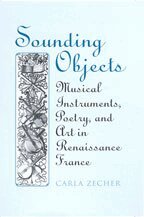
Often abstracted by the aesthetic implications of music itself, musical instruments can be seen as physical signifiers apart from the music that they produce. In Sounding Objects, Carla Zecher studies the representation of musical instruments in French Renaissance poetry and art, arguing that the efficacy of these material objects as literary and pictorial images was derived from their physical characteristics and acoustic properties, as well as from their aesthetic product.Sounding Objects is concerned with ways in which musical culture provided poets with a rich, nuanced vocabulary for reflecting on their own art and its roles in courtly life, the civic arena, and salon society. Poets not only depicted the world of musical practice but also appropriated it, using musical instruments figuratively to establish their literary identities. Drawing on music treatises and archival sources as well as poems, paintings, and engravings, this unique study aims to enrich our understanding of the interplay of poetry, music, and art in this period, and highlights the importance of musical materiality to Renaissance culture.
E-bok
PDF, Engelska, 2007948 kr
Läs direkt efter köp
Often abstracted by the aesthetic implications of music itself, musical instruments can be seen as physical signifiers apart from the music that they produce. In Sounding Objects, Carla Zecher studies the representation of musical instruments in French Renaissance poetry and art, arguing that the efficacy of these material objects as literary and pictorial images was derived from their physical characteristics and acoustic properties, as well as from their aesthetic product.Sounding Objects is concerned with ways in which musical culture provided poets with a rich, nuanced vocabulary for reflecting on their own art and its roles in courtly life, the civic arena, and salon society. Poets not only depicted the world of musical practice but also appropriated it, using musical instruments figuratively to establish their literary identities. Drawing on music treatises and archival sources as well as poems, paintings, and engravings, this unique study aims to enrich our understanding of the interplay of poetry, music, and art in this period, and highlights the importance of musical materiality to Renaissance culture.
E-bok
Engelska, 20071 124 kr
Läs direkt efter köp
Often abstracted by the aesthetic implications of music itself, musical instruments can be seen as physical signifiers apart from the music that they produce. In Sounding Objects, Carla Zecher studies the representation of musical instruments in French Renaissance poetry and art, arguing that the efficacy of these material objects as literary and pictorial images was derived from their physical characteristics and acoustic properties, as well as from their aesthetic product.Sounding Objects is concerned with ways in which musical culture provided poets with a rich, nuanced vocabulary for reflecting on their own art and its roles in courtly life, the civic arena, and salon society. Poets not only depicted the world of musical practice but also appropriated it, using musical instruments figuratively to establish their literary identities. Drawing on music treatises and archival sources as well as poems, paintings, and engravings, this unique study aims to enrich our understanding of the interplay of poetry, music, and art in this period, and highlights the importance of musical materiality to Renaissance culture.
E-bok
PDF, Engelska, 2013501 kr
Läs direkt efter köp
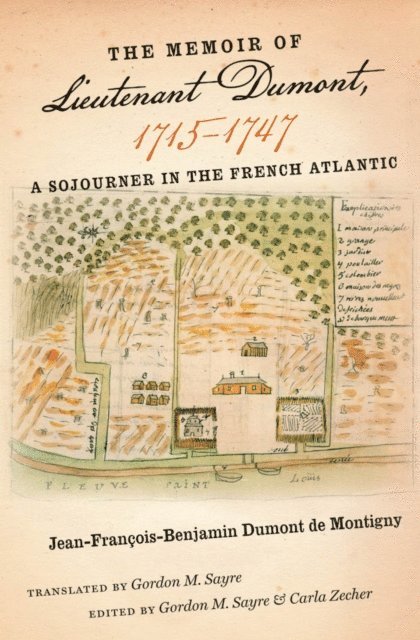
In 1719, Jean-François-Benjamin Dumont de Montigny, son of a Paris lawyer, set sail for Louisiana with a commission as a lieutenant after a year in Quebec. During his peregrinations over the next eighteen years, Dumont came to challenge corrupt officials, found himself in jail, eked out a living as a colonial subsistence farmer, survived life-threatening storms and epidemics, encountered pirates, witnessed the 1719 battle for Pensacola, described the 1729 Natchez Uprising, and gave account of the 1739–1740 French expedition against the Chickasaws.Dumont’s adventures, as recorded in his 1747 memoir conserved at the Newberry Library, underscore the complexity of the expanding French Atlantic world, offering a singular perspective on early colonialism in Louisiana. His life story also provides detailed descriptions and illustrations of the peoples and environment of the lower Mississippi valley. This English translation of the unabridged memoir features a new introduction, maps, and a biographical dictionary to enhance the text. Dumont emerges here as an important colonial voice and brings to vivid life the French Atlantic.