Carol Bacchi – författare
Visar alla böcker från författaren Carol Bacchi. Handla med fri frakt och snabb leverans.
8 produkter
8 produkter
Häftad, Engelska, 2025
628 kr
Skickas inom 10-15 vardagar
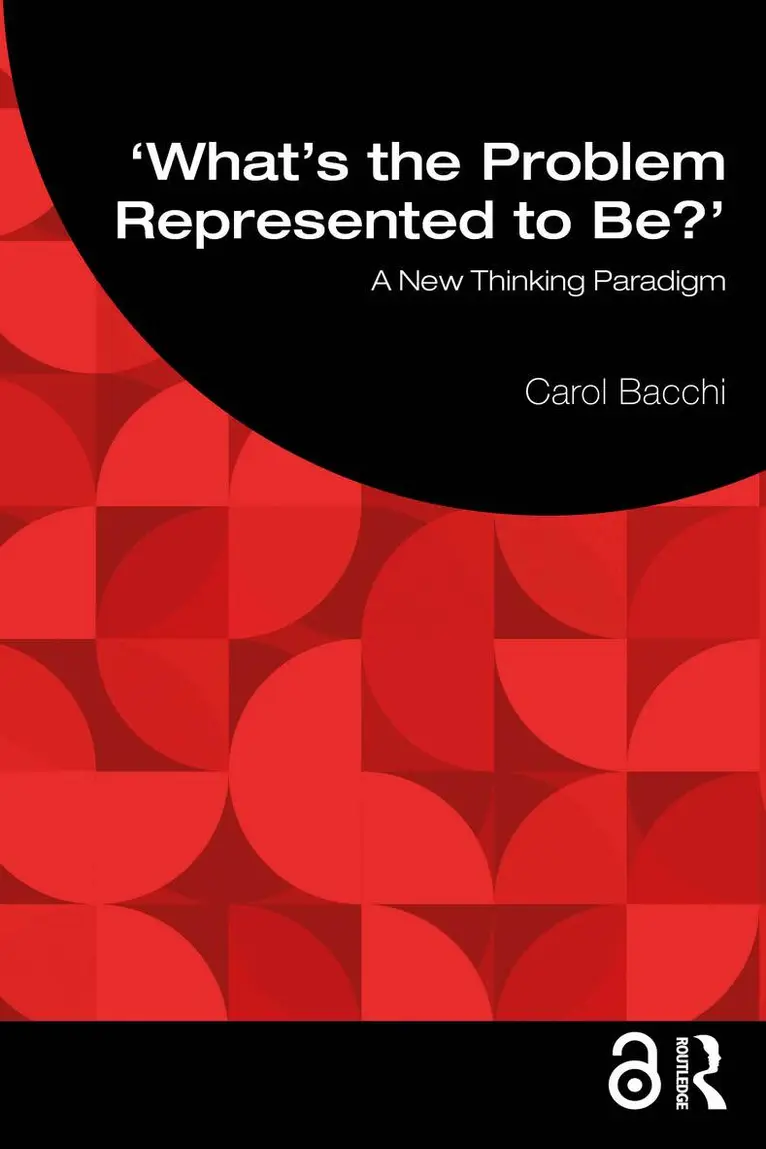
Originally developed as a mode of critical policy analysis, ‘What’s the Problem Represented to Be?’: A New Thinking Paradigm extends the thinking behind the innovative ‘What’s the problem represented to be?’ (WPR) approach to new areas of investigation. It poses a challenge to problem-solving as the dominant way of thinking about human existence and human endeavours and offers a fresh alternative that turns attention to the contours of designated ‘problems’.By focusing on proposed ‘solutions’ to conditions labelled ‘problems’, the WPR approach produces a dynamic form of analysis and critique targeting how ‘problems’ are represented. This critical analytic posture is extended from ‘problems’ to a wide range of putative conditions, including ‘indeterminate situations’, ‘issues’, ‘controversies’ and ‘matters of concern’. In this new thinking paradigm, items, such as buildings and maps, are analysed as proposals for change and hence as problematisations, with important political implications. The book brings together the theoretical resources underpinning the WPR approach and considers important methodological ramifications. A table of WPR questions incorporates changes to the approach signalled in the book.This book will be of interest to undergraduate and postgraduate students, early career researchers and academics in a wide range of fields, including public policy, education, law, international relations and disability, Indigenous and feminists' studies.The Introduction and Chapters 1 and 2 of this book are freely available as a downloadable Open Access PDF at http://www.taylorfrancis.com under a Creative Commons Attribution-Non Commercial-No Derivatives (CC BY-NC-ND) 4.0 license.
Inbunden, Engelska, 2025
546 kr
Skickas inom 10-15 vardagar
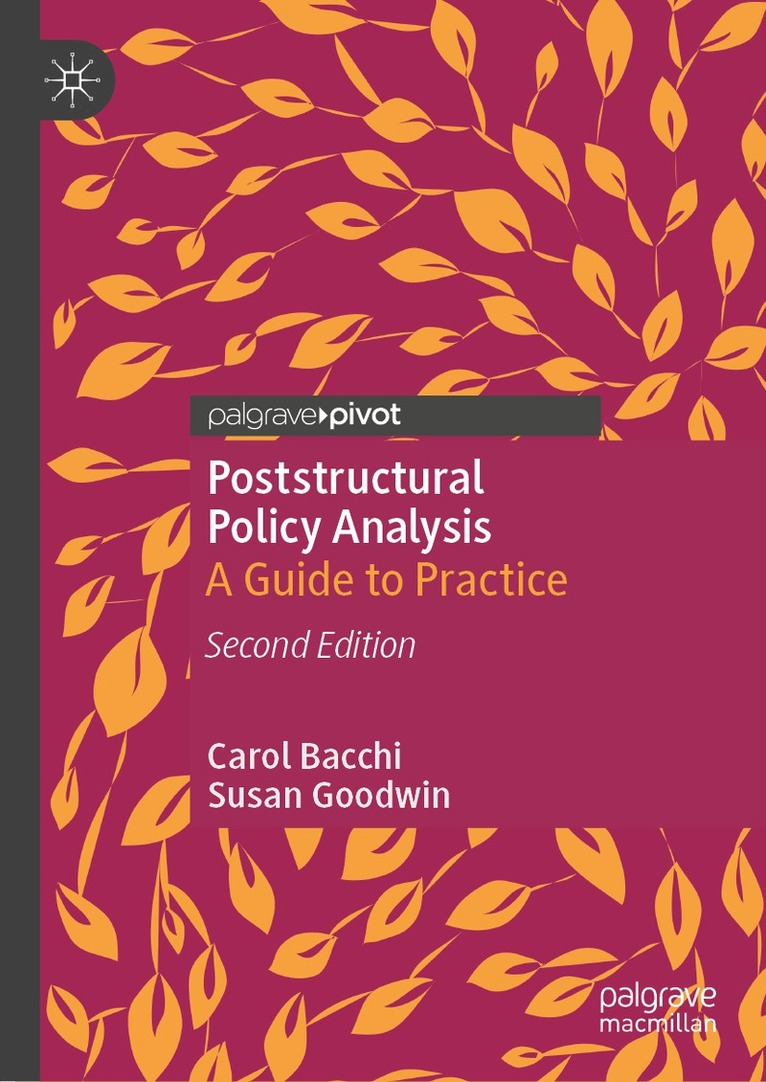
This book offers a distinctive approach to policy analysis and a refreshing and politically engaged way of thinking about policy. It clearly articulates a Foucault-influenced poststructural perspective on policy and policy analysis for researchers, students and policy makers. As a "guide to practice", the book introduces a critical analytical approach to policy analysis called ‘What’s the Problem Represented to be?’ (WPR). Instead of treating policy as simply the government’s best efforts to address problems, this analytic strategy highlights how policies produce ‘problems’ as particular sorts of problem and how governing takes place through these problematisations. First published in 2016, the book describes the conceptual and theoretical underpinnings of the WPR approach to policy analysis in a detailed and accessible manner. It features examples of application of the approach with topics as diverse as obesity, economic policy, migration, drug and alcohol policy, and gender equality.In this second edition, the authors centralise a complementary analytic strategy for poststructural policy analysis—poststructural interview analysis (PIA). This edition integrates this material as a new chapter which sets out PIA as a novel approach to poststructural interview analysis and includes examples of PIA applications. The new chapter provides excellent guidance to undertake interview analysis in a manner congruent with the poststructural precepts set out in the book.
Häftad, Engelska, 2010
309 kr
Skickas inom 5-8 vardagar
Inbunden, Engelska, 2025
2 421 kr
Skickas inom 10-15 vardagar
Originally developed as a mode of critical policy analysis, ‘What’s the Problem Represented to Be?’: A New Thinking Paradigm extends the thinking behind the innovative ‘What’s the problem represented to be?’ (WPR) approach to new areas of investigation. It poses a challenge to problem-solving as the dominant way of thinking about human existence and human endeavours and offers a fresh alternative that turns attention to the contours of designated ‘problems’.By focusing on proposed ‘solutions’ to conditions labelled ‘problems’, the WPR approach produces a dynamic form of analysis and critique targeting how ‘problems’ are represented. This critical analytic posture is extended from ‘problems’ to a wide range of putative conditions, including ‘indeterminate situations’, ‘issues’, ‘controversies’ and ‘matters of concern’. In this new thinking paradigm, items, such as buildings and maps, are analysed as proposals for change and hence as problematisations, with important political implications. The book brings together the theoretical resources underpinning the WPR approach and considers important methodological ramifications. A table of WPR questions incorporates changes to the approach signalled in the book.This book will be of interest to undergraduate and postgraduate students, early career researchers and academics in a wide range of fields, including public policy, education, law, international relations and disability, Indigenous and feminists' studies.The Introduction and Chapters 1 and 2 of this book are freely available as a downloadable Open Access PDF at http://www.taylorfrancis.com under a Creative Commons Attribution-Non Commercial-No Derivatives (CC BY-NC-ND) 4.0 license.
E-bok
PDF, Engelska, 2025673 kr
Läs direkt efter köp
Originally developed as a mode of critical policy analysis, 'What's the Problem Represented to Be?': A New Thinking Paradigm extends the thinking behind the innovative 'What's the problem represented to be?' (WPR) approach to new areas of investigation. It poses a challenge to problem-solving as the dominant way of thinking about human existence and human endeavours and offers a fresh alternative that turns attention to the contours of designated 'problems'.By focusing on proposed 'solutions' to conditions labelled 'problems', the WPR approach produces a dynamic form of analysis and critique targeting how 'problems' are represented. This critical analytic posture is extended from 'problems' to a wide range of putative conditions, including 'indeterminate situations', 'issues', 'controversies' and 'matters of concern'. In this new thinking paradigm, items, such as buildings and maps, are analysed as proposals for change and hence as problematisations, with important political implications. The book brings together the theoretical resources underpinning the WPR approach and considers important methodological ramifications. A table of WPR questions incorporates changes to the approach signalled in the book.This book will be of interest to undergraduate and postgraduate students, early career researchers and academics in a wide range of fields, including public policy, education, law, international relations and disability, Indigenous and feminists' studies.The Introduction and Chapters 1 and 2 of this book are freely available as a downloadable Open Access PDF at http://www.taylorfrancis.com under a Creative Commons Attribution-Non Commercial-No Derivatives (CC BY-NC-ND) 4.0 license.
E-bok
Engelska, 2025673 kr
Läs direkt efter köp
Originally developed as a mode of critical policy analysis, 'What's the Problem Represented to Be?': A New Thinking Paradigm extends the thinking behind the innovative 'What's the problem represented to be?' (WPR) approach to new areas of investigation. It poses a challenge to problem-solving as the dominant way of thinking about human existence and human endeavours and offers a fresh alternative that turns attention to the contours of designated 'problems'.By focusing on proposed 'solutions' to conditions labelled 'problems', the WPR approach produces a dynamic form of analysis and critique targeting how 'problems' are represented. This critical analytic posture is extended from 'problems' to a wide range of putative conditions, including 'indeterminate situations', 'issues', 'controversies' and 'matters of concern'. In this new thinking paradigm, items, such as buildings and maps, are analysed as proposals for change and hence as problematisations, with important political implications. The book brings together the theoretical resources underpinning the WPR approach and considers important methodological ramifications. A table of WPR questions incorporates changes to the approach signalled in the book.This book will be of interest to undergraduate and postgraduate students, early career researchers and academics in a wide range of fields, including public policy, education, law, international relations and disability, Indigenous and feminists' studies.The Introduction and Chapters 1 and 2 of this book are freely available as a downloadable Open Access PDF at http://www.taylorfrancis.com under a Creative Commons Attribution-Non Commercial-No Derivatives (CC BY-NC-ND) 4.0 license.
E-bok
PDF, Engelska, 20161 029 kr
Läs direkt efter köp
This book offers a novel, refreshing and politically engaged way to think about public policy. Instead of treating policy as simply the government’s best efforts to address problems, it offers a way to question critically how policies produce “problems” as particular sorts of problems, with important political implications. Governing, it is argued, takes place through these problematizations. According to the authors, interrogating policies and policy proposals as problematizations involves asking questions about the assumptions they rely upon, how they have been made, what their effects are, as well as how they could be unmade. To enable this form of critical analysis, this book introduces an analytic strategy, the “What’s the Problem Represented to be?” (WPR) approach. It features examples of applications of the approach with topics as diverse as obesity, economic policy, migration, drug and alcohol policy, and gender equality to illustrate the growing popularity of this way of thinking and to provide clear and useful examples of poststructural policy analysis in practice.
E-bok
Engelska, 2025535 kr
Läs direkt efter köp
This book offers a distinctive approach to policy analysis and a refreshing and politically engaged way of thinking about policy. It clearly articulates a Foucault-influenced poststructural perspective on policy and policy analysis for researchers, students and policy makers. As a "e;guide to practice"e;, the book introduces a critical analytical approach to policy analysis called ‘What’s the Problem Represented to be?’ (WPR). Instead of treating policy as simply the government’s best efforts to address problems, this analytic strategy highlights how policies produce ‘problems’ as particular sorts of problem and how governing takes place through these problematisations. First published in 2016, the book describes the conceptual and theoretical underpinnings of the WPR approach to policy analysis in a detailed and accessible manner. It features examples of application of the approach with topics as diverse as obesity, economic policy, migration, drug and alcohol policy, and gender equality. In this second edition, the authors centralise a complementary analytic strategy for poststructural policy analysis—poststructural interview analysis (PIA). This edition integrates this material as a new chapter which sets out PIA as a novel approach to poststructural interview analysis and includes examples of PIA applications. The new chapter provides excellent guidance to undertake interview analysis in a manner congruent with the poststructural precepts set out in the book.