Carol Farbotko - Böcker
Visar alla böcker från författaren Carol Farbotko. Handla med fri frakt och snabb leverans.
4 produkter
4 produkter
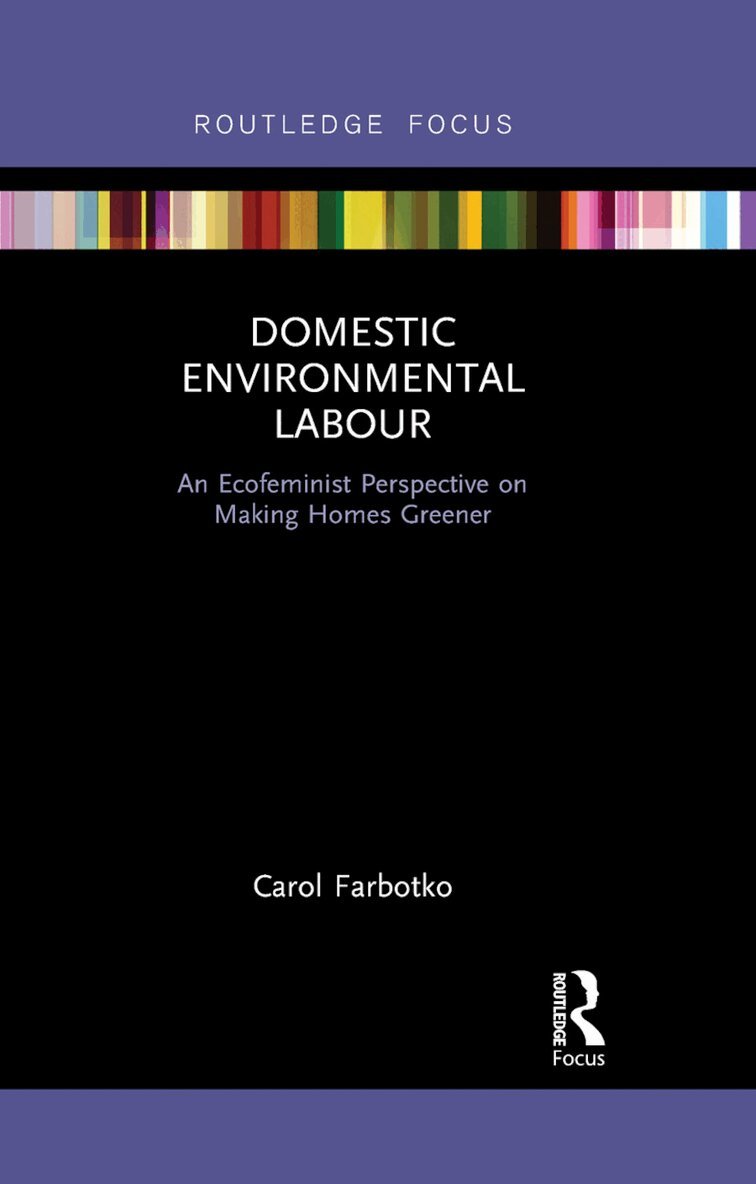
Domestic Environmental Labour
An Ecofeminist Perspective on Making Homes Greener
Häftad, Engelska, 2019
348 kr
Skickas inom 10-15 vardagar
This book addresses the question of domestic environmental labour from an ecofeminist perspective. A work of cultural geography, it explores the proposition that the practice and politics of domestic labour being undertaken in the name of ‘the environment’ needs to be better recognized, understood and accounted for as a phenomenon shaped by, and shaping of, gender, class and spatial relations.The book argues that a significant yet neglected phenomenon worthy of research attention is the upsurge in voluntary, and yet mostly unrecognized, domestic environmental labour in high-consuming households in late modernity, with the burden often falling on women seeking to green their lives and homes in aid of a sustainable planet. Further, because domestic environmental labour is undervalued in governance and the formal economy, much like other types of domestic labour, householders have become an unrecognized and unaccounted-for supply of labour for the greening of capitalism.Situated within broad global debates on links between ecological and social change, the book has relevance in the many jurisdictions around the world in which households are positioned as sites of environmental protection through green consumption. The volume engages existing interest in household environmental behaviour and practice, advancing understanding of these topics in new ways.
Domestic Environmental Labour
An Ecofeminist Perspective on Making Homes Greener
Inbunden, Engelska, 2017
826 kr
Skickas inom 10-15 vardagar
This book addresses the question of domestic environmental labour from an ecofeminist perspective. A work of cultural geography, it explores the proposition that the practice and politics of domestic labour being undertaken in the name of ‘the environment’ needs to be better recognized, understood and accounted for as a phenomenon shaped by, and shaping of, gender, class and spatial relations.The book argues that a significant yet neglected phenomenon worthy of research attention is the upsurge in voluntary, and yet mostly unrecognized, domestic environmental labour in high-consuming households in late modernity, with the burden often falling on women seeking to green their lives and homes in aid of a sustainable planet. Further, because domestic environmental labour is undervalued in governance and the formal economy, much like other types of domestic labour, householders have become an unrecognized and unaccounted-for supply of labour for the greening of capitalism.Situated within broad global debates on links between ecological and social change, the book has relevance in the many jurisdictions around the world in which households are positioned as sites of environmental protection through green consumption. The volume engages existing interest in household environmental behaviour and practice, advancing understanding of these topics in new ways.
1 718 kr
Skickas inom 7-10 vardagar
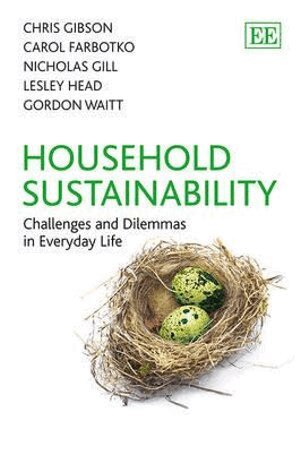
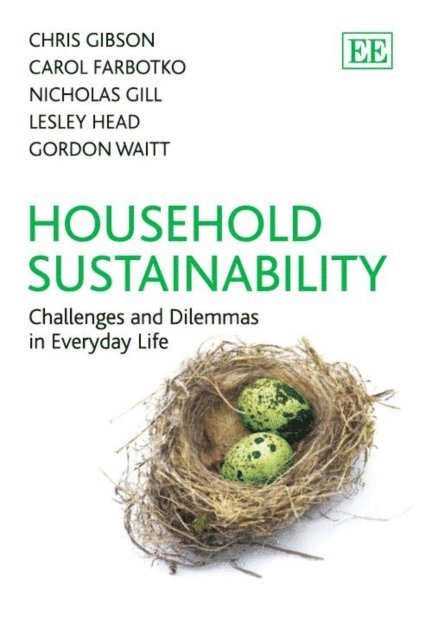
Contrary to the common rhetoric that being green is 'easy', household sustainability is rife with contradiction and uncertainty. Households attempting to respond to the challenge to become more sustainable in everyday life face dilemmas on a daily basis when trying to make sustainable decisions. Various aspects of life such as cars, computers, food, phones and even birth and death, may all provoke uncertainty regarding the most sustainable course of action. Drawing on international scientific and cultural research, as well as innovative ethnographies, this timely book probes these wide-ranging sustainability dilemmas, assessing the avenues open to households trying to improve their sustainability.The authors engage critically, and constructively, with the proposition that households are a key scale of action on climate change. They confront dilemmas of practice and circumstance, and cultural norms of lifestyle and consumerism that are linked to troublesome environmental problems - and question whether they can be easily unsettled. The work also illuminates the informal and often unheralded work by households - frequently the poorest - in reducing their environmental burden. This important book is critical to understanding both the barriers to household sustainability and the 'unsung' sustainability work carried out by householders.Containing a unique combination of science and cultural research, this fascinating book will appeal to researchers and students of environmental science, environmental studies, sustainability studies, climate change adaptation, geography, sociology, cultural studies, science and technology studies, as well as energy studies and housing research. Policy-makers in various levels of government working through sustainability problems, environmental educators, social planners and sustainability officers working for governments, will also find much to interest them in this unique book.
477 kr
Skickas inom 7-10 vardagar
Contrary to the common rhetoric that being green is 'easy', household sustainability is rife with contradiction and uncertainty. Households attempting to respond to the challenge to become more sustainable in everyday life face dilemmas on a daily basis when trying to make sustainable decisions. Various aspects of life such as cars, computers, food, phones and even birth and death, may all provoke uncertainty regarding the most sustainable course of action. Drawing on international scientific and cultural research, as well as innovative ethnographies, this timely book probes these wide-ranging sustainability dilemmas, assessing the avenues open to households trying to improve their sustainability.The authors engage critically, and constructively, with the proposition that households are a key scale of action on climate change. They confront dilemmas of practice and circumstance, and cultural norms of lifestyle and consumerism that are linked to troublesome environmental problems - and question whether they can be easily unsettled. The work also illuminates the informal and often unheralded work by households - frequently the poorest - in reducing their environmental burden. This important book is critical to understanding both the barriers to household sustainability and the 'unsung' sustainability work carried out by householders.Containing a unique combination of science and cultural research, this fascinating book will appeal to researchers and students of environmental science, environmental studies, sustainability studies, climate change adaptation, geography, sociology, cultural studies, science and technology studies, as well as energy studies and housing research. Policy-makers in various levels of government working through sustainability problems, environmental educators, social planners and sustainability officers working for governments, will also find much to interest them in this unique book.