Caroline Gerschlager - Böcker
Visar alla böcker från författaren Caroline Gerschlager. Handla med fri frakt och snabb leverans.
4 produkter
4 produkter
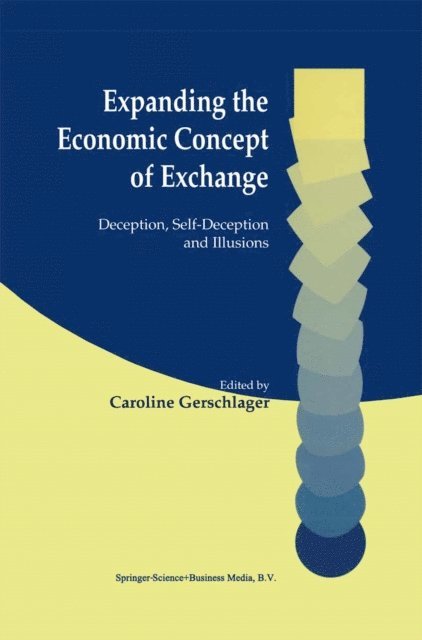
Expanding the Economic Concept of Exchange
Deception, Self-Deception and Illusions
Inbunden, Engelska, 2001
1 625 kr
Skickas inom 10-15 vardagar
Exchange is a pervasive concept in everyday life, affecting phenomena as diverse as interpersonal relationships and market transactions. In addition, economists have used the concept in a highly specific and clearly delineated way. Against this background, "Expanding the Economic Concept of Exchange" sets out to expand the concept of exchange by crossing the boundaries laid down by economists and by examining the function played by deceptions, self-deceptions and illusions. The main motivation for expanding the concept of exchange was the realization that in the prototypical economic model deception is not taken into account. Hence, economists traditionally regard deception as some sort of irrationality, as a flaw in an otherwise perfectly rational process. Authors represented in this volume take a different approach examining deception as a constituent quality of exchange. This is shown by the contributions drawing on recent developments in economic theory, by those with an anthropological orientation, as well as by a contribution referring specifically to Adam Smith. An interrogation into deception is long overdue in economics.This volume prepares the ground for and makes the first contributions to explicitly acknowledging deceptions, self-deceptions and illusions as fundamental dimensions allowing us as economists to further research and develop the concept of change. A particular and perhaps unexpected focus of this volume lies on anthropology, because economics can clearly benefit from integrating selected results on deception from outside its expanding domain. It is primarily targeted at economists interested in institutional aspects of exchanges and social theory. In addition, the topic will find interested readers from anthropology, cultural studies, science studies and philosophy.
1 096 kr
Skickas inom 10-15 vardagar
The experience of deception is widespread in everyday life, where it appears in various forms, ranging from individual to the social deception. This book aims at expanding and correcting "malestream" economic concepts of the exchange economy and its role in society by focusing on deception from a feminist economic perspective. The main motivation for writing the book was the realization that the prototypical economic model of exchange is notable for the total absence of deception. In standard economic models individuals are regarded as "uncheatable". Hence deception, even if individuals have an interest in it, cannot succeed. By contrast, the authors of this volume examine deception as the key to understanding the functioning of exchange by focusing on settings in which deception is successful in exchange. The authors draw on Adam Smith's "Theory of Moral Sentiments" as a starting point for a discussion on feminist views and perspectives on exchange and deception. This is supplemented by examinations of economic thought and traditional economic modelling within a feminist economic framework and by empirical insights into the situation of women.
1 064 kr
Skickas inom 10-15 vardagar
This book aims at expanding and correcting "malestream" economic concepts of the exchange economy and its role in society by focusing on deception from a feminist economic perspective. The main motivation for writing the book was the realization that the prototypical economic model of exchange is notable for the total absence of deception. In standard economic models individuals are regarded as 'uncheatable'. Hence deception, even if individuals have an interest in it, cannot succeed. By contrast, the authors of this volume examine deception as the key to understanding the functioning of exchange by focusing on settings in which deception is successful in exchange. The authors draw on Adam Smith's Theory of Moral Sentiments as a starting point for a discussion on feminist views and perspectives on exchange and deception. This is supplemented by examinations of economic thought and traditional economic modelling within a feminist economic framework and by empirical insights into the situation of women.
Expanding the Economic Concept of Exchange
Deception, Self-Deception and Illusions
Häftad, Engelska, 2012
1 578 kr
Skickas inom 10-15 vardagar
Exchange is a pervasive concept in everyday life, affecting phenomena as diverse as interpersonal relationships and market transactions. In addition, economists have used the concept in a highly specific and clearly delineated way. Against this background, Expanding the Economic Concept of Exchange sets out to expand the concept of exchange by crossing the boundaries laid down by economists and by examining the function played by deceptions, self-deceptions and illusions. The main motivation for expanding the concept of exchange was the realization that in the prototypical economic model deception is not taken into account. Hence, economists traditionally regard deception as some sort of irrationality, as a flaw in an otherwise perfectly rational process. Authors represented in this volume take a different approach examining deception as a constituent quality of exchange. This is shown by the contributions drawing on recent developments in economic theory, by those with an anthropological orientation, as well as by a contribution referring specifically to Adam Smith. An interrogation into deception is long overdue in economics. This volume prepares the ground for and makes the first contributions to explicitly acknowledging deceptions, self-deceptions and illusions as fundamental dimensions allowing us as economists to further research and develop the concept of change. A particular and perhaps unexpected focus of this volume lies on anthropology, because economics can clearly benefit from integrating selected results on deception from outside its expanding domain. It is primarily targeted at economists interested in institutional aspects of exchanges and social theory. In addition, the topic will find interested readers from anthropology, cultural studies, science studies, philosophy.