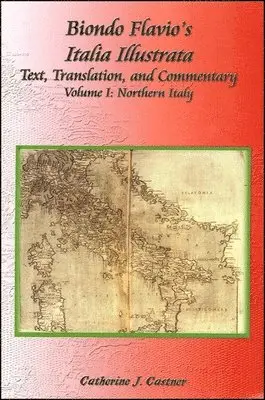
Catherine J. Castner – författare
Visar alla böcker från författaren Catherine J. Castner. Handla med fri frakt och snabb leverans.
2 produkter
2 produkter
Häftad, Engelska, 2005
323 kr
Tillfälligt slut
An English translation of Biondo Flavio's Italia Illustrata, with commentary.In 1447 Alfonso of Aragon, King of Naples, engaged the humanist antiquarian Biondo Flavio to compose in Latin a catalogue of famous men of Italy. This commission became Italia Illustrata, the first historical topography. In it, Biondo superimposed upon Italy's classical heritage and her troubled medieval history a panorama of Italy in his own time. Although Italia Illustrata and three other major Latin treatises made Biondo's reputation as the father of modern historiography and archaeology, these works have been accessible only in early modern printed editions to specialists with entrée to rare book rooms.Catherine J. Castner has now made this important treatise available in modern text with English translation and commentary. The Latin text is the best-known early printed edition, that of Froben (Basel, 1559). A clear, flowing English translation provides modern Italian equivalents for the majority of Biondo's Latin toponyms. The commentary summarizes scholarship on the location and history of towns and cities of Italy and the building activities of their Renaissance lords. The plates include maps of cities and regions of Italy from medieval and early modern times.Italia Illustrata is an essential resource for any serious scholar of Renaissance humanism. Historians of medieval Italy, and of art and architecture, classicists, archaeologists, and epigraphers will value this work for its treasure of evidence: for example, Biondo's eye-witness reports on the status of the building projects of the Malatesta; the Renaissance reception of Livy, Pliny, and Virgil (and the transmission of forged or misinterpreted inscriptions); and correlations of ancient sites with fifteenth-century settlements. This book will appeal to interests ranging from the current popular appetite for travel in Italy, to the growing scholarly attention to early modern geographical and travel literature; in short, to any reader with more than superficial interest in the urban centers and landscapes of Italy.
Häftad, Engelska, 2011
402 kr
Tillfälligt slut
An English translation of Biondo Flavio's Italia Illustrata, with commentary.In 1447 Alfonso of Aragon, King of Naples, engaged the humanist antiquarian Biondo Flavio to compose in Latin a catalogue of famous men of Italy. This commission became Italia Illustrata, the first historical topography. In it, Biondo superimposed upon Italy's classical heritage and her troubled medieval history a panorama of Italy in his own time. Although Italia Illustrata and three other major Latin treatises made Biondo's reputation as the father of modern historiography and archaeology, these works have been accessible only in early modern printed editions to specialists with entrée to rare book rooms.In 2005, Catherine J. Castner made available in the first volume of this work Biondo's Latin description of the regions of northern Italy, accompanied by English translation and detailed commentary. The present volume completes the regions of Italy in Biondo's treatise.Italia Illustrata provides important evidence for Italian geography and political history, the intellectual history of the fifteenth century, and the reception of classical antiquity in the Renaissance. This second volume continues attention to Biondo's direct observation of sites as he describes the towns and cities of central and southern Italy, correlating ancient Roman places with their contemporary counterparts. Along the way, notices of their famous men include early appraisals of important cultural figures, for example appreciations of Leon Battista Alberti and Donatello. Historians of classical archaeology will be interested in Biondo's narrations of antiquarian investigations: his location of the site of Horace's Sabine farm, and his patron Prospero cardinal Colonna's attempt to reclaim an imperial Roman ship from Lake Nemi. Although Biondo left the southern regions unfinished, he provides a substantial presentation of the history of the kingdom of Naples culminating in the triumph of King Alfonso, and eyewitness observation of ancient Roman sites in the Campi Flegrei, evocative for early humanists and Renaissance notables, who considered them second only to the ruins of Rome.