Cathy O'Neil – författare
Visar alla böcker från författaren Cathy O'Neil. Handla med fri frakt och snabb leverans.
13 produkter
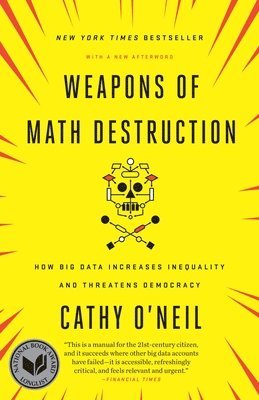
Weapons of Math Destruction
How Big Data Increases Inequality and Threatens Democracy
Av Cathy O'Neil
Häftad, 2017
140 kr
Lägg i varukorg
A former Wall Street quant sounds an alarm on the mathematical models that pervade modern life and threaten to rip apart our social fabric We live in the age of the algorithm. Increasingly, the decisions that affect our lives where we go to school, whether we get a car loan, how much we pay for …
Weapons of Math Destruction
How Big Data Increases Inequality and Threatens Democracy
Av Cathy O'Neil
Häftad, 2017
4,0 utav 5 stjärnor. Totalt antal röster: (2)
141 kr
Lägg i varukorg
'A manual for the 21st-century citizen... accessible, refreshingly critical, relevant and urgent' - Financial Times 'Fascinating and deeply disturbing' - Yuval Noah Harari, Guardian Books of the Year In this New York Times bestseller, Cathy O'Neil, one of the first champions of algorithmic …
Weapons of Math Destruction
How Big Data Increases Inequality and Threatens Democracy
Av Cathy O'Neil
E-bok, 2016
108 kr
Lägg i varukorg
'A manual for the 21st-century citizen... accessible, refreshingly critical, relevant and urgent' - Financial Times 'Fascinating and deeply disturbing' - Yuval Noah Harari, Guardian Books of the Year In this New York Times bestseller, Cathy O'Neil, one of the first champions of algorithmic …
Shame Machine
Who Profits in the New Age of Humiliation
Av Cathy O'Neil
Häftad, 2023
147 kr
Lägg i varukorg
A TIMES BOOK OF THE YEAR Shame is being weaponized by governments and corporations to attack the most vulnerable. It's time to fight backShame is a powerful and sometimes useful tool. When we publicly shame corrupt politicians, abusive celebrities, or predatory corporations, we reinforce values of …
Weapons of Math Destruction
How Big Data Increases Inequality and Threatens Democracy
Av Cathy O'Neil
Ljudbok, 2022
162 kr
Lägg i varukorg
Brought to you by Penguin. In this New York Times bestseller, Cathy O''Neil, one of the first champions of algorithmic accountability, sounds an alarm on the mathematical models that pervade modern life -- and threaten to rip apart our social fabric. We live in the age of the algorithm. …
Weapons of Math Destruction
How Big Data Increases Inequality and Threatens Democracy
Av Cathy O'Neil
E-bok, 2016
142 kr
Lägg i varukorg
Longlisted for the National Book Award New York Times Bestseller A former Wall Street quant sounds an alarm on the mathematical models that pervade modern life — and threaten to rip apart our social fabric We live in the age of the algorithm. Increasingly, the decisions that affect our lives—where …
Doing Data Science
Straight Talk from the Frontline
Av Rachel Schutt, Cathy O'Neil
E-bok, 2013
409 kr
Lägg i varukorg
Now that people are aware that data can make the difference in an election or a business model, data science as an occupation is gaining ground. But how can you get started working in a wide-ranging, interdisciplinary field that’s so clouded in hype? This insightful book, based on Columbia …
Doing Data Science
Straight Talk from the Frontline
Av Rachel Schutt, Cathy O'Neil
E-bok, 2013
488 kr
Lägg i varukorg
Now that people are aware that data can make the difference in an election or a business model, data science as an occupation is gaining ground. But how can you get started working in a wide-ranging, interdisciplinary field that’s so clouded in hype? This insightful book, based on Columbia …
Shame Machine
Who Profits in the New Age of Humiliation
Av Cathy O'Neil
E-bok, 2022
125 kr
Lägg i varukorg
A TIMES BOOK OF THE YEAR Shame is being weaponized by governments and corporations to attack the most vulnerable. It's time to fight backShame is a powerful and sometimes useful tool. When we publicly shame corrupt politicians, abusive celebrities, or predatory corporations, we reinforce values of …
Shame Machine
Who Profits in the New Age of Humiliation
Av Cathy O'Neil
Ljudbok, 2022
112 kr
Lägg i varukorg
Brought to you by Penguin. Shame is being weaponized by governments and corporations to attack the most vulnerable. It''s time to fight back Shame is a powerful and sometimes useful tool. When we publicly shame corrupt politicians, abusive celebrities, or predatory corporations, we reinforce values …
The Shame Machine
Who Profits in the New Age of Humiliation
Av Cathy O'Neil
Inbunden, 1900
282 kr
Lägg i varukorg
NEW YORK TIMES EDITORS’ CHOICE • A clear-eyed warning about the increasingly destructive influence of America’s “shame industrial complex” in the age of social media and hyperpartisan politics —from the New York Times bestselling author of Weapons of Math Destruction “O’Neil reminds us that we must …
Armas de destrucción matemática
Cómo el Big Data aumenta la desigualdad y amenaza la democracia
Av Cathy O'Neil
E-bok, 2018
112 kr
Lägg i varukorg
Vivimos en la edad del algoritmo. Las decisiones que afectan a nuestras vidas no están hechas por humanos, sino por modelos matemáticos. En teoría, esto debería conducir a una mayor equidad: todos son juzgados de acuerdo con las mismas reglas, sin sesgo. Pero en realidad, ocurre exactamente lo …