Chance E. Bonar – författare
Visar alla böcker från författaren . Handla med fri frakt och snabb leverans.
9 produkter
9 produkter
Inbunden, Engelska, 2027
1 148 kr
Kommande
During both the republic and the empire, Romans enslaved large numbers of people, drawn from captives taken in warfare and from generations of children born to those they had enslaved. Given the imbalance in source material toward free Roman societal concerns, the lives of the enslaved are but sketchily drafted and rely heavily on descriptions written by their enslavers. Their religious beliefs and praxes are mentioned rarely, and never without bias. Similarly, despite the fame of a few revolts, the motivations and details even of the better-known rebellious leaders are often murky.In this monograph, Chance E. Bonar demonstrates that we cannot understand slave revolts or Roman discussions of them without understanding the religious cultures of both the enslaved and their enslavers. Religious conviction could provide a catalyst for revolts as well as a means to delegitimize and suppress them. Further, elite Roman writers used religious cultures to craft their own narratives of slave revolts, sometimes decades or even centuries later. Bonar extracts the strands of religious thought among the enslaved that have been hidden by dominant accounts, recovering fuller pictures of their lives.
Inbunden, Engelska, 2025
884 kr
Skickas inom 7-10 vardagar
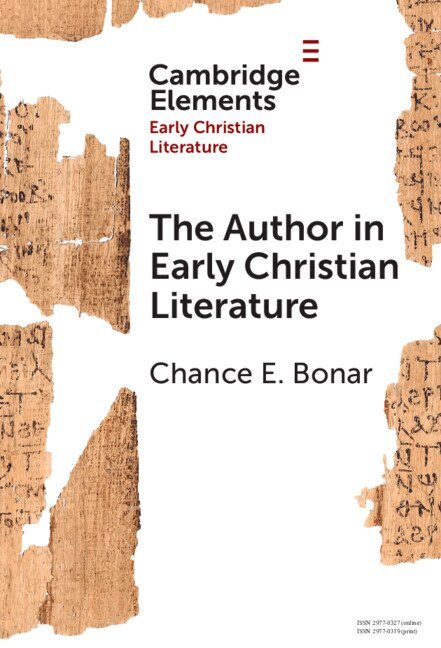
While scholars of ancient Mediterranean literature have focused their efforts heavily on explaining why authors would write pseudonymously or anonymously, less time has been spent exploring why an author would write orthonymously (that is, under their own name). This Element explores how early Christian writers began to care deeply about 'correct' attribution of both Christian and non-Christian literature for their own apologetic purposes, as well as how scholars have overlooked the function that orthonymity plays in some early Christian texts. Orthonymity was not only a decision made by a writer regarding how to attribute one's own writings, but also how to classify other writers' texts based on proper or improper attribution. This Element urges us to examine forms of authorship that are often treated as an unexamined default, as well as to more robustly consider when, how, for whom, and for what purposes an instance of authorial attribution is deemed 'correct.
Häftad, Engelska, 2025
274 kr
Skickas inom 7-10 vardagar
While scholars of ancient Mediterranean literature have focused their efforts heavily on explaining why authors would write pseudonymously or anonymously, less time has been spent exploring why an author would write orthonymously (that is, under their own name). This Element explores how early Christian writers began to care deeply about 'correct' attribution of both Christian and non-Christian literature for their own apologetic purposes, as well as how scholars have overlooked the function that orthonymity plays in some early Christian texts. Orthonymity was not only a decision made by a writer regarding how to attribute one's own writings, but also how to classify other writers' texts based on proper or improper attribution. This Element urges us to examine forms of authorship that are often treated as an unexamined default, as well as to more robustly consider when, how, for whom, and for what purposes an instance of authorial attribution is deemed 'correct.
E-bok
Engelska, 2025328 kr
Läs direkt efter köp
E-bok
PDF, Engelska, 2025328 kr
Läs direkt efter köp
E-bok
Engelska, 20251 424 kr
Läs direkt efter köp
Inbunden, Engelska, 2025
1 217 kr
Skickas inom 7-10 vardagar
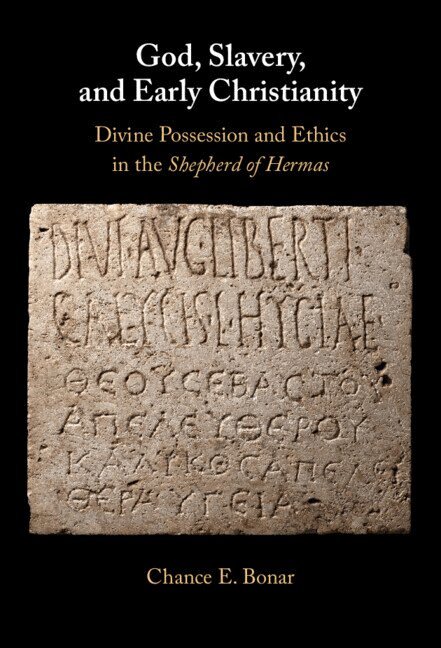
Ancient Christians understood themselves to be enslaved to God, an attitude that affected their ethics, theology, and self-understanding. This widespread belief is made especially clear in the Shepherd of Hermas, an overlooked early Christian text written by an enslaved person, which was nearly included in the New Testament. In this book, Chance Bonar provides a robust analysis of the ancient discourses and practices of slavery found in the Shepherd of Hermas. He shows how the text characterizes God's enslaved persons as useful, loyal property who could be put to work, surveilled, and disciplined throughout their lives - and the afterlife. Bonar also investigates the notion that God enslaved believers, which allowed the Shepherd to theorize key early Christian concepts more deeply and in light of ancient Mediterranean slavery. Bonar's study clarifies the depth to which early Christians were entrenched - intellectually, practically, and theologically - in Roman slave society. It also demonstrates how the Shepherd offers new approaches to early Christian literary and historical interpretation.
E-bok
PDF, Engelska, 20251 424 kr
Läs direkt efter köp
Häftad, Engelska, 2027
419 kr
Kommande