Chandra Dip Singh – författare
5 487 kr
Läs direkt efter köp
Earth interacts with other objects in space, especially the Sun and the Moon. At present, Earth orbits the Sun once for every roughly 366.26 times it rotates about its axis, which is equal to 365.26 solar days, or one sidereal year. The Earth's axis of rotation is tilted 23.4° away from the perpendicular to its orbital plane, producing seasonal variations on the planet's surface with a period of one tropical year (365.24 solar days). Earth's only known natural satellite, the Moon, which began orbiting it about 4.53 billion years ago, provides ocean tides, stabilizes the axial tilt and gradually slows the planet's rotation. Earth (or the Earth) is the third planet from the Sun, and the densest and fifth-largest of the eight planets in the Solar System. It is also the largest of the Solar System's four terrestrial planets. It is sometimes referred to as the World, the Blue Planet, or by its Latin name, Terra. Home to millions of species including humans, Earth is currently the only place where life is known to exist. The planet formed 4.54 billion years ago, and life appeared on its surface within a billion years. Earth's biosphere has significantly altered the atmosphere and other abiotic conditions on the planet, enabling the proliferation of aerobic organisms as well as the formation of the ozone layer which, together with Earth's magnetic field, blocks harmful solar radiation, permitting life on land. This book fulfills the long felt necessity of a text dealing with concepts of this subject. It can also prove to be a worthy companion and guide for the students, users and researchers.
5 439 kr
Läs direkt efter köp
Earth interacts with other objects in space, especially the Sun and the Moon. At present, Earth orbits the Sun once for every roughly 366.26 times it rotates about its axis, which is equal to 365.26 solar days, or one sidereal year. The Earth's axis of rotation is tilted 23.4° away from the perpendicular to its orbital plane, producing seasonal variations on the planet's surface with a period of one tropical year (365.24 solar days). Earth's only known natural satellite, the Moon, which began orbiting it about 4.53 billion years ago, provides ocean tides, stabilizes the axial tilt and gradually slows the planet's rotation. Earth (or the Earth) is the third planet from the Sun, and the densest and fifth-largest of the eight planets in the Solar System. It is also the largest of the Solar System's four terrestrial planets. It is sometimes referred to as the World, the Blue Planet, or by its Latin name, Terra. Home to millions of species including humans, Earth is currently the only place where life is known to exist. The planet formed 4.54 billion years ago, and life appeared on its surface within a billion years. Earth's biosphere has significantly altered the atmosphere and other abiotic conditions on the planet, enabling the proliferation of aerobic organisms as well as the formation of the ozone layer which, together with Earth's magnetic field, blocks harmful solar radiation, permitting life on land. This book fulfills the long felt necessity of a text dealing with concepts of this subject. It can also prove to be a worthy companion and guide for the students, users and researchers.
5 439 kr
Läs direkt efter köp
Remote sensing is the small- or large-scale acquisition of information of an object or phenomenon, by the use of either recording or real-time sensing devices) that are wireless, or not in physical or intimate contact with the object (such as by way of aircraft, spacecraft, satellite, buoy, or ship). in practice, remote sensing is the stand-off collection through the use of a variety of devices for gathering information on a given object or area. Thus, Earth observation or weather satellite collection platforms, ocean and atmospheric observing weather buoy platforms, the monitoring of a parolee via an ultrasound identification system, Magnetic Resonance imaging (MRl), Positron Emission Tomography (PET), X-radiation (X-RAY) and space probes are all examples of remote sensing. In modern usage, the term generally refers to the use of. imaging sensor technologies including: instruments found in aircraft and spacecraft as well as those used in electrophysiology, and is distinct from other imaging-related fields such as medical imaging. This book contains advanced information about this subject. This book will be a boost for the learners and an essential subject manual. Designing of the book is such that the students will be benefited as far as the their knowledge and examination is concerned.
4 207 kr
Läs direkt efter köp
Dalit is a self-designation for a South Asian group of people traditionally regarded as untouchables (outcastes) or of low caste. Dalits are a mixed population of numerous caste groups all over South Asia and speak various languages. It is impossible to differentiate between Dalits and the various other caste groups on the basis of phenotypes or genetics. The caste system is a social construct among South Asian people and has no genetic basis. While the caste system has been formally abolished under the Indian constitution, there is still discrimination and prejudice against Dalits in South Asia. Since independence, significant steps have been taken to provide opportunities in jobs and education. Other governments in South Asia such as Nepal and Bangladesh have also implemented policies to improve the living standards of their Dalit population. In the 21st century, Dalits have begun to assert political control in populous northern states of India such as Uttar Pradesh. The aim of this encyclopaedia is to highlight the physical, historical, social, political, economic, religious and cultural life of Indian Dalits.
4 294 kr
Läs direkt efter köp
Dalit is a self-designation for a South Asian group of people traditionally regarded as untouchables (outcastes) or of low caste. Dalits are a mixed population of numerous caste groups all over South Asia and speak various languages. It is impossible to differentiate between Dalits and the various other caste groups on the basis of phenotypes or genetics. The caste system is a social construct among South Asian people and has no genetic basis. While the caste system has been formally abolished under the Indian constitution, there is still discrimination and prejudice against Dalits in South Asia. Since independence, significant steps have been taken to provide opportunities in jobs and education. Other governments in South Asia such as Nepal and Bangladesh have also implemented policies to improve the living standards of their Dalit population. In the 21st century, Dalits have begun to assert political control in populous northern states of India such as Uttar Pradesh. The aim of this encyclopaedia is to highlight the physical, historical, social, political, economic, religious and cultural life of Indian Dalits.
4 207 kr
Läs direkt efter köp
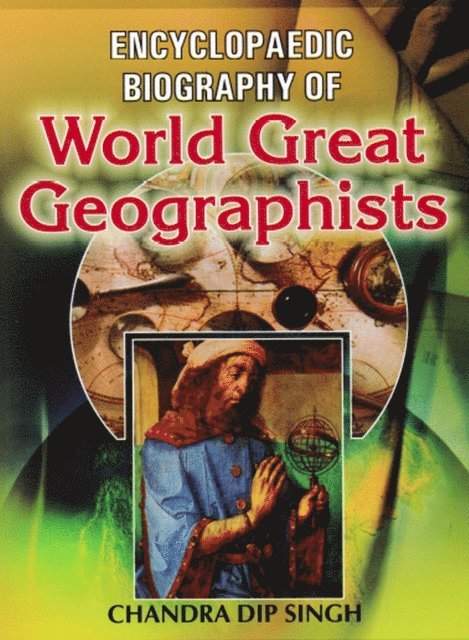
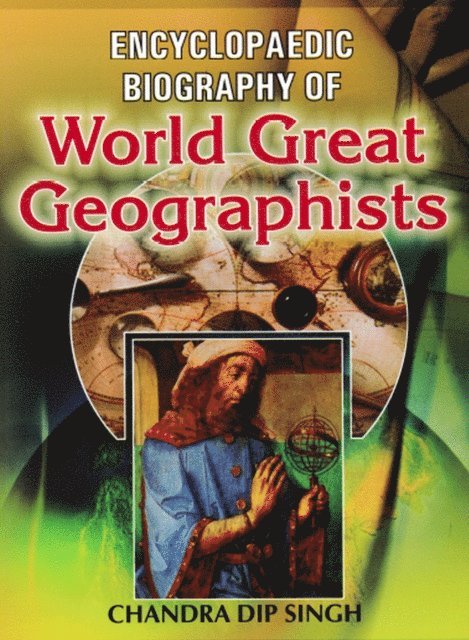
Geography is the study of the Earth and its lands, features, inhabitants, and phenomena. A literal translation would be "to describe or write about the Earth". The first person to use the word "geography" was Eratosthenes. Four historical traditions in geographical research are the spatial analysis of natural and human phenomena (geography as a study of distribution), area studies (places and regions), study of man-land relationship, and research in earth sciences. A geographist is a scientist whose area of study is geography, the study of Earth's physical environment and human habitat. Though geographists are historically known as people who make maps, map making is actually the field of study of cartography, a subset of geography. Geographists study not only the physical details of the environment but also its impact on human and wildlife ecologies, weather and climate patterns, economics, and culture. The book (in three volumes) contain the life and work of World Great Geographists.
4 294 kr
Läs direkt efter köp
Geography is the study of the Earth and its lands, features, inhabitants, and phenomena. A literal translation would be "to describe or write about the Earth". The first person to use the word "geography" was Eratosthenes. Four historical traditions in geographical research are the spatial analysis of natural and human phenomena (geography as a study of distribution), area studies (places and regions), study of man-land relationship, and research in earth sciences. A geographist is a scientist whose area of study is geography, the study of Earth's physical environment and human habitat. Though geographists are historically known as people who make maps, map making is actually the field of study of cartography, a subset of geography. Geographists study not only the physical details of the environment but also its impact on human and wildlife ecologies, weather and climate patterns, economics, and culture. The book (in three volumes) contain the life and work of World Great Geographists.
4 294 kr
Läs direkt efter köp
Geography is the study of the Earth and its lands, features, inhabitants, and phenomena. A literal translation would be "to describe or write about the Earth". The first person to use the word "geography" was Eratosthenes. Four historical traditions in geographical research are the spatial analysis of natural and human phenomena (geography as a study of distribution), area studies (places and regions), study of man-land relationship, and research in earth sciences. A geographist is a scientist whose area of study is geography, the study of Earth's physical environment and human habitat. Though geographists are historically known as people who make maps, map making is actually the field of study of cartography, a subset of geography. Geographists study not only the physical details of the environment but also its impact on human and wildlife ecologies, weather and climate patterns, economics, and culture. The book (in three volumes) contain the life and work of World Great Geographists.