Charlene Desir – författare
Visar alla böcker från författaren Charlene Desir. Handla med fri frakt och snabb leverans.
7 produkter
7 produkter
Häftad, Engelska, 2023
352 kr
Skickas inom 5-8 vardagar
Inbunden, Engelska, 2023
483 kr
Skickas inom 5-8 vardagar
E-bok
Engelska, 2023617 kr
Läs direkt efter köp
Vodou and Christianity in Interreligious Dialogue addresses both historical factors and ideological issues that created antagonism and conflict between Christians and Vodouists in Haiti. The book offers practical solutions and strategies to help create a harmonious and peaceful environment between religious practitioners associated with Vodou and Christianity. Toward this goal, this volume considers various perspectives and theories, such as autobiography, anthropology, ethnographic fieldwork, religious experience, and gender to examine the subject matter. This volume offers practical examples and resources on how to engage in interreligious dialogue and promote interreligious education in Haiti. There are three philosophical and practical ideas underlying this book project: (1) it is grounded on the belief that religion has value, and it could bring social goods to different communities and enhance human dignity and justice; (2) it is premised on the idea that dialogue and cooperation are necessary for nation-building and human development (as democratic ideals) and that one of the leading functions of the world''s religious traditions is to promote both cooperation and dialogue through mutual understanding and for the common good; and (3) that the power and public role of religion in society can be used as a major force of unification and peace-building among divergent factions and schools of thought, and to promote reconciliation, mutual respect, and friendship in the world.
Häftad, Engelska, 2015
594 kr
Skickas inom 5-8 vardagar
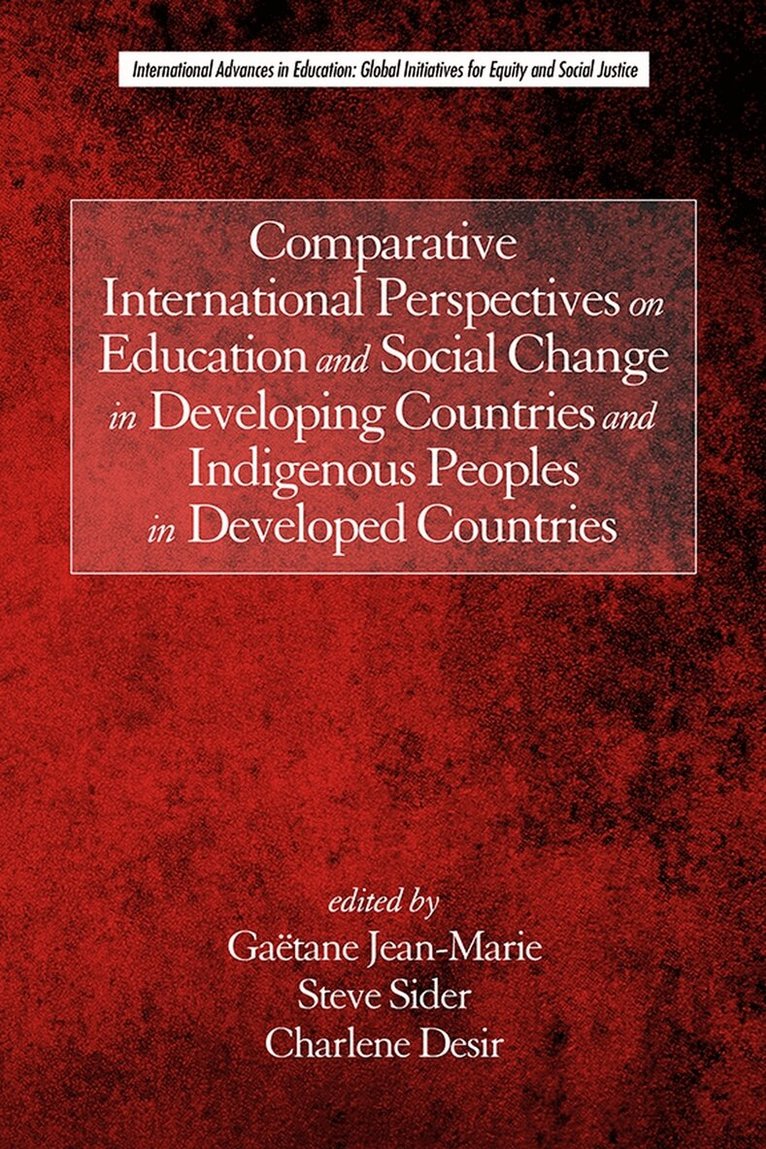
Democratizing educational access and building capacity in developing countries and amongst indigenous peoples in developed countries may be elusive but are hopeful goals. Many developing countries are striving to reengineer their incoherent education systems at a time when they are most vulnerable, particularly with susceptibility to natural disasters, political unrests, and economic instabilities (UNESCO, 2007). Similarly, indigenous peoples in developed countries are seeking more control over education as they consider the long-term effects of educational policies that have been forced on them.Research on education and social change in developing countries has a long history (Glewwe, 2002; Hanushek, 1995; Sider, 2011). However, there is limited research on educational capacity-building in developing countries such as Kenya, Honduras, Haiti, Ghana, Hong Kong, India, Peru, China, and Thailand. Further, the educational frameworks by which Indigenous peoples (Maori, Canada’s First Nations, and American Indian/Alaska Natives) have been educated have some significant similarities to those encountered in developing countries. The compilation of chapters illuminates research and collaborative initiatives between the authors and local leaders in developing countries’ and Indigenous peoples in developed countries’ efforts to solve the complexity of social inequities through educational access and quality learning. The authors draw on theoretical lens, knowledge bases, and strategies, and identify trends and developments to provide the scope of educational improvement in a globalization context (Brooks & Normore, 2010; Jean-Marie, Normore & Brooks, 2009).
Inbunden, Engelska, 2015
1 050 kr
Skickas inom 5-8 vardagar
Democratizing educational access and building capacity in developing countries and amongst indigenous peoples in developed countries may be elusive but are hopeful goals. Many developing countries are striving to reengineer their incoherent education systems at a time when they are most vulnerable, particularly with susceptibility to natural disasters, political unrests, and economic instabilities (UNESCO, 2007). Similarly, indigenous peoples in developed countries are seeking more control over education as they consider the long-term effects of educational policies that have been forced on them.Research on education and social change in developing countries has a long history (Glewwe, 2002; Hanushek, 1995; Sider, 2011). However, there is limited research on educational capacity-building in developing countries such as Kenya, Honduras, Haiti, Ghana, Hong Kong, India, Peru, China, and Thailand. Further, the educational frameworks by which Indigenous peoples (Maori, Canada’s First Nations, and American Indian/Alaska Natives) have been educated have some significant similarities to those encountered in developing countries. The compilation of chapters illuminates research and collaborative initiatives between the authors and local leaders in developing countries’ and Indigenous peoples in developed countries’ efforts to solve the complexity of social inequities through educational access and quality learning. The authors draw on theoretical lens, knowledge bases, and strategies, and identify trends and developments to provide the scope of educational improvement in a globalization context (Brooks & Normore, 2010; Jean-Marie, Normore & Brooks, 2009).
E-bok
Engelska, 2015418 kr
Läs direkt efter köp
Democratizing educational access and building capacity in developing countries and amongst indigenous peoples in developed countries may be elusive but are hopeful goals. Many developing countries are striving to reengineer their incoherent education systems at a time when they are most vulnerable, particularly with susceptibility to natural disasters, political unrests, and economic instabilities (UNESCO, 2007). Similarly, indigenous peoples in developed countries are seeking more control over education as they consider the long-term effects of educational policies that have been forced on them.Research on education and social change in developing countries has a long history (Glewwe, 2002; Hanushek, 1995; Sider, 2011). However, there is limited research on educational capacity-building in developing countries such as Kenya, Honduras, Haiti, Ghana, Hong Kong, India, Peru, China, and Thailand. Further, the educational frameworks by which Indigenous peoples (Maori, Canada's First Nations, and American Indian/Alaska Natives) have been educated have some significant similarities to those encountered in developing countries. The compilation of chapters illuminates research and collaborative initiatives between the authors and local leaders in developing countries' and Indigenous peoples in developed countries' efforts to solve the complexity of social inequities through educational access and quality learning. The authors draw on theoretical lens, knowledge bases, and strategies, and identify trends and developments to provide the scope of educational improvement in a globalization context (Brooks & Normore, 2010; Jean-Marie, Normore & Brooks, 2009).
E-bok
Engelska, 2015626 kr
Läs direkt efter köp
Democratizing educational access and building capacity in developing countries and amongst indigenous peoples in developed countries may be elusive but are hopeful goals. Many developing countries are striving to reengineer their incoherent education systems at a time when they are most vulnerable, particularly with susceptibility to natural disasters, political unrests, and economic instabilities (UNESCO, 2007). Similarly, indigenous peoples in developed countries are seeking more control over education as they consider the long-term effects of educational policies that have been forced on them.Research on education and social change in developing countries has a long history (Glewwe, 2002; Hanushek, 1995; Sider, 2011). However, there is limited research on educational capacity-building in developing countries such as Kenya, Honduras, Haiti, Ghana, Hong Kong, India, Peru, China, and Thailand. Further, the educational frameworks by which Indigenous peoples (Maori, Canada's First Nations, and American Indian/Alaska Natives) have been educated have some significant similarities to those encountered in developing countries. The compilation of chapters illuminates research and collaborative initiatives between the authors and local leaders in developing countries' and Indigenous peoples in developed countries' efforts to solve the complexity of social inequities through educational access and quality learning. The authors draw on theoretical lens, knowledge bases, and strategies, and identify trends and developments to provide the scope of educational improvement in a globalization context (Brooks & Normore, 2010; Jean-Marie, Normore & Brooks, 2009).