Charles F. Hockett – författare
Visar alla böcker från författaren Charles F. Hockett. Handla med fri frakt och snabb leverans.
6 produkter
6 produkter
Häftad, Engelska, 1987
393 kr
Skickas inom 5-8 vardagar
In the centenary year of Leonard Bloomfield's birth, this abridgment makes available a representative selection of the writings of this central figure in the history of linguistics. "Hockett has achieved his purpose—to reveal Bloomfield's way of working, the general principles that guided his work, and last, but by no means least, to indicate how Bloomfield's interests and attitudes changed with the passing years."—Harry Hoijer, Language
Häftad, Engelska, 1988
171 kr
Skickas inom 5-8 vardagar
(International Journal of American Linguistics, 21: 4, Part 1, Memoir 11)
Inbunden, Engelska, 1967
1 587 kr
Skickas inom 5-8 vardagar
No detailed description available for "Language, mathematics, and linguistics".
E-bok
PDF, Engelska, 20191 465 kr
Läs direkt efter köp
No detailed description available for "e;Language, mathematics, and linguistics"e;.
Inbunden, Engelska, 1970
1 601 kr
Skickas inom 5-8 vardagar
No detailed description available for "The State of the Art".
1 384 kr
Läs direkt efter köp
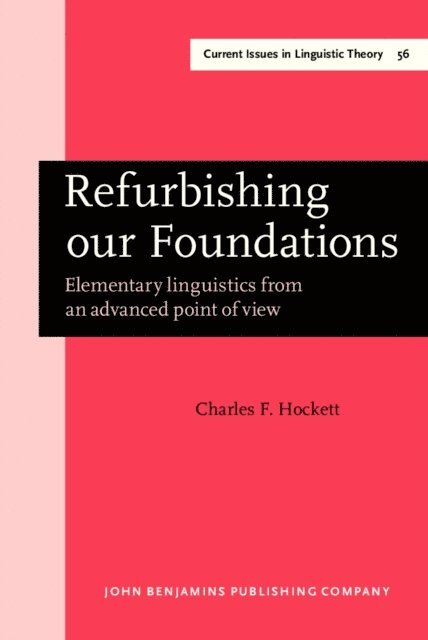
This essay challenges several patterns of thinking common in twentieth-century linguistics. The most pervasive of these is our habit of looking at language from the point of view of the speaker. When we take, instead, that of the hearer, matters fall into place in a new way. In syntax, we are led to examine the evidence available to hearers for interpreting what they hear, and this reveals both the true nature and the locus existendi of “deep structure”. Chomsky''s 1957 diagnosis of the then prevalent syntactic theory is upheld, though his proposed remedy is not. The principle of Gestalt perception yields a characterization of the word quite different from Bloomfield''s classic definition, lending support of new kind to Pike''s mid-century views of the relation between phonemics and grammar. In morphology, assuming the hearer''s standpoint forces the abondonment of the “atomic morpheme” that has prevailed in America since the post-Bloomfieldians, together with much of classical morphophonemics, and by a domino effect this in turn undermines much of generative phonology.