Charles R. Shipan – författare
Visar alla böcker från författaren . Handla med fri frakt och snabb leverans.
7 produkter
7 produkter
1 108 kr
Läs direkt efter köp
Members of Congress and interest groups fiercely struggle over the seemingly unimportant procedural details of legislation such as the provisions for judicial review. Charles R. Shipan, in a study based on a detailed consideration of congressional debates over communications legislation, argues that the actors realize that current procedural choices will structure future alternatives and thus are willing to expend considerable resources over these issues. Using a rational choice framework, Shipan argues that provisions for judicial review, such as the specification of which agency actions are reviewable and which courts have review authority, are among the issues over which interested parties struggle because these issues will significantly affect the outcome of important future court action. Shipan tests his theory in a detailed exploration of the development of communications legislation during the 1920s and 1930s. This is a rich period in which to study the importance of judicial review provisions, for, while most political actors accepted the courts as part of the regulatory process, the concept of assigning broad decision-making powers to agencies was new and controversial. In addition, regulation of radio was both an important issue and one fraught with uncertainty, thus inducing members of Congress and interest groups to attempt to plan ahead for future actions. Shipan examines the motivations, actions, and choices of both interest groups and members of Congress. He then looks at the impact of the choices made on later court action in the communications legislation. This book will appeal to political scientists and legal scholars interested in the politics of judicial review, the courts, legislative politics, and communication policy.
Häftad, Engelska, 2002
444 kr
Skickas inom 7-10 vardagar
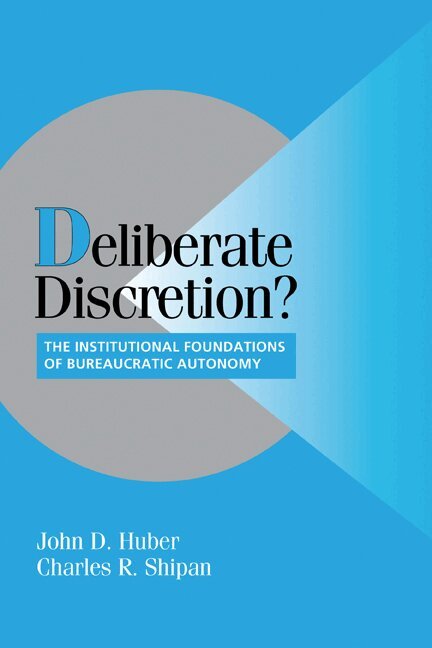
The laws that legislatures adopt provide the most important and definitive opportunity elected politicians have to define public policy. But the ways politicians use laws to shape policy varies considerably across polities. In some cases, legislatures adopt detailed and specific laws in efforts to micromanage policy-making processes. In others, they adopt general and vague laws that leave the executive and bureaucrats substantial autonomy to fill in the policy details. What explains these differences across political systems, and how do they matter? The authors address this issue by developing and testing a comparative theory of how laws shape bureaucratic autonomy. Drawing on a range of evidence from advanced parliamentary democracies and the American states, they argue that particular institutional forms have a systematic and predictable effect on how politicians use laws to shape the policy making process.
Inbunden, Engelska, 2002
1 143 kr
Skickas inom 7-10 vardagar
The laws that legislatures adopt provide the most important and definitive opportunity elected politicians have to define public policy. But the ways politicians use laws to shape policy varies considerably across polities. In some cases, legislatures adopt detailed and specific laws in efforts to micromanage policy-making processes. In others, they adopt general and vague laws that leave the executive and bureaucrats substantial autonomy to fill in the policy details. What explains these differences across political systems, and how do they matter? The authors address this issue by developing and testing a comparative theory of how laws shape bureaucratic autonomy. Drawing on a range of evidence from advanced parliamentary democracies and the American states, they argue that particular institutional forms have a systematic and predictable effect on how politicians use laws to shape the policy making process.
Inbunden, Engelska, 2021
747 kr
Skickas inom 7-10 vardagar
Building on a deep theoretical foundation and drawing on numerous examples, we examine how policies spread across the American states. We argue that for good policies to spread while bad policies are pushed aside, states must learn from one another. The three ingredients for this positive outcome are observable experiments, time to learn, and favorable incentives and expertise among policymakers. Although these ingredients are sometimes plentiful, we also note causes for concern, such as when policies are complex or incompatible with current practices, when policymakers give in to underlying political biases, or when political institutions lack the capacity for cultivating expertise. Under such conditions, states may rely on competition, imitation, and coercion, rather than learning, which can allow bad policies, rather than good ones, to spread. We conclude with lessons for reformers and policymakers and an assessment of our overall argument based on state responses to the COVID-19 pandemic.
Häftad, Engelska, 2021
239 kr
Skickas inom 7-10 vardagar
Building on a deep theoretical foundation and drawing on numerous examples, we examine how policies spread across the American states. We argue that for good policies to spread while bad policies are pushed aside, states must learn from one another. The three ingredients for this positive outcome are observable experiments, time to learn, and favorable incentives and expertise among policymakers. Although these ingredients are sometimes plentiful, we also note causes for concern, such as when policies are complex or incompatible with current practices, when policymakers give in to underlying political biases, or when political institutions lack the capacity for cultivating expertise. Under such conditions, states may rely on competition, imitation, and coercion, rather than learning, which can allow bad policies, rather than good ones, to spread. We conclude with lessons for reformers and policymakers and an assessment of our overall argument based on state responses to the COVID-19 pandemic.
E-bok
Engelska, 2021285 kr
Läs direkt efter köp
Building on a deep theoretical foundation and drawing on numerous examples, we examine how policies spread across the American states. We argue that for good policies to spread while bad policies are pushed aside, states must learn from one another. The three ingredients for this positive outcome are observable experiments, time to learn, and favorable incentives and expertise among policymakers. Although these ingredients are sometimes plentiful, we also note causes for concern, such as when policies are complex or incompatible with current practices, when policymakers give in to underlying political biases, or when political institutions lack the capacity for cultivating expertise. Under such conditions, states may rely on competition, imitation, and coercion, rather than learning, which can allow bad policies, rather than good ones, to spread. We conclude with lessons for reformers and policymakers and an assessment of our overall argument based on state responses to the COVID-19 pandemic.
E-bok
PDF, Engelska, 2021275 kr
Läs direkt efter köp
Building on a deep theoretical foundation and drawing on numerous examples, we examine how policies spread across the American states. We argue that for good policies to spread while bad policies are pushed aside, states must learn from one another. The three ingredients for this positive outcome are observable experiments, time to learn, and favorable incentives and expertise among policymakers. Although these ingredients are sometimes plentiful, we also note causes for concern, such as when policies are complex or incompatible with current practices, when policymakers give in to underlying political biases, or when political institutions lack the capacity for cultivating expertise. Under such conditions, states may rely on competition, imitation, and coercion, rather than learning, which can allow bad policies, rather than good ones, to spread. We conclude with lessons for reformers and policymakers and an assessment of our overall argument based on state responses to the COVID-19 pandemic.