Christian Breitsamter – författare
4 305 kr
Läs direkt efter köp
New Results in Numerical and Experimental Fluid Mechanics X
Contributions to the 19th STAB/DGLR Symposium Munich, Germany, 2014
3 231 kr
Skickas inom 10-15 vardagar
3 809 kr
Läs direkt efter köp
This book presents contributions tothe 19th biannual symposium of the German Aerospace Aerodynamics Association(STAB) and the German Society for Aeronautics and Astronautics (DGLR). Theindividual chapters reflect ongoing research conducted by the STAB members inthe field of numerical and experimental fluid mechanics and aerodynamics,mainly for (but not limited to) aerospace applications, and cover bothnationally and EC-funded projects. Special emphasis is given to collaborativeresearch projects conducted by German scientists and engineers fromuniversities, research-establishments and industries. By addressing a number ofcutting-edge applications, together with the relevant physical and mathematicsfundamentals, the book provides readers with a comprehensive overview of thecurrent research work in the field. Though the book’s primary emphasis is onthe aerospace context, it also addresses further important applications, e.g.in ground transportation and energy.
New Results in Numerical and Experimental Fluid Mechanics X
Contributions to the 19th STAB/DGLR Symposium Munich, Germany, 2014
3 231 kr
Skickas inom 10-15 vardagar
New Results in Numerical and Experimental Fluid Mechanics IV
Contributions to the 13th STAB/DGLR Symposium Munich, Germany 2002
2 156 kr
Skickas inom 10-15 vardagar
2 741 kr
Läs direkt efter köp
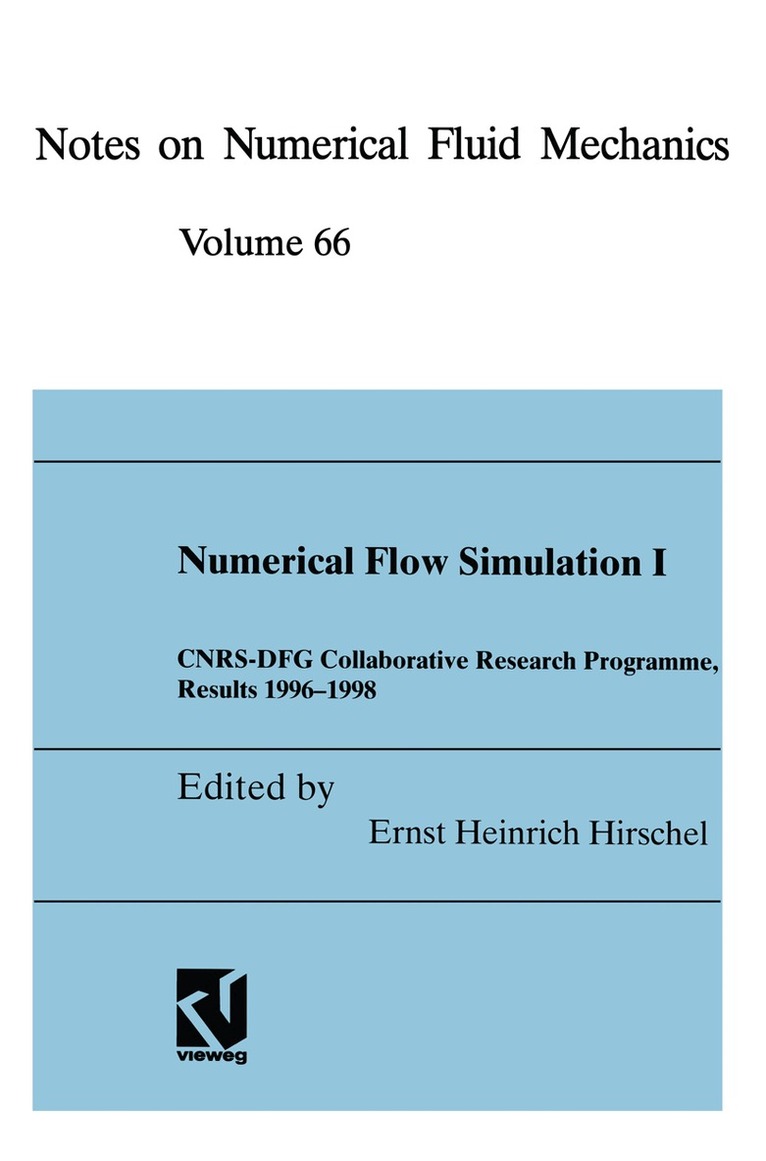
Numerical Flow Simulation I
CNRS-DFG Collaborative Research Programme, Results 1996–1998
1 619 kr
Skickas inom 10-15 vardagar
1 977 kr
Läs direkt efter köp
New Results in Numerical and Experimental Fluid Mechanics IV
Contributions to the 13th STAB/DGLR Symposium Munich, Germany 2002
2 156 kr
Skickas inom 10-15 vardagar
Numerical Flow Simulation I
CNRS-DFG Collaborative Research Programme, Results 1996–1998
1 619 kr
Skickas inom 10-15 vardagar
1 941 kr
Skickas inom 10-15 vardagar
2 435 kr
Läs direkt efter köp
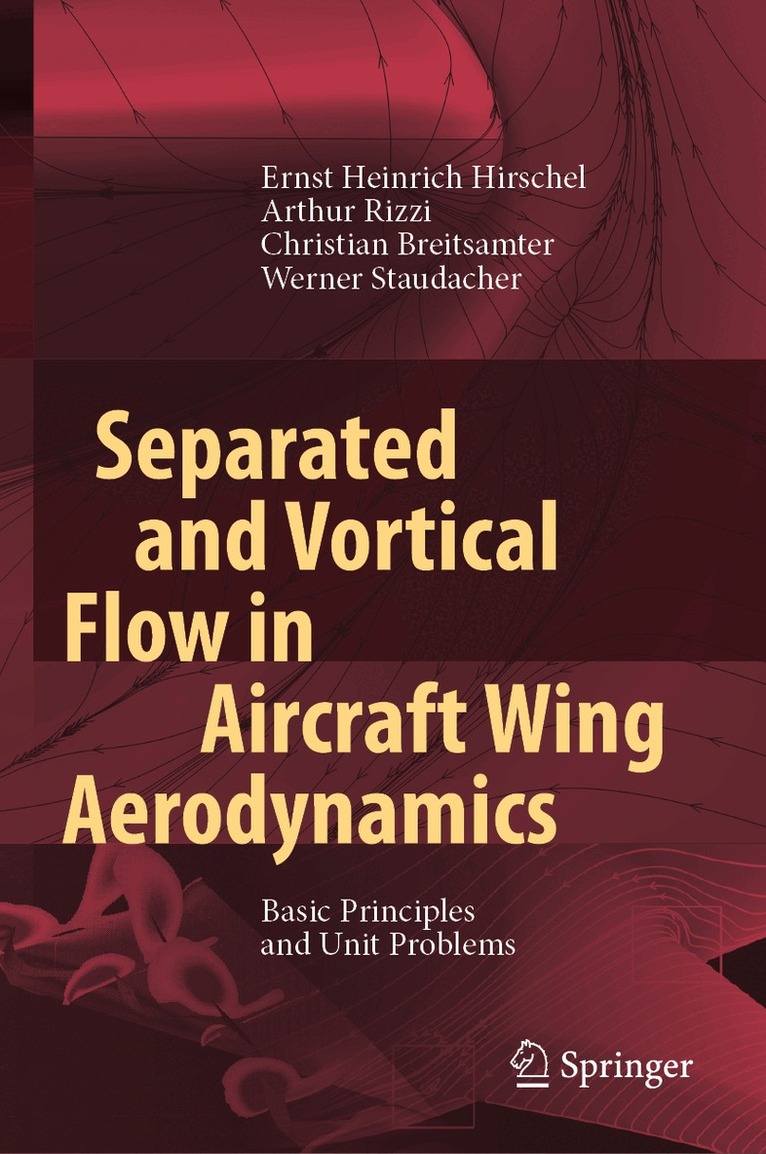
Fluid mechanical aspects of separated and vortical flow in aircraft wing aerodynamics are treated. The focus is on two wing classes: (1) large aspect-ratio wings and (2) small aspect-ratio delta-type wings. Aerodynamic design issues in general are not dealt with.
Discrete numerical simulation methods play a progressively larger role in aircraft design and development. Accordingly, in the introduction to the book the different mathematical models are considered, which underlie the aerodynamic computation methods (panel methods, RANS and scale-resolving methods). Special methods are the Euler methods, which as rather inexpensive methods embrace compressibility effects and also permit to describe lifting-wing flow.
The concept of the kinematically active and inactive vorticity content of shear layers gives insight into many flow phenomena, but also, with the second break of symmetry---the first one is due to the Kutta condition---an explanation of lifting-wing flow fields. The prerequisite is an extended definition of separation: “flow-off separation” at sharp trailing edges of class (1) wings and at sharp leading edges of class (2) wings. The vorticity-content concept, with a compatibility condition for flow-off separation at sharp edges, permits to understand the properties of the evolving trailing vortex layer and the resulting pair of trailing vortices of class (1) wings. The concept also shows that Euler methods at sharp delta or strake leading edges of class (2) wings can give reliable results.Three main topics are treated:
1) Basic Principles are considered first: boundary-layer flow, vortex theory, the vorticity content of shear layers, Euler solutions for lifting wings, the Kutta condition in reality and the topology of skin-friction and velocity fields.
2) Unit Problems treat isolated flow phenomena of the two wing classes. Capabilities of panel and Euler methods are investigated. One Unit Problem is the flow past the wing of the NASA Common Research Model. Other Unit Problems concern the lee-side vortex system appearing at the Vortex-Flow Experiment 1 and 2 sharp- and blunt-edged delta configurations, at a delta wing with partly round leading edges, and also at the Blunt Delta Wing at hypersonic speed.
3) Selected Flow Problems of the two wing classes. In short sections practical design problems are discussed. The treatment of flow past fuselages, although desirable, was not possible in the frame of this book.