Christian Hafner – författare
Visar alla böcker från författaren Christian Hafner. Handla med fri frakt och snabb leverans.
7 produkter
7 produkter
Inbunden, Engelska, 1999
2 741 kr
Skickas inom 5-8 vardagar
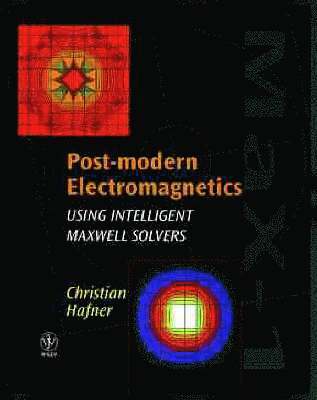
Presenting innovative, promising and unconventional techniques, Post-modern Electromagnetics outlines the essential tools for the creation of numerical methods. Hafner offers a comparative analysis of the fundamental computational electromagnetics methods and proposes future adaptive strategies. Complementary to Max-1: A Visual Electromagnetics Platform, this unique text challenges current thinking and provides guidance through the solution of practical problems. Features Include:* Outline of Maxwell theory from simple material properties to complex media and wave equations * Discussion of intelligent optimization strategies such as genetic algorithms designed to improve the performance of existing techniques * Applications section demonstrating solutions in statics, scattering, gratings, antenna, antenna arrays, guided waves, resonators, coupling and waveguide discontinuities * Explanation of the background to numerical methods showing how the various approaches to computational electromagnetics can be generalized and combinedStudents and researchers interested in advanced numerical approaches and design engineers developing new codes for computational electromagnetics will benefit from this exploration of creative electromagnetics solutions.
Inbunden, Engelska, 1990
1 787 kr
Skickas inom 5-8 vardagar
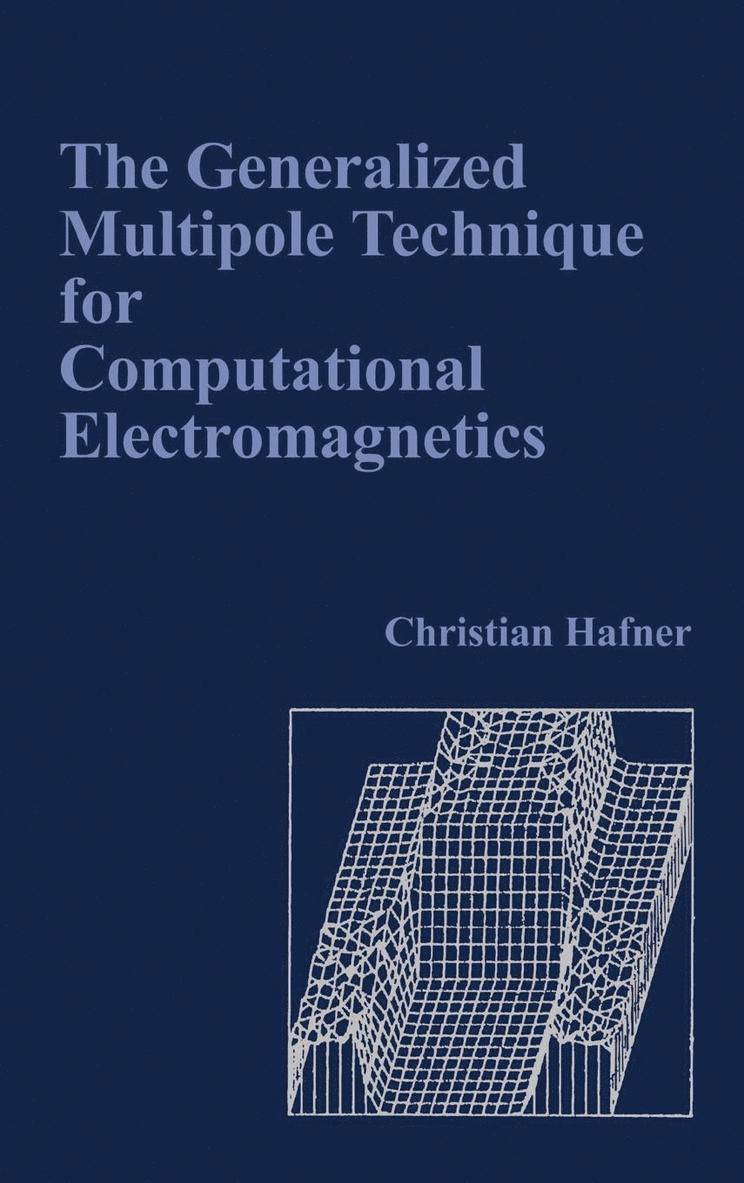
Beginning with a detailed comparison of "traditional" methods of EM field analysis, this text leads up to a step-by-step explication of the Generalized Multiple Technique (GMT).
Häftad, Tyska, 1987
559 kr
Skickas inom 10-15 vardagar
E-bok
PDF, Engelska, 2010480 kr
Läs direkt efter köp
Diploma Thesis from the year 2008 in the subject Computer Science - Commercial Information Technology, grade: 1,0, TU Bergakademie Freiberg, language: English, abstract: Changing industry structures and altering rules of competition is why most companies today face a new challenge in creating a competitive advantage. The meaning of Information Technology (IT) has changed from just being available to accelerating and facilitating processes to an integral part of the company's mission and strategy. IT governance is what defines the holistic perspective of how to deal with and use IT, especially in large companies. The objective is to create advantages by aligning IT and corporate strategy in order to create value while minimizing risk and monitoring the performance of IT. Many different frameworks and standards have emerged over the last years, providing processes and control objectives for keeping the company s IT in a value-adding track. However, an important issue seems to be the huge availability of various frameworks. This mostly results in problems concerning the right decision on frameworks to be selected. Implementing efficient IT governance requires using only those processes that cover the individual IT-related issues and problems of a company best, while ignoring unnecessary ones. The use of frameworks is associated with costs and may quickly result in an inefficient use of IT governance. The present thesis addresses this challenge and shall help IT decision makers to decide on an efficient framework or set of frameworks. In order to do so, a model analyzes the fit between discovered IT-related problems and various existing publicly available frameworks. Different surveys and market analyses will be used for identifying possible IT-related problems. The creation of problem-clusters will help to determine the most efficient framework by measuring the coverage of processes by different frameworks. As a result, this thesis will provide an approach to avoid processes that may not be necessary while covering important ones for an efficient use of IT governance frameworks.
E-bok
PDF, Tyska, 2013586 kr
Läs direkt efter köp
E-bok
PDF, Engelska, 2013712 kr
Läs direkt efter köp
Häftad, Engelska, 1997
560 kr
Skickas inom 10-15 vardagar
The present book was accepted as a dissertation at the Humboldt Universitat zu Berlin in summer 1996. I am very much obliged to thank my advisor, Professor Wolfgang Hardie, for the continuous, always inspiring support and for opening me the world of non parametric statistics. Without him I probably would have worked on a different, less exciting topic and this book would not exist. Also, I would like to thank my second advisor, Professor Helmut Liitkepohl, for his excellent introduction to time series analysis and for always helpful comments on my work. This work was financially supported by the Deutsche Forschungsgemein- schaft, in the first stage while I was a member of the Graduiertenkolleg "Ap- plied Microeconomics", and later when I came to the Sonderforschungsbereich 373. For an interestingly widespread academic surrounding I want to thank the members of the Graduiertenkolleg and the Sonderforschungsbereich, es- pecially Stefan Sperlich and Axel Werwatz. For the use of XploRe and many other issues I received substantial help from my colleagues Sigbert Klinke, Thomas Kotter, Marlene Miiller and Swetlana Schmelzer.Concerning many central topics of this dissertation, helpful and improving comments were given by Jorg Breitung, Helmut Herwartz, RolfTschernig and Lijian Yang, who also revised most parts of the manuscript. I have much reason to thank them for their help. Of course, all remaining errors are mine. Berlin, July 1997 CHRISTIAN M 0 HAFNER Contents Preface ...IX List of Tables .