Christian Theres – författare
Visar alla böcker från författaren Christian Theres. Handla med fri frakt och snabb leverans.
2 produkter
2 produkter
Häftad, Engelska, 2021
1 124 kr
Skickas inom 10-15 vardagar
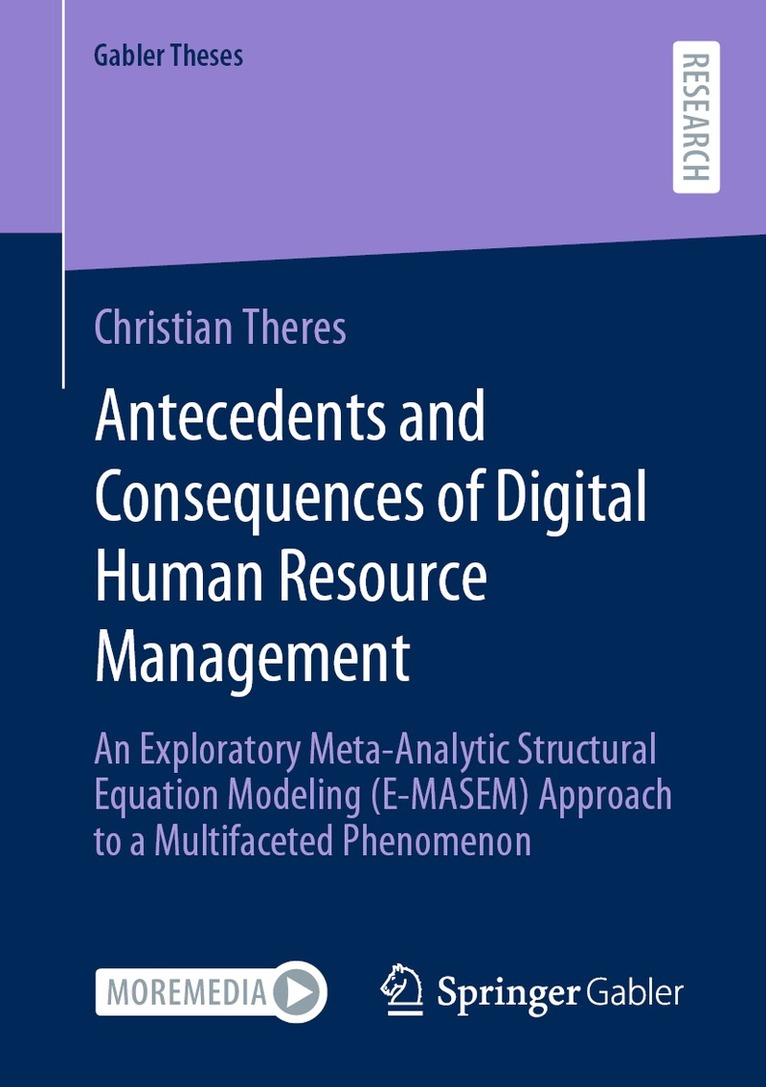
During the last decades, a considerable amount of research has been directed towards explaining the concept of Digital Human Resource Management (DHRM). Yet, a holistic assessment of DHRM antecedents and consequences with respect to possible contextual contingencies is still missing. To this end, this thesis introduces a research framework illuminating the multifaceted phenomenon of DHRM from various perspectives. An exploratory four-step meta-analytic structural equation modelling (E-MASEM) approach tailored to address the domain-specific challenges of DHRM is introduced and applied. Results identify 32 constructs associated with the DHRM usage phenomenon which are categorized into DHRM antecedents and DHRM consequences. Findings reveal that user perceptions, expectations, attitudes, and intentions are essential in predicting DHRM usage while HRM service quality and user satisfaction are found crucial in explaining other DHRM consequences. Further, practitioners are informed about therelative importance of factors for both facilitating DHRM adoption and measuring DHRM success. Lastly, this thesis also contributes to the MASEM methodology by outlining a new approach to summarize statistical inferences from multiple moderator tests.
E-bok
Engelska, 20211 408 kr
Läs direkt efter köp
During the last decades, a considerable amount of research has been directed towards explaining the concept of Digital Human Resource Management (DHRM). Yet, a holistic assessment of DHRM antecedents and consequences with respect to possible contextual contingencies is still missing. To this end, this thesis introduces a research framework illuminating the multifaceted phenomenon of DHRM from various perspectives. An exploratory four-step meta-analytic structural equation modelling (E-MASEM) approach tailored to address the domain-specific challenges of DHRM is introduced and applied. Results identify 32 constructs associated with the DHRM usage phenomenon which are categorized into DHRM antecedents and DHRM consequences. Findings reveal that user perceptions, expectations, attitudes, and intentions are essential in predicting DHRM usage while HRM service quality and user satisfaction are found crucial in explaining other DHRM consequences. Further, practitioners are informed about therelative importance of factors for both facilitating DHRM adoption and measuring DHRM success. Lastly, this thesis also contributes to the MASEM methodology by outlining a new approach to summarize statistical inferences from multiple moderator tests.