
Christopher Hemmer – författare
Visar alla böcker från författaren . Handla med fri frakt och snabb leverans.
3 produkter
3 produkter
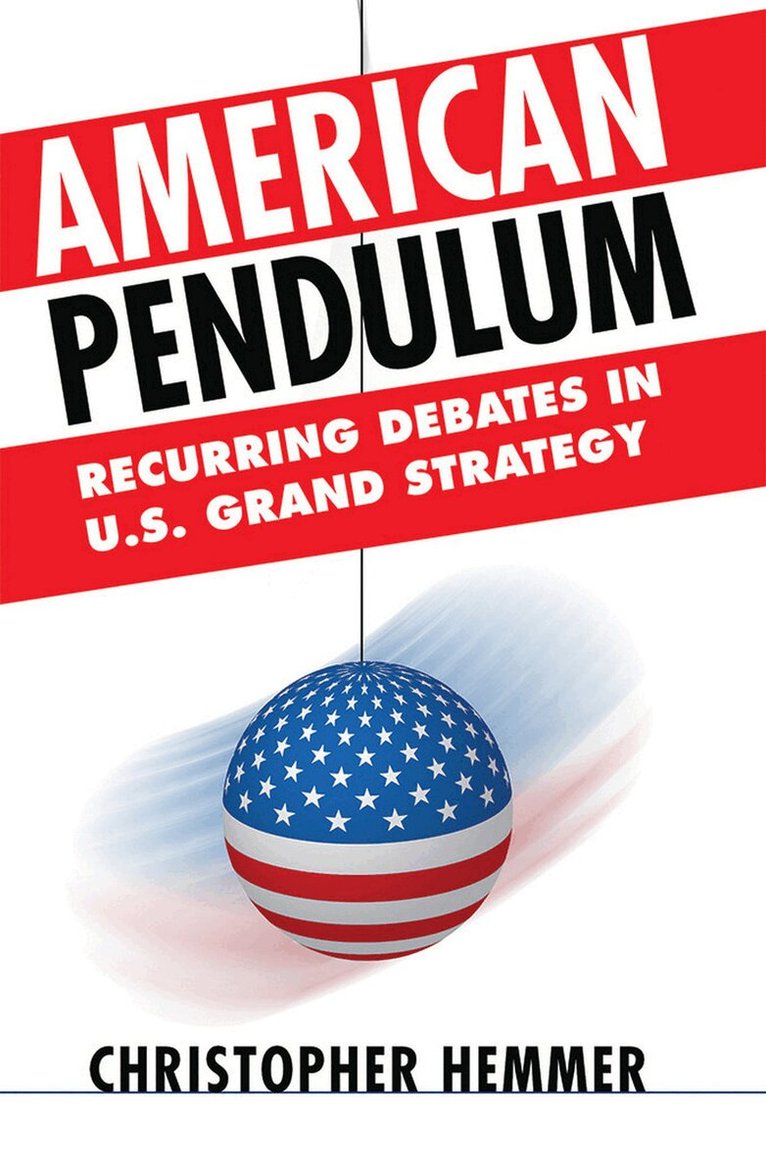
Inbunden, Engelska, 2015
346 kr
Skickas inom 3-6 vardagar
As new presidential administrations come into power, they each bring their own approach to foreign policy. No grand strategy, however, is going to be completely novel. New administrations never start with a blank slate, so it is always possible to see similarities between an administration and its predecessors. Conversely, since each administration faces novel problems and operates in a unique context, no foreign policy strategy is going to be an exact replica of its predecessors.In American Pendulum, Christopher Hemmer examines America's grand strategic choices between 1914 and 2014 using four recurring debates in American foreign policy as lenses. First, how should the United States balance the trade-offs between working alone versus working with other states and international organizations? Second, what is the proper place of American values in foreign policy? Third, where does the strategic perimeter of the United States lie? And fourth, is time on the side of the United States or of its enemies?Offering new readings of debates within the Wilson, Truman, Nixon, Bush, and Obama administrations, Hemmer asserts that heated debates, disagreements, and even confusions over U.S. grand strategy are not only normal but also beneficial. He challenges the claim that uncertainties or inconsistences about the nation's role in the world or approach to security issues betray strategic confusion or the absence of a grand strategy. American foreign policy, he states, is most in danger not when debates are at their most pointed but when the weight of opinion crushes dissent.As the United States looks ahead to an increasingly multipolar world with increasing complicated security issues, Hemmer concludes, developing an effective grand strategy requires ongoing contestation and compromises between competing visions and policies.
Inbunden, Engelska, 2000
1 079 kr
Tillfälligt slut
Christopher Hemmer offers a model for how U.S. decision makers use the lessons of history to diagnose and make policy choices.As policy makers turn to the lessons of history, to which lessons will they turn? This book offers a model of the analogical reasoning process that helps answer the important question of why some historical analogies are seen as relevant for later decisions, while others are ignored. It explores the previously neglected possibility that analogies can do more than simply advance the pre-existing interests of decision makers, but can also determine the very interests policy makers seek to further. The usefulness of this approach in impacting the lessons of history is demonstrated by examining American policy toward Iran concerning American hostages from 1979 to 1987, detailing both the Carter administration's policy during the Hostage Crisis and the Reagan administration's policy that resulted in the Iran-Contra Affair.
Häftad, Engelska, 2000
389 kr
Tillfälligt slut
Christopher Hemmer offers a model for how U.S. decision makers use the lessons of history to diagnose and make policy choices.As policy makers turn to the lessons of history, to which lessons will they turn? This book offers a model of the analogical reasoning process that helps answer the important question of why some historical analogies are seen as relevant for later decisions, while others are ignored. It explores the previously neglected possibility that analogies can do more than simply advance the pre-existing interests of decision makers, but can also determine the very interests policy makers seek to further. The usefulness of this approach in impacting the lessons of history is demonstrated by examining American policy toward Iran concerning American hostages from 1979 to 1987, detailing both the Carter administration's policy during the Hostage Crisis and the Reagan administration's policy that resulted in the Iran-Contra Affair.