Claudio Conti – författare
Visar alla böcker från författaren Claudio Conti. Handla med fri frakt och snabb leverans.
4 produkter
4 produkter
Inbunden, Engelska, 2026
714 kr
Kommande
Driven by advances in data science and machine learning, photonics has evolved rapidly in recent years and has transformed into a highly interdisciplinary field, connecting fundamental research with cutting-edge applications. Inspired by recent Nobel Prizes in Physics in 2021 and 2024, Conti highlights the interplay between photonics and spin glasses, a key concept for understanding the link between photon propagation and complex systems. Beginning with a study of black-body radiation, the book then revisits laser theory using techniques from non-equilibrium statistical mechanics. Through a step-by-step exploration of important photonic experiments, it bridges foundational concepts and advances in optical computing, with a focus on developing efficient hardware for classical and quantum artificial intelligence. This reveals the profound ties between complexity, photonics, and the future of AI technologies. The book will be a valuable resource for advanced undergraduate and graduate students and more practised researchers.
Inbunden, Engelska, 2024
1 416 kr
Skickas inom 10-15 vardagar
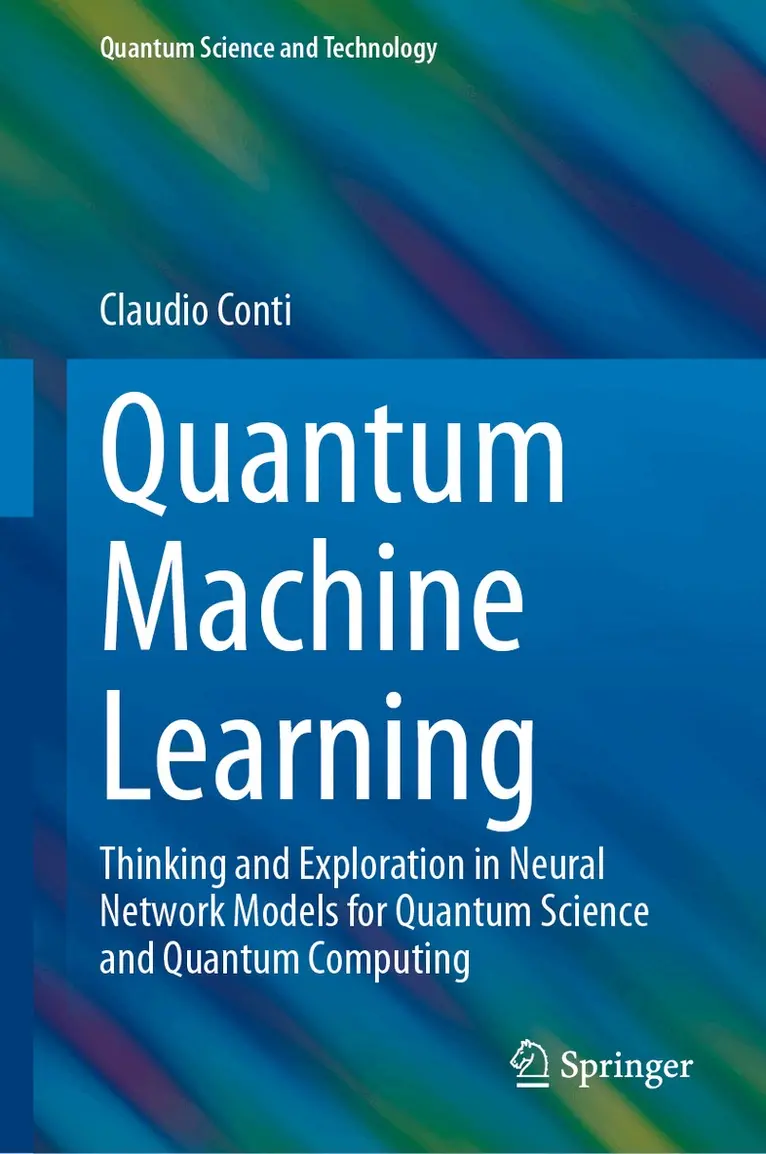
This book presents a new way of thinking about quantum mechanics and machine learning by merging the two. Quantum mechanics and machine learning may seem theoretically disparate, but their link becomes clear through the density matrix operator which can be readily approximated by neural network models, permitting a formulation of quantum physics in which physical observables can be computed via neural networks. As well as demonstrating the natural affinity of quantum physics and machine learning, this viewpoint opens rich possibilities in terms of computation, efficient hardware, and scalability. One can also obtain trainable models to optimize applications and fine-tune theories, such as approximation of the ground state in many body systems, and boosting quantum circuits’ performance. The book begins with the introduction of programming tools and basic concepts of machine learning, with necessary background material from quantum mechanics and quantum information also provided. This enables the basic building blocks, neural network models for vacuum states, to be introduced. The highlights that follow include: non-classical state representations, with squeezers and beam splitters used to implement the primary layers for quantum computing; boson sampling with neural network models; an overview of available quantum computing platforms, their models, and their programming; and neural network models as a variational ansatz for many-body Hamiltonian ground states with applications to Ising machines and solitons. The book emphasizes coding, with many open source examples in Python and TensorFlow, while MATLAB and Mathematica routines clarify and validate proofs. This book is essential reading for graduate students and researchers who want to develop both the requisite physics and coding knowledge to understand the rich interplay of quantum mechanics and machine learning.
E-bok
Engelska, 20231 672 kr
Läs direkt efter köp
This book presents a new way of thinking about quantum mechanics and machine learning by merging the two. Quantum mechanics and machine learning may seem theoretically disparate, but their link becomes clear through the density matrix operator which can be readily approximated by neural network models, permitting a formulation of quantum physics in which physical observables can be computed via neural networks. As well as demonstrating the natural affinity of quantum physics and machine learning, this viewpoint opens rich possibilities in terms of computation, efficient hardware, and scalability. One can also obtain trainable models to optimize applications and fine-tune theories, such as approximation of the ground state in many body systems, and boosting quantum circuits’ performance. The book begins with the introduction of programming tools and basic concepts of machine learning, with necessary background material from quantum mechanics and quantum information also provided. This enables the basic building blocks, neural network models for vacuum states, to be introduced. The highlights that follow include: non-classical state representations, with squeezers and beam splitters used to implement the primary layers for quantum computing; boson sampling with neural network models; an overview of available quantum computing platforms, their models, and their programming; and neural network models as a variational ansatz for many-body Hamiltonian ground states with applications to Ising machines and solitons. The book emphasizes coding, with many open source examples in Python and TensorFlow, while MATLAB and Mathematica routines clarify and validate proofs. This book is essential reading for graduate students and researchers who want to develop both the requisite physics and coding knowledge to understand the rich interplay of quantum mechanics and machine learning.
Häftad, Engelska, 2025
1 416 kr
Skickas inom 10-15 vardagar
This book presents a new way of thinking about quantum mechanics and machine learning by merging the two. Quantum mechanics and machine learning may seem theoretically disparate, but their link becomes clear through the density matrix operator which can be readily approximated by neural network models, permitting a formulation of quantum physics in which physical observables can be computed via neural networks. As well as demonstrating the natural affinity of quantum physics and machine learning, this viewpoint opens rich possibilities in terms of computation, efficient hardware, and scalability. One can also obtain trainable models to optimize applications and fine-tune theories, such as approximation of the ground state in many body systems, and boosting quantum circuits’ performance. The book begins with the introduction of programming tools and basic concepts of machine learning, with necessary background material from quantum mechanics and quantum information also provided. This enables the basic building blocks, neural network models for vacuum states, to be introduced. The highlights that follow include: non-classical state representations, with squeezers and beam splitters used to implement the primary layers for quantum computing; boson sampling with neural network models; an overview of available quantum computing platforms, their models, and their programming; and neural network models as a variational ansatz for many-body Hamiltonian ground states with applications to Ising machines and solitons. The book emphasizes coding, with many open source examples in Python and TensorFlow, while MATLAB and Mathematica routines clarify and validate proofs. This book is essential reading for graduate students and researchers who want to develop both the requisite physics and coding knowledge to understand the rich interplay of quantum mechanics and machine learning.